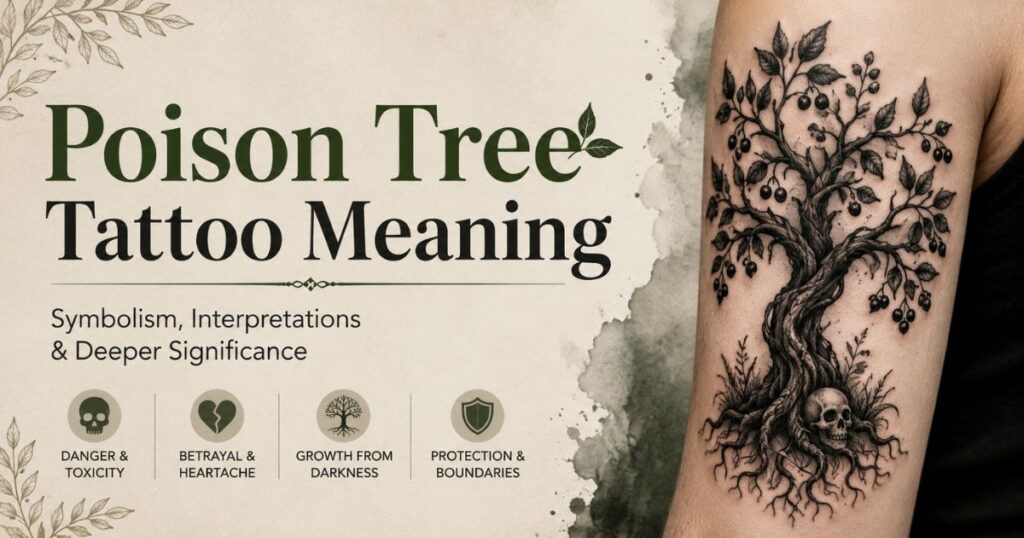
A poison tree tattoo is dark, twisted, and deliberately unsettling cracked bark, bare branches, glowing fruit. It’s inspired by one of literature’s most quoted poems about hidden anger. Here’s the real poison tree tattoo meaning, its origins, symbolism, and best design ideas.
The Origins: William Blake’s “A Poison Tree” (1794)
The poison tree tattoo traces directly back to English poet William Blake, who published A Poison Tree in 1794 as part of his collection Songs of Experience.
The poem tells a short, sixteen-line story:
- The speaker gets angry at a friend he says so, and the anger disappears.
- The speaker gets angry at a foe he says nothing to, and the anger stays.
- He “waters” that hidden anger with fears and fake smiles.
- The anger grows into a tree that eventually bears a shiny, poisoned apple.
- The enemy sneaks in, eats the apple, and dies.
- The speaker wakes up “glad” to see his foe lying dead beneath the tree.
Blake wasn’t celebrating revenge. He was exposing what happens psychologically when resentment is bottled up instead of expressed. The poem became a lasting metaphor for suppressed rage, and centuries later, that same metaphor found a new home on human skin.
Poison Tree Tattoo Meaning: Core Symbolism
At its core, the poison tree tattoo represents emotions that grow in silence. It’s a visual reminder that what we refuse to say out loud doesn’t vanish, it takes root.
Common symbolic themes include:
| Symbol Element | Meaning |
| Twisted or cracked bark | Inner turmoil, hidden pain |
| Bare or thorny branches | Isolation, emotional walls |
| Glowing or dripping apple/fruit | Temptation, the “reward” of unresolved anger |
| Roots digging deep | How resentment embeds itself over time |
| A single bloom on decaying bark | Hope, healing, or growth after pain |
Most people who choose this tattoo aren’t glorifying anger, they’re marking the lesson they learned from it. The design becomes a permanent note-to-self: speak up before silence turns toxic.
Poison Tree Tattoo Meaning for Girl
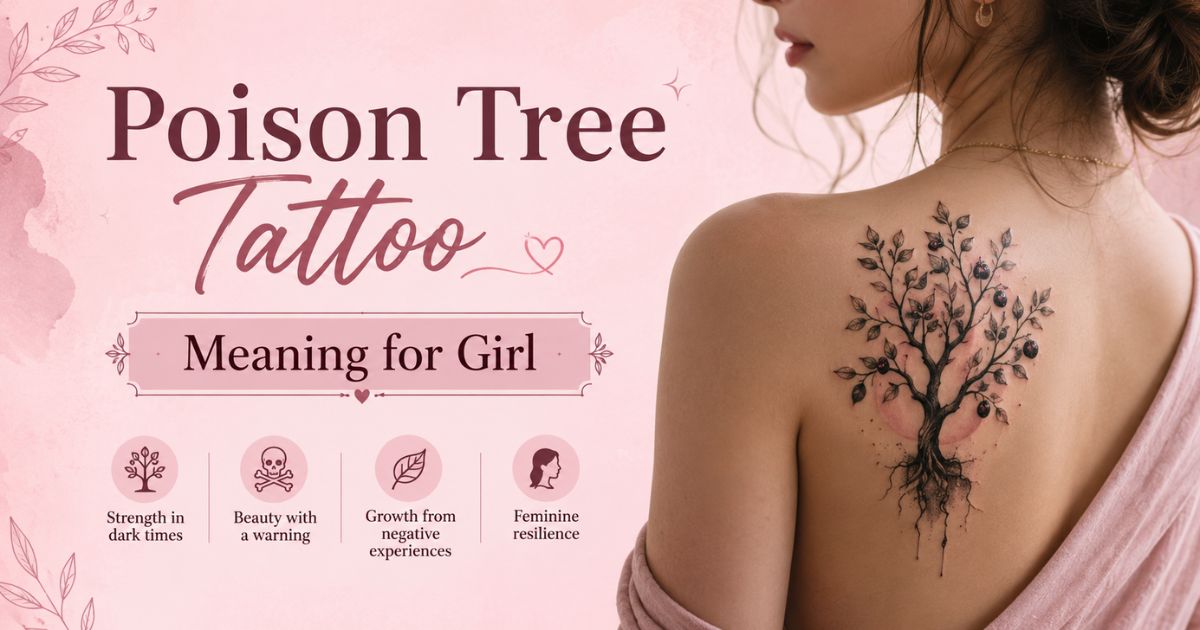
For many women, the poison tree tattoo takes on a slightly different emotional layer. It’s often chosen to represent:
- Recovering from a toxic relationship or betrayal
- Reclaiming personal power after staying silent for too long
- Emotional resilience surviving something poisonous and still standing
Feminine interpretations of the design often soften the harshness with delicate linework, floral accents, or watercolor shading, turning a “dark” symbol into something that also feels like quiet strength.
Who Gets a Poison Tree Tattoo and Why
This isn’t a random trend tattoo. People who choose it usually have a specific reason, such as:
- Surviving a toxic relationship with a partner, friend, or family member who caused lasting emotional damage.
- Processing anger in a healthier way using the tattoo as a permanent reminder to communicate instead of suppress.
- Literary appreciation fans of William Blake’s poetry who want a piece of art rooted in classic literature.
- Marking personal transformation turning a painful chapter into something meaningful and visible.
- Aesthetic pull toward dark, gothic art some are drawn purely to the moody, unconventional visual style.
Whatever the reason, this tattoo tends to attract people who value symbolism over trend. It’s chosen for meaning first, looks second.
Popular Design Variations

Because the poem itself is open to interpretation, tattoo artists have created many visual styles around it. Some of the most requested versions include:
- Gothic blackwork tree heavy shading, sharp branches, high contrast
- Skeletal or hand-shaped branches branches that curve into fingers or claws
- Split apple design one half healthy, one half rotten, symbolizing internal conflict
- Minimalist line-art tree a single continuous line, subtle and understated
- Tree with a single glowing fruit focuses attention on the “poison” at the center
- Realistic dead tree rendered like a photograph, often in black-and-grey realism
Poison Tree Tattoo Meaning: Mental Health
Beyond literature, this tattoo has become popular within the mental health community as a symbol of emotional awareness. It’s often used to represent:
- The danger of bottling up feelings instead of processing them
- A personal reminder to practice honest communication
- Surviving depression, anxiety, or emotional burnout caused by unspoken pain
- A milestone marking therapy, healing, or self-reflection
For many wearers, the tattoo isn’t about staying angry, it’s about remembering what happens when anger isn’t dealt with, and choosing a healthier path forward.
Poison Tree Tattoo Meaning X
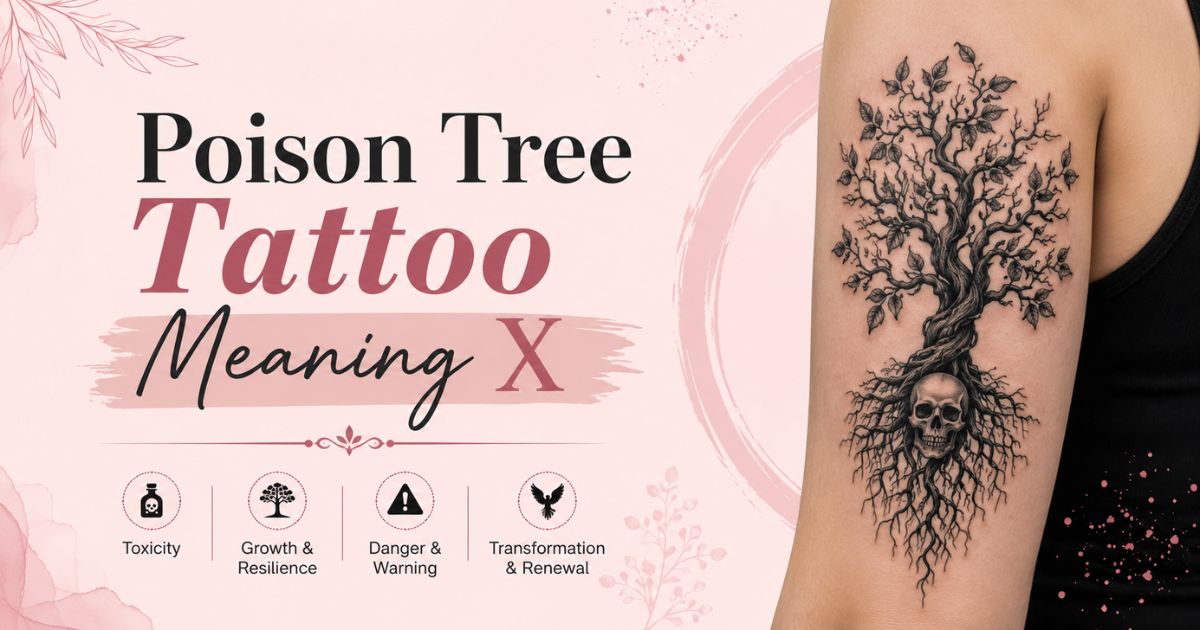
Some people search variations like “poison tree tattoo meaning X” while looking for niche interpretations, for example, pairing the tree with an “X” symbol to represent closure, a crossed-out chapter of life, or the ending of a toxic connection. In this context, the X often reinforces the idea of cutting ties with whatever “poisoned” the wearer in the first place.
Color Meanings in Poison Tree Tattoos
While black-and-grey is the most common palette (it suits the gothic tone), color choices can shift the meaning slightly.
| Color | Symbolic Meaning |
| Black | Grief, silence, hidden emotion |
| Deep red | Anger, betrayal, passion |
| Green | Growth, healing, renewal |
| Purple | Mystery, transformation |
| Gold/yellow apple | Temptation, false reward |
| Grey/faded tones | Emotional numbness, memory |
A tattoo that blends decayed black bark with a single vibrant green leaf, for instance, is a popular way to show pain giving way to healing.
Best Placement Options for a Poison Tree Tattoo
Placement affects both visibility and the emotional “weight” of the tattoo. Popular choices include:
- Forearm visible, great for detailed branch work
- Upper arm/shoulder enough space for a full tree with roots
- Back ideal for large, elaborate designs with shading
- Ribcage more private, often chosen for personal or painful stories
- Calf or thigh good balance of size and discretion
- Wrist or ankle smaller, minimalist versions of the design
If the tattoo represents something deeply personal, many people choose a spot that can be covered easily, like the ribs or thigh. If it’s meant as a statement piece, the forearm or upper arm offers the best visibility.
Also Read This Blog : What Does NM Mean in Text
Psychological Dimension: Why This Symbol Resonates So Deeply
The poison tree tattoo endures because it captures something almost everyone has experienced: the discomfort of unexpressed anger. Psychologists have long noted that suppressed emotion doesn’t disappear; it resurfaces as stress, resentment, or even physical tension.
Blake’s poem illustrates this in miniature: anger spoken to a friend dissolves, while anger hidden from a foe festers and grows. That contrast is the emotional engine behind the tattoo’s popularity. It’s not really about the poem’s literal ending, it’s about the warning embedded inside it.
This is also why the design appeals across such different audiences: literature lovers, mental health advocates, people healing from toxic relationships, and simply anyone who connects with the idea that silence can be its own kind of danger.
Poison Tree Tattoo Meaning: Simple
In the simplest terms: a poison tree tattoo means hidden anger that grew because it was never spoken. It’s a reminder to release emotions honestly instead of letting them quietly take root.
Conclusion
The poison tree tattoo is far more than a dark, gothic design; it’s a piece of wearable literature. Rooted in William Blake’s 1794 poem, it captures a truth that still applies over two centuries later: what we suppress doesn’t disappear, it grows.
Whether chosen to mark healing from a toxic relationship, to honor a favorite piece of poetry, or simply as a personal reminder to speak honestly, this tattoo carries meaning that goes far deeper than its striking visuals. If you’re considering one, take time to choose a design, color palette, and placement that reflects your own story because this is a symbol meant to be felt, not just seen.