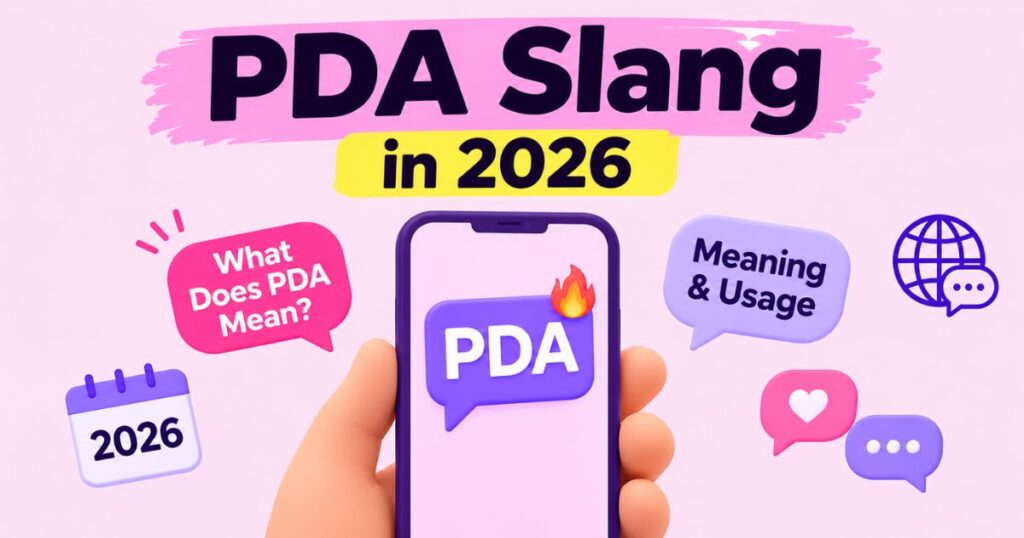
If you’ve scrolled through TikTok, Instagram, or a group chat and spotted the letters “PDA,” you’ve probably wondered what it actually stands for. The truth is, PDA isn’t a one-trick term. Depending on where you see it, a text message, a hospital chart, a political headline, or a viral video it can mean something completely different.
This guide breaks down every popular meaning of PDA slang, explains where it comes from, and shows you exactly how people use it in real conversations today.
Understanding acronyms like PDA matters more than ever in a world where texting shorthand, viral captions, and cross-industry jargon constantly overlap.
A single three-letter term can carry romantic, medical, political, or technical weight depending on who’s typing it and knowing the difference saves you from awkward misunderstandings.
What Does PDA Full Form Slang Mean?
In everyday slang, PDA stands for “Public Display of Affection.” It refers to any romantic gesture, hand-holding, hugging, kissing, or cuddling that happens openly in front of other people, rather than in private.
The phrase has been around for decades, but it exploded in popularity with texting, social media captions, and dating culture, where people now use “PDA” as a quick, casual shorthand instead of spelling out the whole phrase.
Here’s a quick snapshot of the term across different fields:
| Context | Full Form of PDA | Meaning |
| Slang / Relationships | Public Display of Affection | Showing affection openly in public |
| Technology | Personal Digital Assistant | Handheld device like a PalmPilot or pocket computer |
| Politics (India) | Pichhda, Dalit, Alpsankhyak | An alliance representing backward, Dalit, and minority communities |
| Medical | Patent Ductus Arteriosus | A congenital heart condition in infants |
| Psychology | Pathological Demand Avoidance | A profile linked to anxiety-driven avoidance of everyday demands |
| Computer Science | Pushdown Automaton | A theoretical computing model used in automata theory |
PDA Meaning in Relationship
In a relationship, PDA simply means showing love or affection while other people think hugging your partner at a party, holding hands on the street, or kissing goodbye at a train station. It’s often used as a way to describe how comfortable (or uncomfortable) a couple is with expressing intimacy publicly.
Some couples are naturally more affectionate in public, while others prefer to keep that side of their relationship private. Neither is “wrong” it usually comes down to personality, culture, and comfort level.
PDA Full Form Slang on TikTok
On TikTok, “PDA” is used almost exactly like it is in real life, but amplified for content. You’ll see:
- Couple duos captioned “POV: too much PDA at the mall 😂”
- Relationship advice videos discussing “healthy PDA vs. too much PDA”
- Comment sections joking “get a room” under affectionate couple clips
TikTok slang rarely changes the meaning of PDA; it just packages it into short, relatable, often comedic clips that make the term trend repeatedly.
PDA Full Form in Politics
In Indian political discourse, PDA has taken on a very different meaning in recent years. Here, PDA stands for Pichhda (Backward), Dalit, and Alpsankhyak (Minority) , a term used to describe a social and political coalition built around these three community groups.
Political leaders have used it to represent unity against social exploitation and to mobilize voters around shared identity and justice issues.
PDA Full Form in Medical
In medicine, PDA stands for Patent Ductus Arteriosus. This is a heart condition, most common in premature infants, where a blood vessel (the ductus arteriosus) that should close shortly after birth stays open instead.
This can cause extra blood flow to the lungs and, if untreated, may lead to complications. Doctors typically monitor it and, when necessary, treat it with medication or a minor procedure.
PDA Full Form in Mail
In professional or office emails, “PDA” is less common but can occasionally refer to a Personal Digital Assistant (an older handheld device) when discussing outdated office equipment, or it may appear as company-specific shorthand (like “Please Do the Above” in some casual internal threads).
Always check the context of the email corporate acronyms vary widely between organizations, and PDA isn’t a universally standardized email term the way “FYI” or “ASAP” is.
What Does PDA Mean in Texting and Social Media?
In texting and social captions, PDA almost always refers to Public Display of Affection. It’s typically used in three ways:
- Describing a moment “We had a full PDA moment at the concert 🥹”
- Setting a boundary “No PDA in front of my parents, please.”
- Teasing someone “Stop the PDA, we’re literally in a meeting.”
It’s casual, quick, and instantly understood by most people under 40 which is exactly why it has stuck around in digital slang for so long.
Examples of PDA in Real Life

PDA can range from subtle to very obvious. Common examples include:
- Holding hands while walking through a mall
- Hugging tightly at an airport reunion
- A quick kiss before parting ways at work
- Resting your head on your partner’s shoulder in public
- Wrapping an arm around your partner at a party
- Kissing on a date at a restaurant
Each of these falls somewhere on the “PDA spectrum” from mild affection to more intense displays that some people consider excessive in public settings.
Context also plays a huge role in how these moments are perceived. A quick hug at a family gathering reads very differently than the same hug during a formal business dinner.
Similarly, cultural background shapes what feels normal in some countries, hand-holding is barely noticed, while in others even that small gesture can draw attention.
This is why the same act of affection can be labeled “sweet” in one setting and “inappropriate” in another, even though nothing about the gesture itself has changed.
Is PDA Good or Bad?
There’s no single right answer; it depends on the setting, culture, and the people involved. Here’s a simple breakdown:
| Aspect | When PDA Is Seen as Good | When PDA Is Seen as Bad |
| Setting | Casual outings, parties, private gatherings | Formal events, workplaces, religious spaces |
| Intensity | Holding hands, light hugs | Intense kissing, making out in public |
| Cultural context | Common in Western dating culture | Frowned upon in more conservative cultures |
| Partner comfort | Both partners are comfortable | One partner feels embarrassed or pressured |
In general, mild PDA is widely accepted as a normal way to express affection, while excessive PDA can make bystanders uncomfortable or come across as inconsiderate of shared spaces.
Why Do Couples Engage in PDA?
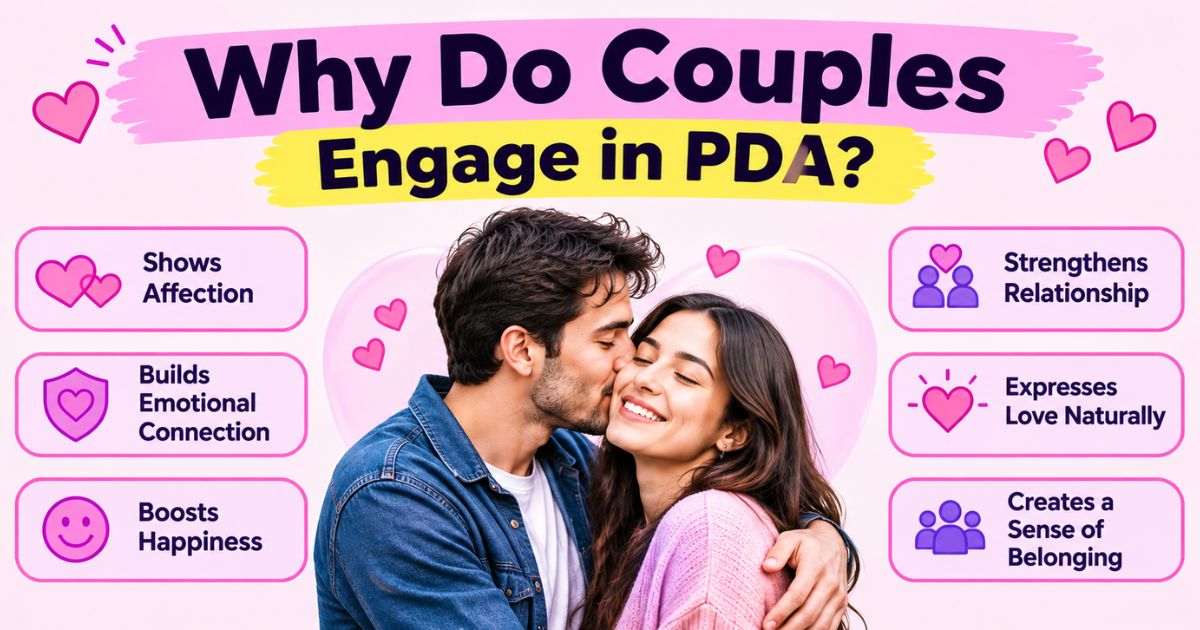
PDA isn’t just a random habit psychologists suggest it often reflects deeper relationship dynamics, personality traits, and even attachment styles.
Some people express affection openly because it’s how they were raised, while others do it instinctively because touch is their primary way of feeling connected. Couples show affection in public for several psychological and social reasons, including:
- Emotional connection physical touch releases oxytocin, which strengthens bonding.
- Confidence in the relationship some couples want to openly signal they’re together.
- Cultural or generational norms younger generations tend to be more openly affectionate.
- Habit and comfort for some couples, small touches are simply second nature.
- Social validation: A few people enjoy the visibility PDA brings to their relationship.
Does PDA Only Refer to Couples?
Not necessarily. While PDA is most commonly associated with romantic couples, the phrase “public display of affection” can technically apply to any warm, affectionate gesture shown openly such as a parent hugging a child, close friends embracing, or family members greeting each other affectionately. That said, in modern slang and social media use, PDA is used almost exclusively to describe romantic partners.
Other Meanings of PDA
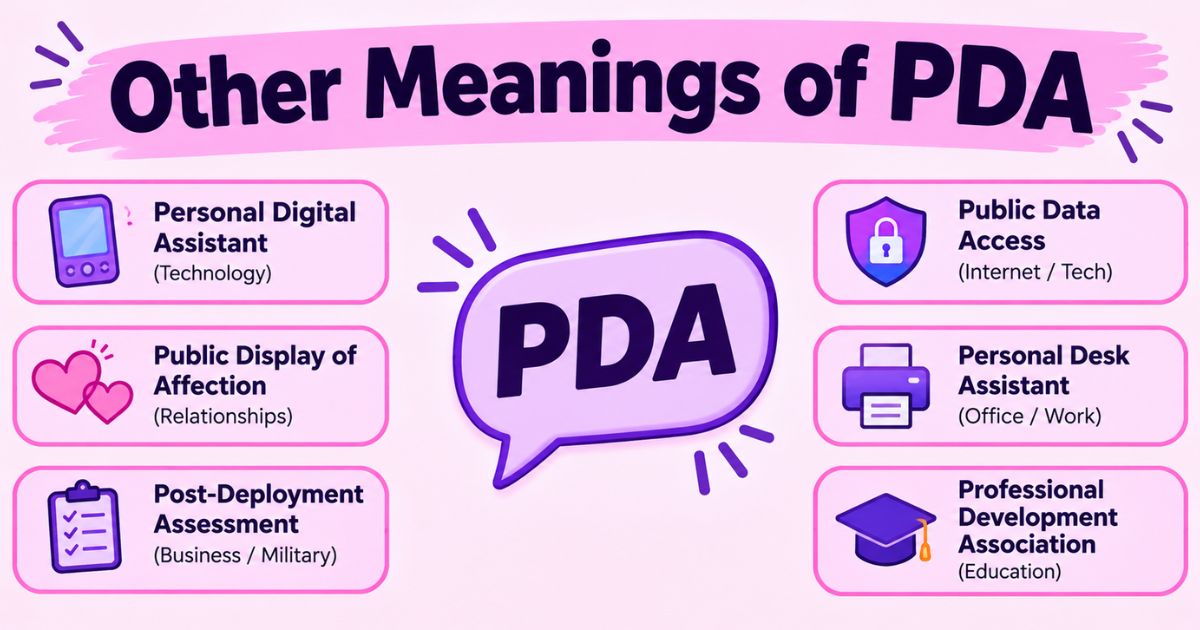
Outside slang, relationships, and the fields already mentioned, PDA also appears in:
- Public Defenders Association legal advocacy organizations
- Personal Development Award used in some educational and scouting programs
- Product Development Agreement a business/legal contract term
- Pushdown Automaton a computational model in theoretical computer science used to study formal languages
Because PDA is such a short acronym, its meaning always depends heavily on context so it’s worth checking the surrounding text before assuming which version applies.
PDA and Modern Dating Culture
In today’s dating culture, PDA has become almost a relationship “checkpoint.” Many people view a partner’s willingness to hold hands or hug in public as a sign of security and commitment. Social media has also amplified this as couples often post PDA-style photos and videos as a way of publicly affirming their relationship status.
At the same time, there’s a growing conversation online about “PDA boundaries” recognizing that not everyone is comfortable being affectionate in front of others, and that this doesn’t mean the relationship is any less strong.
Healthy modern dating culture increasingly emphasizes discussing PDA comfort levels early on, rather than assuming both partners feel the same way.
PDA Etiquette: Where to Draw the Line
Since comfort levels around affection vary so widely, a bit of unspoken etiquette has developed around PDA over time. Most people agree on a few general guidelines:
- Read the room. A quick hug is fine almost anywhere, but intense affection is best saved for private moments.
- Respect the venue. Workplaces, classrooms, and religious settings usually call for minimal or no PDA.
- Check in with your partner. Not everyone is equally comfortable being affectionate in front of others, and that’s worth discussing openly.
- Consider the audience. Being around family, coworkers, or strangers can change what feels appropriate.
Following this kind of simple etiquette helps couples enjoy affectionate moments without making the people around them uncomfortable and it keeps the relationship’s more private side, well, private.
Also Read This : What Does ATP Mean?
Final Thoughts
PDA is one of those acronyms that changes meaning entirely based on where you encounter it. In slang, texting, and dating culture, it almost always means Public Display of Affection, a term used to describe affectionate behavior shown openly between partners.
But step into a hospital, a political debate, or a computer science classroom, and PDA suddenly means something entirely different.
Understanding the context is the key to decoding PDA correctly and now that you know all its major meanings, you’ll never be confused by this three-letter acronym again.