If you’ve ever scrolled through Facebook Marketplace, Craigslist, or a classified ad and spotted the letters “OBO” tucked next to a price tag, you’ve probably paused for a second wondering what it actually means. You’re not alone. OBO is one of those small acronyms that carries a lot of weight in everyday buying, selling, and even business communication.
In this guide, we’ll break down everything you need to know about OBO from its core definition to its use in construction, banking, legal documents, and even pop culture (yes, Davido fans, we’re getting to that). By the end, you’ll know exactly how and when to use OBO correctly.
The Core Definition of OBO
At its heart, OBO stands for “or best offer.” It’s a short abbreviation sellers attach to a listed price to signal that they’re open to negotiation. It tells potential buyers, “Here’s my asking price, but I won’t necessarily walk away if you offer a bit less.”
For example:
- “Used mountain bike for $250 OBO.”
- “Dining table, barely used, $120 OBO.”
The phrase essentially invites a conversation instead of shutting the door on it. Instead of a rigid, take-it-or-leave-it price, OBO softens the deal and encourages back-and-forth discussion between buyer and seller.
This acronym has been around for decades, showing up in printed classified sections long before online marketplaces existed. As selling moved from newspaper columns to platforms like eBay, Craigslist, and Facebook Marketplace, OBO simply followed the trend and became a digital-age staple.
OBO Meaning in Business
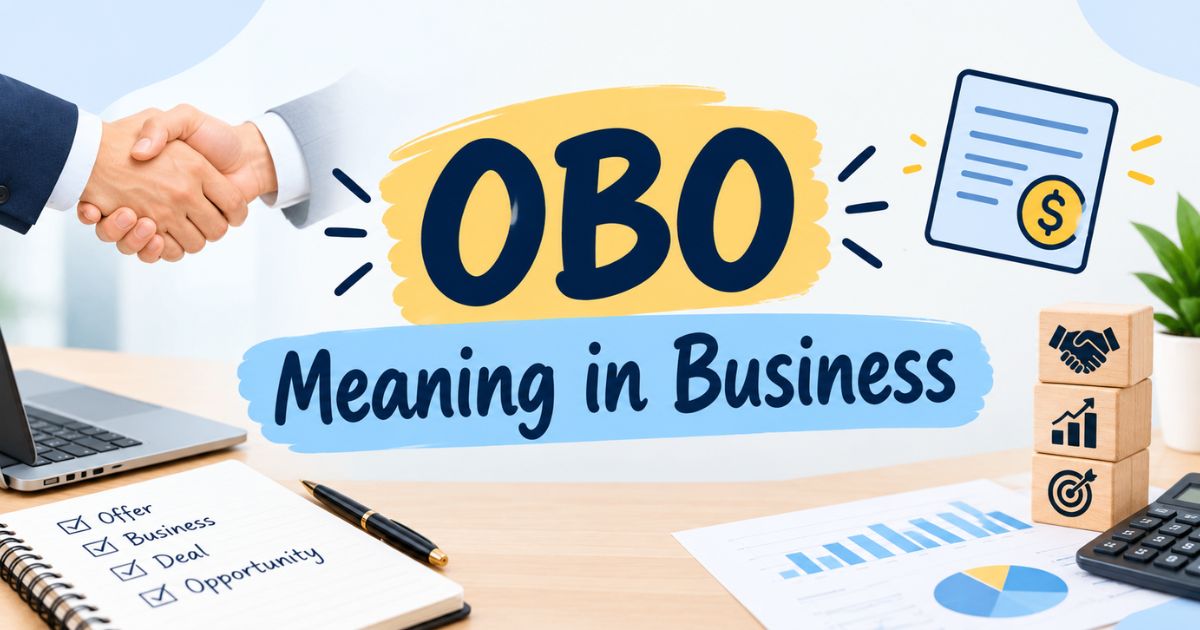
In a business context, OBO usually keeps its classic meaning or best offer but it also shows up when small business owners or independent sellers are pricing inventory, equipment, or assets they no longer need.
A retailer clearing out old stock might list items as “OBO” to move inventory quickly without underselling it upfront.
Beyond pricing, “OBO” occasionally appears in a different business sense as an abbreviation of “owner buy out,” a financial restructuring strategy where a business owner creates a holding company to repurchase their own shares or property.
This is more common in corporate finance and real estate circles, and it’s a completely separate meaning from the classifieds usage.
OBO Meaning in Construction
In the construction and contracting world, OBO can stand for “operated by others.” This term shows up in project specifications, equipment listings, or contracts to indicate that certain machinery, tools, or services will be handled by a separate party rather than the main contractor. It helps clarify responsibility and avoid confusion over who is accountable for operating specific equipment on a job site.
OBO Meaning in English
In standard English usage particularly in dictionaries like Cambridge and Oxford OBO is defined simply as an abbreviation for “or best offer.” It’s most often used in written form, especially in classified ads, and can appear in both uppercase (OBO) and lowercase (obo). Both versions are grammatically acceptable.
OBO Meaning: Davido
If you follow Afrobeats, you’ve likely heard Nigerian superstar Davido referred to as “OBO.” In this context, the acronym has nothing to do with pricing or negotiation. It stands for “Omo Baba Olowo,” a Yoruba phrase meaning “child of a wealthy father” or “son of a rich man.
” Davido adopted this as his nickname and even titled his 2012 debut album “Omo Baba Olowo (OBO),” referencing his father’s wealth and status as a successful businessman.
Over the years, the nickname stuck, and fans and media alike now use OBO interchangeably with Davido’s stage name. It’s a great example of how one acronym can carry completely different meanings depending on cultural context.
OBO Meaning: On Behalf Of
In formal writing, emails, and signatures, OBO sometimes written as o/b/o can also mean “on behalf of.” This usage typically appears when one person signs a document or communication for another individual or organization. For instance, an assistant might sign a letter “o/b/o [Manager’s Name]” to indicate they’re acting on that person’s authority.
OBO Meaning in Yoruba
As mentioned above, in Yoruba culture the term connects directly to Davido’s nickname. “Omo Baba Olowo” translates to “child of a wealthy father.” It’s a phrase rooted in pride and lineage, commonly used in Nigerian entertainment and social circles to describe someone from an affluent or influential family background.
OBO Meaning: Legal
In legal documents, OBO frequently stands for “Objecting Beneficial Owner.” This term is used in corporate and securities law to describe shareholders who hold shares through a broker or intermediary but have objected to having their identity disclosed to the company whose shares they own. This is distinct from a “Non-Objecting Beneficial Owner” (NOBO), who allows their information to be shared.
OBO Meaning: Banking
In banking and finance, OBO can appear as shorthand for terms like “on behalf of” (when a bank processes a transaction for a client) or, in some regional contexts, as part of compliance and ownership disclosure language similar to its legal usage. Always check the surrounding context in financial documents, since banking terminology can vary by institution and country.
OBO on Classified Platforms
Here’s where most people encounter OBO daily on classified and resale platforms. Here’s a quick breakdown of common platforms where you’ll see it:
| Platform | Typical OBO Usage |
| Facebook Marketplace | Attached to furniture, electronics, and vehicle listings |
| Craigslist | One of the most traditional homes of OBO listings |
| eBay | Used in “Buy It Now” listings open to offers |
| Local classifieds/newspapers | Original historical use, dating back decades |
When you see “$500 OBO” on any of these platforms, it means the seller is willing to entertain offers below the listed price, though there’s no guarantee they’ll accept every offer that comes in.
How Negotiations Work with OBO
Listing something as OBO opens the door to negotiation, but there’s an unspoken etiquette buyers and sellers usually follow:
- The seller sets an anchor price slightly higher than their actual bottom line, leaving room to negotiate.
- The buyer submits an offer often below the listed price, but reasonable enough to be taken seriously.
- The seller responds either accepting, rejecting, or countering with a new figure.
- Both parties settle on a final price that works for both sides, or the deal falls through if expectations don’t align.
This process is similar to a mini negotiation table, and understanding it can help you get better deals whether you’re buying or selling.
OBO in Workplace and Banking
Outside of marketplaces, OBO shows up in professional and administrative settings too. In workplace communication, “acting OBO” typically means representing or signing for them. In banking operations, similar “on behalf of” language appears in transaction records, wire transfers, and authorization forms where one party executes an action for another.
Distinguishing OBO from Other Pricing Strategies
OBO isn’t the only pricing signal used in sales. Here’s how it compares to similar terms:
| Term | Meaning | Flexibility Level |
| OBO (Or Best Offer) | Seller accepts offers below asking price | High |
| Firm | Price is non-negotiable | None |
| ONO (Or Nearest Offer) | Common in UK listings, similar to OBO | High |
| Fixed Price | Set price, no negotiation expected | None |
| Make an Offer (MO) | Buyer proposes price without a starting figure | Very high |
Understanding these distinctions helps buyers set realistic expectations before reaching out to a seller.
Slang and Cultural References
Beyond marketplaces and Davido’s nickname, OBO occasionally pops up in casual online slang with looser, informal meanings depending on the community using it. Context is everything. The same three letters can mean something entirely different in a music forum versus a classifieds app versus a corporate contract.
OBO in Legal and Formal Documents
As covered earlier, legal paperwork often uses OBO to describe objecting beneficial owners in shareholder communications, or as shorthand for “on behalf of” in signed agreements. If you come across OBO in a contract or legal filing, it’s worth checking the document’s glossary or definitions section, since legal usage can be more specific than everyday slang.
Also Read This : 7 Real Meanings of PDA Slang in 2026
Outside of Marketplace Transactions
OBO’s versatility means it shows up far beyond garage sales and online listings. It’s used in:
- Corporate finance (owner buy-outs)
- Construction contracts (operated by others)
- Legal shareholder documentation (objecting beneficial owner)
- Government and diplomatic contexts (Bureau of Overseas Buildings Operations)
- Music and entertainment branding (Davido’s OBO persona)
This wide range of applications is exactly why context matters so much when interpreting the acronym.
Common Pitfalls When Using OBO
Even though OBO seems simple, people misuse or misunderstand it in a few common ways:
- Assuming OBO means the seller must accept any offer. It doesn’t, it just means they’re open to considering one.
- Using OBO without a stated price. OBO works best when paired with an actual number, giving buyers a reference point.
- Confusing OBO with “make an offer.” OBO implies a starting price exists; “make an offer” often doesn’t include one at all.
- Forgetting regional differences. Buyers in the UK may be more familiar with ONO than OBO.
Tips for Effective Negotiation
If you’re using OBO as a buyer or seller, a few simple strategies go a long way:
- Sellers: Price slightly above your minimum acceptable amount to leave the negotiating room.
- Buyers: Offer a reasonable amount, not an insultingly low one, to keep the conversation productive.
- Both parties: Stay polite and responsive negotiations move faster when communication is clear.
- Sellers: Be ready to explain the item’s condition or value if a buyer questions your price.
- Buyers: Research similar listings before making an offer, so your number is grounded in real market value.
Conclusion
OBO might look like a tiny three-letter acronym, but as we’ve seen, its meaning shifts dramatically depending on where you encounter it. On Craigslist or Facebook Marketplace, it simply means “or best offer” an invitation to negotiate.
In legal and banking contexts, it can mean “on behalf of” or “objecting to a beneficial owner.” In construction, it often refers to equipment “operated by others.” And in Afrobeats culture, OBO is inseparable from Davido’s identity as the “Omo Baba Olowo.”
Understanding these different meanings helps you avoid confusion and communicate more effectively, whether you’re haggling over a used couch or reading through a formal contract.