
If you’ve spent even five minutes scrolling through WhatsApp, Snapchat, or Instagram, chances are you’ve bumped into the letters “BTW” somewhere in a message. Maybe a friend dropped it in the middle of a conversation, or you saw it in a comment section and wondered what it actually stands for.
Don’t worry you’re not alone. BTW is one of the most commonly used chat abbreviations on the internet, and once you understand it, you’ll start noticing it everywhere.
In this article, we’ll break down the full meaning BTW, where it’s used, why people love using it, and how you can use it correctly without sounding awkward or out of place.
What Does BTW Mean?
BTW stands for “By The Way.”
It’s a short, informal phrase used to introduce a new thought, an extra piece of information, or a side comment that isn’t directly connected to the main topic of conversation. Instead of typing out the whole phrase, people simply type “BTW” to save time and keystrokes.
For example:
“I’ll call you after dinner. BTW, did you finish the assignment?”
Here, BTW is used to shift the conversation slightly from dinner plans to a completely different topic without making the message feel disjointed.
Simple Meaning of BTW
In the simplest terms possible:
- B = By
- T = The
- W = Way
Put together, it means “by the way” a phrase used to add something extra to a conversation without disrupting its natural flow. Think of it as a verbal nudge that says, “Oh, one more thing before I forget.”
BTW Meaning in Chat
In everyday texting and instant messaging, BTW acts as a conversational connector. People use it to:
- Add a forgotten detail
- Bring up something unrelated
- Soften a sudden change of subject
- Add humor or a casual afterthought
Example in chat:
“Running 10 minutes late. BTW, love your new profile picture!”
It keeps the tone light and casual, which is exactly why it’s so popular in text-based conversations.
BTW Meaning in Snapchat
On Snapchat, where conversations are quick, visual, and often accompanied by snaps or stories, BTW is used the same way as in regular texting but usually even more casually.
You’ll often see it used:
- In snap captions (“BTW this filter is amazing 😂”)
- In chat replies to add a quick side note
- In story replies to bring up something unrelated to the snap
Since Snapchat conversations move fast, BTW helps users squeeze in extra thoughts without slowing down the chat.
BTW Meaning in WhatsApp Chat
WhatsApp is one of the most common platforms where BTW shows up, especially in group chats and personal conversations. Because WhatsApp supports longer, more detailed conversations compared to Snapchat, BTW is often used to:
- Introduce follow-up information
- Add reminders mid-conversation
- Shift smoothly from one topic to another in group discussions
Example:
“Meeting confirmed for 5 PM. BTW, please bring your laptops.”
What Does BTW Mean for a Woman?
There’s no different meaning of BTW based on gender. The abbreviation means exactly the same thing whether it’s used by a man, woman, or anyone else. It simply means “by the way.”
However, in casual conversations between friends, BTW used by a woman (or anyone) can sometimes carry a slightly playful or flirty undertone depending on the context of the message for example:
“BTW, you looked really nice today 😊”
Here, BTW isn’t changing meaning; it’s just softening the delivery of a compliment or personal comment, making it feel more casual and less direct.
Where Is BTW Used?
BTW is used across almost every digital communication platform, including:
| Platform | Common Usage |
| Texting (SMS) | Adding quick side notes |
| Extending conversations, reminders | |
| Snapchat | Casual captions and chat replies |
| Comments and DMs | |
| Twitter/X | Adding context to tweets or replies |
| Emails (informal) | Casual follow-up notes |
| Workplace chat apps (Slack, Teams) | Quick, informal updates |
While BTW is mostly informal, it has slowly made its way into semi-professional communication too, especially in casual workplace chats.
Interestingly, the rise of remote work has pushed BTW even further into everyday business communication.
Platforms like Slack, Microsoft Teams, and Google Chat are technically professional tools, but the tone used inside them is often much more relaxed than traditional email.
In these settings, BTW helps colleagues quickly add reminders, share quick updates, or mention something unrelated to the main project discussion all without sounding overly formal or robotic.
It’s a good example of how internet slang gradually blends into mainstream communication once enough people start using it regularly, regardless of the setting.
Why Do People Use BTW?
People use BTW for a few simple but important reasons:
- Saving time typing three letters is faster than typing “by the way.”
- Keeps conversations smooth. It signals a topic shift without abruptly changing the subject.
- Feels casual and friendly It softens the tone of a message.
- Fits mobile texting habits Short, quick, and easy to type on a small screen.
- Adds extra info without restarting the conversation No need for a whole new sentence structure.
The Psychology Behind Using BTW
There’s actually a small psychological reason why BTW feels so natural in conversation. When we talk to someone, our brains don’t always organize thoughts in a perfectly linear order. Sometimes a completely unrelated idea pops up mid-conversation, and instead of losing that thought or awkwardly blurting it out, BTW gives us a smooth way to insert it.
This is why BTW is often called a discourse marker in linguistics, a small word or phrase that helps manage the flow of conversation rather than adding new factual meaning on its own. Other discourse markers include words like “anyway,” “so,” and “well.” BTW simply does this job in a more modern, text-friendly way.
Using BTW also softens the impact of suddenly changing topics. Without it, jumping from one subject to another can feel abrupt or even confusing to the reader. Add a quick “BTW” before the new point, and the transition feels intentional rather than random. This is especially useful in text-based communication, where tone of voice and body language aren’t available to guide the listener.
Real-Life Examples of BTW
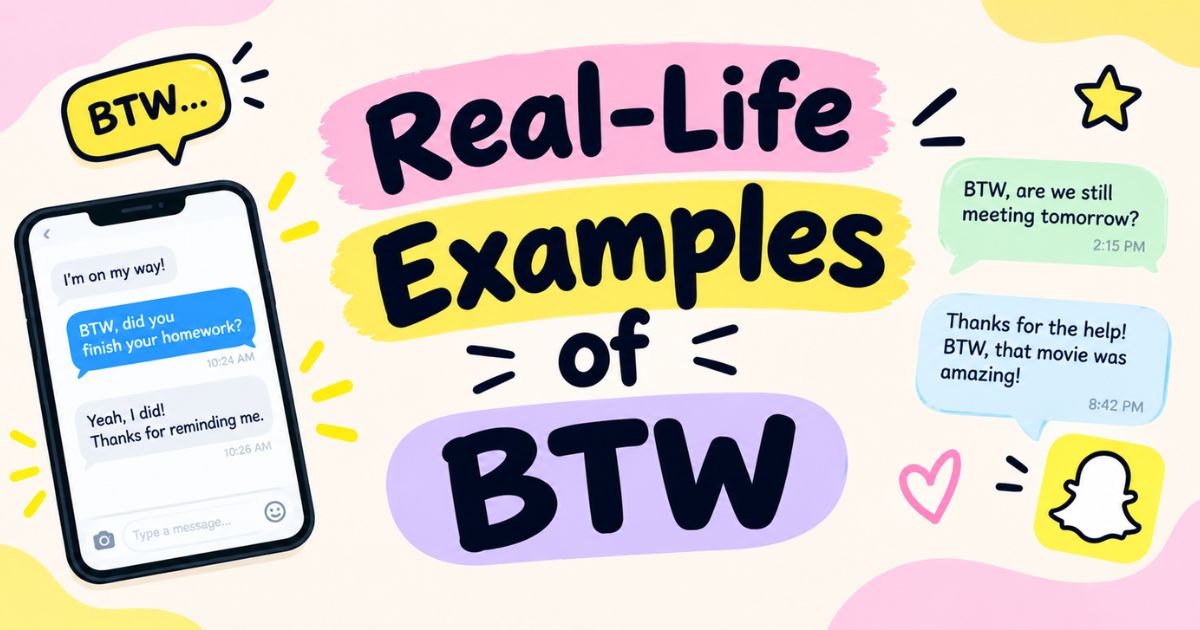
Here are a few everyday examples showing how BTW naturally fits into conversations:
- “The movie starts at 8 PM. BTW, I already bought the tickets.”
- “Thanks for the help earlier! BTW, are we still meeting tomorrow?”
- “I sent you the file. BTW, check your spam folder if you don’t see it.”
- “I loved the party last night. BTW, where did you get that outfit?”
Each example shows BTW being used to smoothly add something extra without derailing the main message.
BTW vs Similar Terms
BTW is often confused with other common chat abbreviations. Here’s a quick comparison:
| Abbreviation | Full Form | Main Use |
| BTW | By The Way | Adding a side note or new topic |
| FYI | For Your Information | Sharing important facts |
| IMO/IMHO | In My (Humble) Opinion | Expressing personal opinion |
| TBH | To Be Honest | Stating an honest opinion |
| NVM | Never Mind | Dismissing or cancelling a point |
| ICYMI | In Case You Missed It | Reminding about missed info |
While BTW and FYI are sometimes used interchangeably in casual chats, they technically serve different purposes BTW introduces something new, while FYI shares information the other person should know.
When Should You Use BTW?
BTW works best in the following situations:
- Casual texting with friends or family
- Social media comments and captions
- Informal workplace messaging (like Slack or WhatsApp groups)
- Adding a quick afterthought you almost forgot to mention
When You Should Avoid BTW
- Formal emails or business proposals
- Academic writing or essays
- Legal or official documentation
- First-time professional communication with clients
Common Misunderstandings About BTW
Even though BTW is widely used, a few misunderstandings still exist:
- Myth: BTW is only for texting teenagers. Fact: It’s used across all age groups in digital communication today.
- Myth: BTW and FYI mean exactly the same thing. Fact: They’re similar but not identical BTW introduces a new point, FYI shares useful information.
- Myth: Using BTW makes a message sound unprofessional. Fact: It depends on context. It’s fine in casual workplace chats but not in formal writing.
The History of BTW
BTW isn’t a new-age internet trend; its roots go back further than most people expect.
- It first appeared in early online chat rooms, bulletin board systems (BBS), and internet forums around the late 1980s.
- It became popular through IRC (Internet Relay Chat) and early instant messaging platforms where speed and brevity mattered.
- With the rise of SMS texting in the 2000s, BTW became a texting staple due to character limits.
- Today, it’s a permanent fixture in social media, messaging apps, and even casual workplace communication.
Different Ways BTW Is Written
BTW can appear in multiple formats depending on the platform or personal texting style:
- BTW (most common, uppercase)
- btw (lowercase, casual texting)
- Btw (sentence-style capitalization)
- B.T.W. (rarely used, more formal-looking style)
All variations mean the same thing: capitalization usually depends on personal texting habits rather than grammar rules.
Also Read This : LWK Mean in Text
Pro Tips for Using BTW Correctly
- ✅ Use it to add relevant side information, not unrelated randomness.
- ✅ Keep it casual it’s not meant for formal writing.
- ✅ Use it sparingly; overusing BTW in every message can feel repetitive.
- ✅ Match the tone of the conversation playful in casual chats, minimal in professional ones.
- ❌ Avoid using it in resumes, cover letters, or official documents.
Final Thoughts
BTW is a small abbreviation with a big role in digital communication. Whether you’re chatting on WhatsApp, replying to a Snapchat story, or commenting on Instagram, BTW helps conversations flow naturally by adding extra thoughts without disrupting the main topic.
Now that you know the full meaning, its history, and the right way to use it, you can confidently use it in your everyday chats casually, correctly, and without confusion.


1 thought on “What Does BTW Actually Mean in 2026? (Ultimate Guide) ”