
If you have ever heard an Arabic song, watched a Middle Eastern drama, or chatted with an Arab friend, you have probably heard the word habibti. It sounds warm, soft, and affectionate. But what does it really mean, and can anyone say it?
In short, habibti means “my love” or “my dear” and is used to address a woman or girl. This guide explains its meaning, spelling, pronunciation, origin, and cultural weight. You will also learn when it is friendly, when it is romantic, and how to use it without awkward mistakes.
What Does Habibti Mean in Arabic?
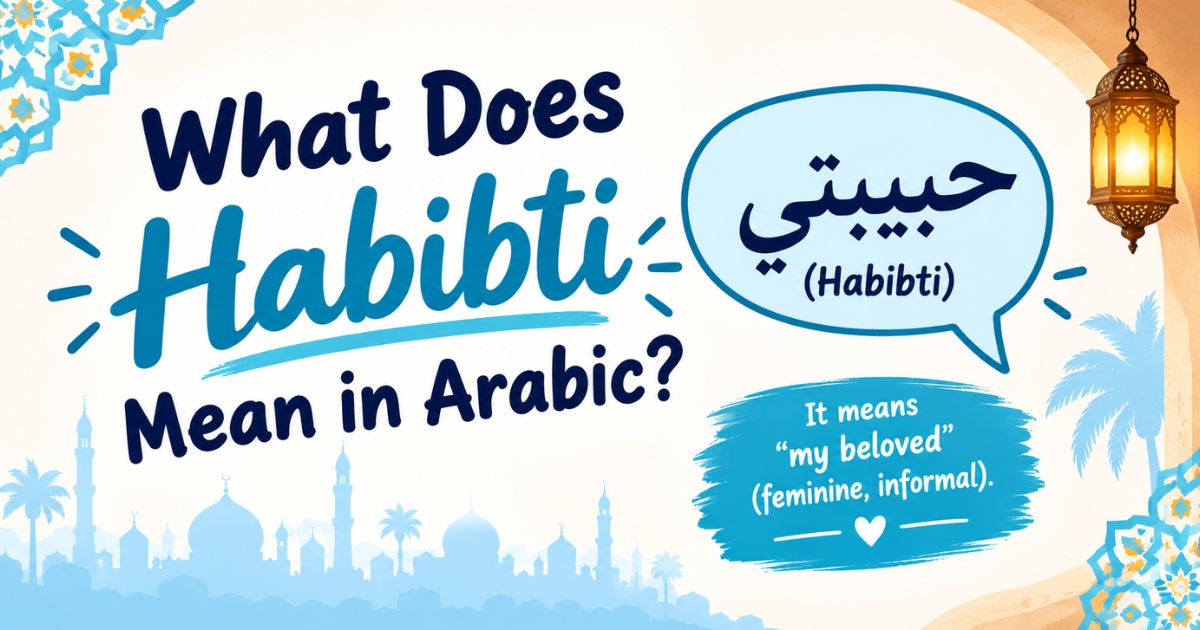
Habibti (حبيبتي) is an Arabic term of endearment. It translates to “my beloved,” “my darling,” or “my dear” when speaking to a female.
The word has three parts:
- Hubb (حب): the Arabic root for love
- Habiba (حبيبة): a beloved woman
- -i (ـي): the suffix meaning “my”
Put together, habiba + i becomes habibti: “my beloved (female).”
Arabs use it for mothers, daughters, sisters, wives, girlfriends, and close friends. Its tone changes with the speaker, the relationship, and the voice behind it.
Habibti Meaning in Islam
Habibti is a cultural Arabic word, not a religious term. In Islam, it is considered kind and acceptable between spouses, family members, and close friends of the same gender.
Between an unrelated man and woman, many Muslims see it as too familiar, especially if it sounds flirtatious.
Habibti Meaning in Quran
The exact word “habibti” does not appear in the Quran. However, the root h-b-b (love) appears often, for example in verses about Allah’s love for believers and believers’ love for Allah.
Habibti Meaning for Male
Habibti is feminine, so it is not used for men. Use habibi (حبيبي) for a man. Calling a man “habibti” is usually a joke or a mistake.
Habibti Meaning in English
The closest English equivalents are “my love,” “darling,” “sweetheart,” “honey,” and “dear.” None of them carry the full emotional range of the Arabic.
How Is Habibti Written and Pronounced?
Arabic script: حبيبتي
Common Latin spellings: habibti, habibty, 7abibti, habibati (rare)
The number “7” is common in Arabizi, the chat-style Arabic written in Latin letters. It stands for the Arabic letter ح (ḥā), a soft breathy “h.”
Pronunciation: ha-BEEB-tee
Here is a simple breakdown:
- ha: a soft, breathy “h” from the throat (stronger than English “h”)
- BEEB: stressed syllable, like “beeb”
- tee: sounds like the English word “tea”
In some dialects, the ending sounds like “-ty” or “-ti.” Egyptians, Lebanese, and Gulf Arabs each add their own rhythm, but the word stays recognizable everywhere.
What Is the Difference Between Habibi and Habibti?
The difference is gender. The two words share the same root and meaning, but they point to different people.
| Feature | Habibi (حبيبي) | Habibti (حبيبتي) |
| Gender | Masculine | Feminine |
| Addressed to | A man or boy | A woman or girl |
| Literal meaning | My beloved (m.) | My beloved (f.) |
| Plural form | Habaybi / ya habibeen | Habaybi / ya habibat |
| Typical use | Friends, family, partners | Friends, family, partners |
One twist: in casual speech, many people use habibi as a general, almost gender-neutral term, even for women. But habibti is never used for men. When speaking to a woman, habibti is the more accurate choice.
Is Habibti Romantic or Friendly?
It can be both. Context decides.
Friendly or family use:
- A mother calling her daughter
- Two female friends greeting each other
- A shopkeeper being warm with a customer
- A colleague showing support
Romantic use:
- A husband speaking to his wife
- A partner using it as a pet name
- Love songs and poems
Here is a quick way to tell the difference:
| Clue | Likely Friendly | Likely Romantic |
| Who is speaking | Family, female friend | Spouse or partner |
| Tone | Light, cheerful | Soft, intimate |
| Setting | Public, casual | Private, personal |
| Extra words | “Yalla habibti” (come on) | “Habibti ana bahebbik” (I love you) |
What Does Habibti Mean in American Culture?
In the United States, habibti is mostly known through Arab American communities, social media, music, and travel. Many people first learn it from friends, TV, or TikTok.
Americans usually treat it like “babe,” “girl,” or “sweetie.” Among Arab Americans, it keeps its traditional warmth. Outside those circles, it often shows closeness or cultural curiosity.
A small warning: using it with someone you barely know can come across as overly familiar, just like “honey” or “babe” would.
Where Does Habibti Come From?
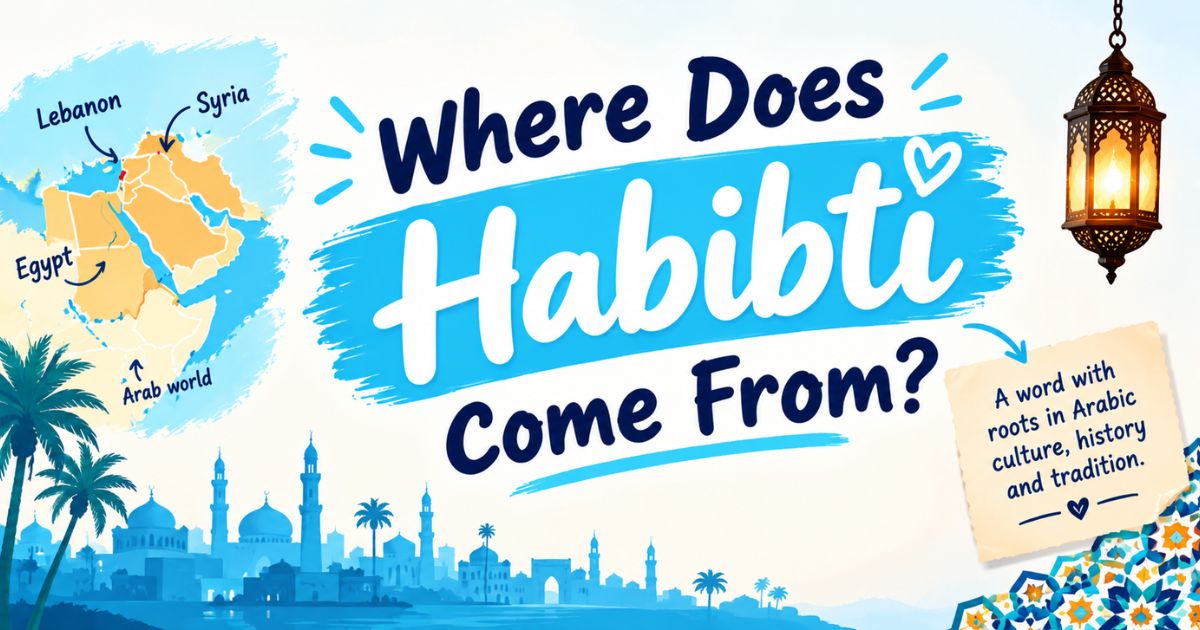
Habibti comes from Arabic, a Semitic language with roots going back more than a thousand years. Its parent root, ḥ-b-b, produces many related words:
- Hubb: love
- Habib: beloved (male)
- Habiba: beloved (female)
- Mahabba: affection
- Muhibb: a lover or admirer
The word spread across the Arab world, then into Turkish, Persian, Urdu, Hebrew-speaking communities, and many other languages through trade, migration, and shared culture. Today it is common from Morocco to Iraq and beyond.
What Does Habibti Symbolize Emotionally?
More than a translation, habibti carries feeling. It often signals:
- Warmth: you are safe with me
- Respect: you matter to me
- Closeness: we share a bond
- Comfort: a soft way to calm or encourage someone
- Belonging: you are part of my circle
Arabic culture values hospitality and close relationships, so affectionate words appear in daily life more freely than in many English-speaking settings.
Also Read This : DSL Meaning Slang
How Is Habibti Used in Texting and Social Media?
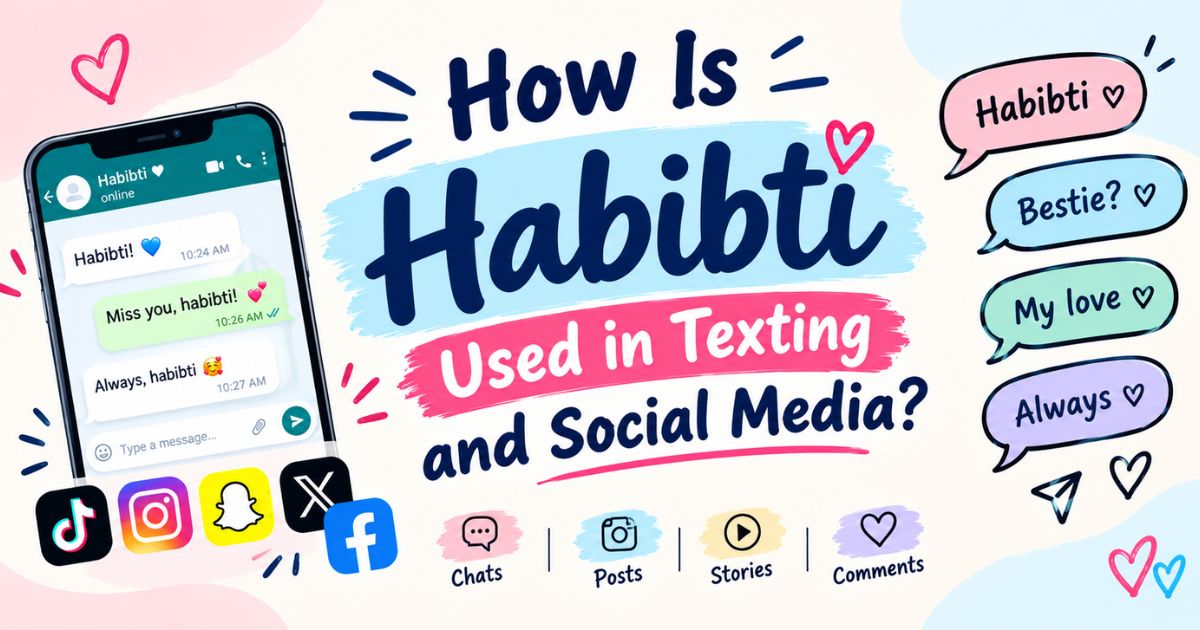
Online, habibti is short, friendly, and easy to type. People use it in many forms:
- “Habibti ❤️”: a sweet, simple message
- “Yalla habibti”: “come on, my dear” or “let’s go”
- “Shukran habibti”: “thank you, dear”
- “Miss you habibti”: a mix of English and Arabic
- “7abibti”: Arabizi spelling
On Instagram and TikTok, it often shows up in captions, comments, and birthday posts between friends. It also appears in memes and trending audio, where it can be playful, teasing, or heartfelt.
Habibti in Music, Movies, and Pop Culture
Arabic music has used “habibi” and “habibti” for generations. Legendary singers such as Fairuz, Umm Kulthum, and Abdel Halim Hafez built a tradition of love songs around such terms. Modern artists like Amr Diab and Nancy Ajram continue it.
In film and TV, the word signals warmth, flirtation, or family closeness, depending on the scene. Global pop and hip-hop collaborations also sprinkle Arabic words into hooks, which has helped the term reach listeners who do not speak Arabic.
What Are the Spiritual and Cultural Associations?
Culturally, habibti is tied to family, hospitality, and emotional openness. In many homes, children grow up hearing it daily from parents and grandparents.
Spiritually, the word sits near a deeper idea. The root for love, hubb, also appears in Arabic religious speech about love for God and for one another. That does not make habibti a religious phrase, but it shows how central love is in the language itself.
How Should You Use Habibti Respectfully?
Follow these simple rules:
- Use it for women or girls only. Use habibi for men.
- Know the relationship. It fits family, close friends, and partners best.
- Read the room. Avoid it in formal or professional settings.
- Watch your tone. A gentle voice reads as kind; a smirk can read as mocking.
- Respect boundaries. If someone seems uncomfortable, stop.
- Avoid using it as a pick-up line with strangers, especially in conservative settings.
- Learn the pronunciation. A sincere attempt shows respect.
What Are Common Misunderstandings About Habibti?
- “It always means romance.” No. Friends and family use it all the time.
- “It’s only for wives.” No. It is common between mothers and daughters, and between friends.
- “Anyone can use it with anyone.” Not quite. Context and relationship matter.
- “It’s a religious word.” No. It is cultural, not religious.
- “Habibi and habibti are interchangeable.” Not exactly. One is masculine, one is feminine.
- “It’s flirty by default.” It depends on tone and setting.
How Has the Meaning of Habibti Changed Over Time?
The core meaning, “my beloved,” has stayed stable. What has changed is how widely and casually it is used.
| Period | Typical Use |
| Classical and early modern Arabic | Poetry, family, and close relationships |
| 20th century | Songs, cinema, and everyday speech |
| Internet era | Texting, memes, and cross-cultural use |
| Today | Global slang, often playful or friendly |
Social media gave the word a second life. It now crosses language lines and shows up in captions, comments, and even brand names.
Habibti Meaning in Different Contexts
| Context | What It Usually Means | Example |
| Family | Deep love and care | A mother to her daughter |
| Friendship | Warm closeness | “Thanks, habibti!” |
| Romance | Intimate pet name | A husband to his wife |
| Shopping or service | Friendly politeness | A vendor to a customer |
| Social media | Playful or supportive | A comment under a photo |
| Music | Poetic affection | A love song lyric |
| Religious setting | Respectful, same-gender or family only | Between sisters in faith |
Conclusion
Habibti is more than a pretty word. It is a small piece of Arabic culture that packs affection, respect, and warmth into three syllables. Whether it comes from a mother, a best friend, or a partner, it says one thing clearly: you matter to me.
Use it for women and girls, keep your tone kind, and match the setting. Do that, and habibti will sound as natural coming from you as it does in Beirut, Cairo, or Dubai.


1 thought on “What Does Habibti Mean? Meaning, Usage & Tips (2026 Guide) ”