
If you’ve scrolled TikTok, YouTube comments or gym Reddit lately, you’ve seen it: “He mogs everyone in the room.” So what is the mog meaning, exactly?
In short, to mog someone means to outshine or outclass them, usually in looks, but sometimes in physique, confidence or skill. This guide covers the definition, origin, variations like mogging and mogged, and the odd side meanings you may run into (cats and weddings included).
What Does Mog Mean in Slang?
Mog is internet slang for outclassing someone. Merriam-Webster defines it as outclassing another person, though it is most often used about physical appearance.
If you “mog” someone, you look better, stronger or more impressive than they do in the same setting.
Quick examples:
- “He walked in and mogged the whole table.”
- “That hairstyle mogs his old one.”
- “She mogs everyone in this group photo.”
The word is a verb. You mog someone. It can also be a noun, as in “that was a mog.”
What Does Mogging Mean?
Mogging is the act of outshining someone, usually in a direct comparison. It’s the “-ing” form, so you’ll hear it in the middle of an action.
- “Look at him, he’s mogging everyone here.”
- “She’s mogging in that photo.”
Mogging depends on context. A person doesn’t mog in a vacuum. It happens when two or more people (or things) are side by side, and one clearly stands out.
What Does “Mogged” Mean?
Mogged is the past tense: it means you were outclassed. It describes the person on the losing end.
- “I got mogged at the gym by a guy twice my size.”
- “He looked fine until his friend arrived and mogged him.”
Because it describes a loss, “mogged” tends to sting more than “mog” or “mogging.”
What Is a Mogger or Moggee?
| Term | Meaning | Example |
| Mogger | The person who outshines others | “He’s the mogger of the group.” |
| Moggee | The person who gets outshone | “I was the moggee in that photo.” |
“Moggee” is less common than “mogged,” but it shows up in meme culture and forums.
Is Mog Always About Looks?
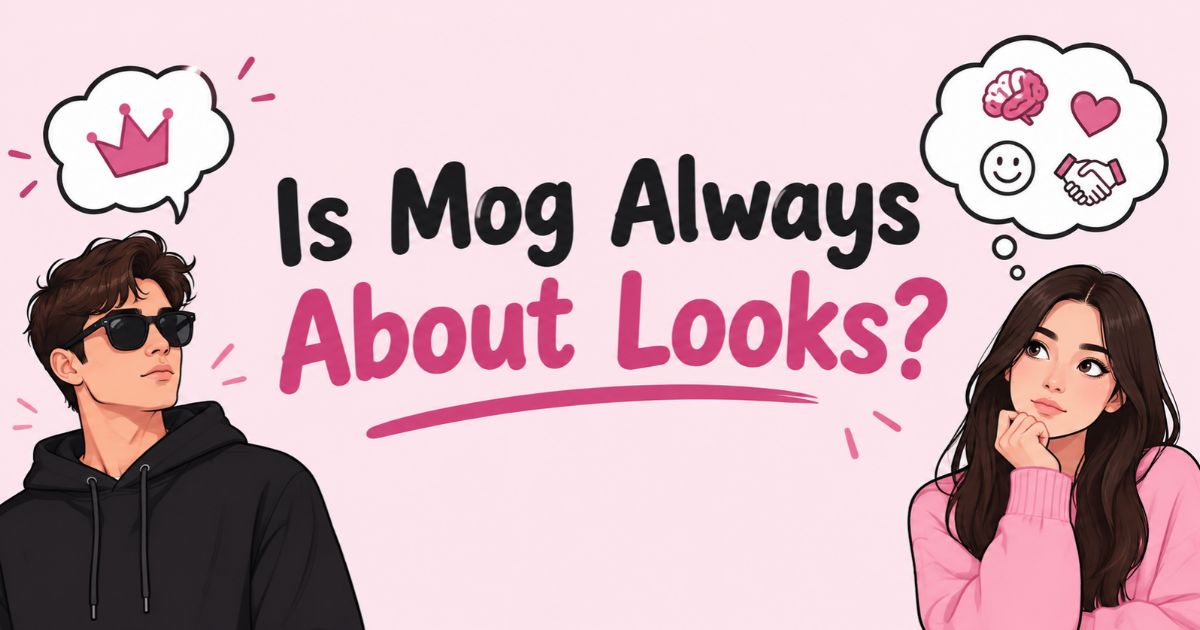
No. Looks are the most common use, but not the only one. Many people also use it for:
- Athletic ability (lifting, running, sports)
- Gaming skill (“He mogged the whole lobby”)
- Confidence or personality
- Style and fashion
- Status (car, job, achievement)
Still, if someone says “mog” with no context, they usually mean appearance.
Common Types of Mogging
Online communities have invented plenty of labels. These are the ones you’ll see most:
- Face mogging: Better facial features, such as jawline or eyes.
- Height mogging: Being noticeably taller.
- Frame mogging: A broader skeleton, shoulders or overall build that dwarfs someone else.
- Physique mogging: More muscle or a leaner body.
- Aura or presence mogging: Confidence and charisma that take over a room.
- Skill mogging: Outperforming others at a sport, game or craft.
How Is “Mog” Used on Social Media?
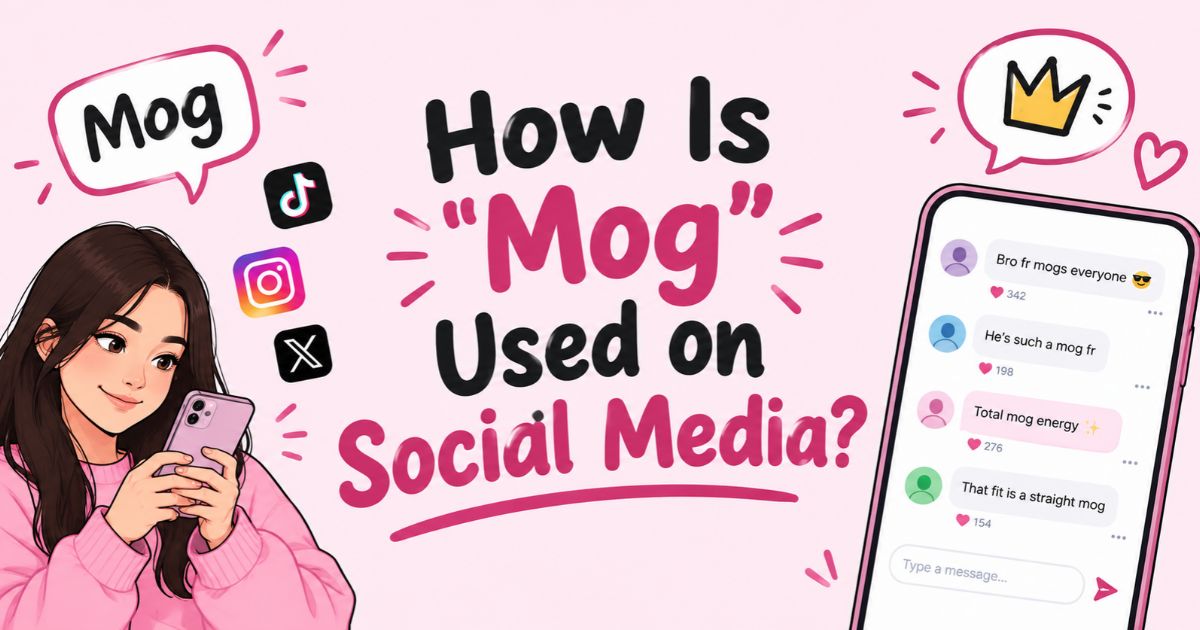
On social platforms, mog works as a quick verdict. You’ll see it in:
- Comment sections: “Mogs everyone in this video.”
- Photo slideshows: Users pair a celebrity with others in the frame and caption who “mogs” whom.
- Gym and fitness content: Creators compare physiques.
- Memes: Often ironic, exaggerated or self-mocking.
- Gaming chats: For dominating a match.
The tone swings between serious rating and pure joke, so reading the room matters.
Mog Meaning TikTok
On TikTok, mog usually means looking better than the people around you. Videos tagged with the word have racked up huge view counts, and creators post slideshows or clips claiming they “mog” classmates or coworkers.
Some TikTok users also use “mog” to mean “man of God,” a separate, unrelated meaning. Context (and the comment section) usually makes it clear which one is intended.
Mog Meaning Cat
In British English, a “mog” or “moggy” is an ordinary, non-pedigree cat. It has nothing to do with the slang above. If a pet owner writes “my mog is asleep on the sofa,” they mean their cat.
Mog Meaning Wedding
In wedding planning, MOG stands for “mother of the groom.” Its counterpart is MOB, “mother of the bride.” You’ll see these abbreviations on guest lists, dress guides and seating charts, and they are unrelated to the slang meaning.
What Does Mog Mean in Looksmaxxing?
Looksmaxxing is an online trend focused on maximizing physical attractiveness through grooming, fitness, skincare, style and, in more extreme circles, cosmetic procedures.
In this world, “mog” is the scoreboard. Members compare themselves to others and talk about who “mogs” whom, sometimes with intense, numbers-driven analysis of faces and proportions.
Critics argue that this culture can be harsh and unhealthy. Experts have also warned that constant appearance rankings can damage self-image, so it’s worth treating the language with some caution.
What Are the “Mog Wars”?
The term “mog wars” refers to online back-and-forth where creators and fans argue over who looks better than whom. Language experts note that these debates put more weight on appearance than on character, and that is where the slang starts to feel less harmless than it sounds.
Not every use is part of that scene, though. When an athlete says they “mogged the competition” after winning gold, they simply mean they outperformed everyone. Always check who is speaking and why before reading too much into the word.
Where Did the Word “Mog” Come From?
The most widely cited origin is AMOG, short for “alpha male of the group.” The term came out of pickup artist circles, where “AMOGing” described asserting dominance over other men in a social setting.
From there, the shortened word spread through:
- Fitness forums and imageboards (4chan’s fitness board is often cited)
- The broader “manosphere”
- Looksmaxxing communities
- TikTok, YouTube and meme culture in the early 2020s
Two older, unrelated meanings exist too. Some dictionaries record “mog” as a dialect word meaning to move along or depart, and one Urban Dictionary entry describes a Norfolk, England use meaning to trudge through snow.
Why Did Mog Go Viral?
Mog spread for the same reason most slang does: it’s short, easy to say and fits any comparison. One syllable replaces a whole sentence like “he looks way better than everyone else here.”
It also taps into a basic human habit, social comparison. We constantly measure ourselves against the people around us, and mog gives that habit a catchy label. Add short-form video, where a single photo or clip can be ranked in seconds, and the word was bound to travel far beyond its forum roots.
Is Mog a Compliment or an Insult?
It depends on which side of the comparison you’re on.
- To the mogger: A compliment. It signals superiority.
- To the moggee: Often an insult, since it implies you came off worse.
- Among friends: Frequently a joke or playful flex.
The word has roots in a competitive, status-obsessed subculture, so using it on a stranger’s appearance can feel rude or hurtful. When in doubt, save it for yourself or for clear banter.
Also Read This : ASL Meaning in Text
How to Respond If Someone Says You Got Mogged
Being called “mogged” can feel personal, even when it’s meant as a joke. A few simple ways to handle it:
- Laugh it off. Most uses are ironic, and a relaxed reply defuses the moment.
- Remember it’s subjective. Attractiveness varies by taste, culture and lighting, so no single comparison is a fact.
- Set a boundary. If comments keep targeting your looks, tell the person it isn’t funny.
- Step away from the feed. If rating culture starts affecting your mood, mute the accounts or take a break.
If the teasing turns into repeated harassment, treat it as bullying and report it.
Mog vs. Mogging vs. Mogged
| Form | Role | Meaning | Example |
| Mog | Verb / noun | To outclass | “He mogs me.” |
| Mogging | Present participle | Currently outclassing | “She’s mogging right now.” |
| Mogged | Past tense | Was outclassed | “I got mogged.” |
| Mogger | Noun | The one who outclasses | “He’s a mogger.” |
| Moggee | Noun | The one who is outclassed | “I was the moggee.” |
Mog vs. Flex: What’s the Difference?
Both involve showing superiority, but they work differently.
| Mog | Flex | |
| Who does it? | Often happens to someone | Done on purpose |
| Needs a comparison? | Yes, a second person | No |
| Focus | Looks and presence, mostly | Money, gear, achievements, body |
| Intent | Can be accidental | Usually deliberate |
| Example | “He mogged me in that photo.” | “He flexed his new watch.” |
Simple rule: you flex on purpose, but you can mog without trying.
How to Use Mog in a Sentence
Here are natural examples for each form:
Mog (verb)
- “Honestly, his new haircut mogs the old one.”
- “The goalkeeper mogged every striker today.”
Mogging
- “She’s mogging everyone at this wedding.”
- “Stop mogging the group photo!”
Mogged
- “I felt completely mogged next to my brother.”
- “He got mogged by the new guy at the gym.”
Playful, self-aware use
- “I was feeling confident until my cat mogged me in the mirror.”
Tip: Keep it light. Aim the word at yourself or a close friend who’ll laugh.
What Does Mog Mean in Different Contexts?
| Context | Meaning |
| General slang | To outclass or outshine someone |
| Looksmaxxing | To surpass someone’s physical attractiveness |
| Gym / fitness | To have a bigger, better physique |
| Gaming | To dominate other players |
| TikTok | Looking better than people around you; sometimes “man of God” |
| British English | A cat (“moggy”) |
| Weddings | Mother of the groom |
| Dialect | To move along or depart |
Final Thought
The mog meaning is simple at its core: to outclass someone. What makes it tricky is context. Online, it usually points to looks and status. In the UK it might be a cat, and in wedding planning it’s the mother of the groom.
Use the slang carefully. It’s fun among friends, but it comes from a rating-obsessed corner of the internet, and being “mogged” can sting. Know the meaning, read the room, and you’ll never be lost in a comment section again.


1 thought on “What Does Mog Mean in 2026? Definition, Origins & Examples ”