
You have probably heard someone sigh “c’est la vie” after a missed bus, a failed plan, or a burnt dinner. It sounds elegant, and it feels like it says a lot in three words.
So what does it actually mean? In this guide, you will learn the c’est la vie meaning, where the phrase comes from, how to pronounce it, when to use it, and how to reply when someone says it to you.
Quick answer: C’est la vie is a French phrase that means “that’s life.” People say it to accept something unfortunate that they cannot change.
What Does “C’est la Vie” Mean?
C’est la vie (pronounced say lah vee) is a French idiom meaning “that’s life” or “such is life.” It expresses calm acceptance of a disappointing or unlucky situation.
Break it into three parts:
| Word | Meaning | Note |
| C’est | “it is” / “that is” | Contraction of ce + est |
| La | “the” | Feminine definite article |
| Vie | “life” | Feminine noun |
Word for word, it reads “it is life.” The real meaning goes beyond that. It carries a shrug, a half-smile, and the idea that some things just happen.
Definition in a Nutshell
- Dictionary-style definition: An expression used to show acceptance of a setback or an unfortunate event.
- Tone: Resigned, relaxed, sometimes humorous.
- Core message: Life has ups and downs, so let it go and move on.
How Do You Pronounce “C’est la Vie”?
Say it as “say lah vee.” The “s” in c’est sounds like the “s” in “say.” The final “e” in vie is silent. Many English speakers write it as “say la vie” or “se la vie,” but the correct spelling is always c’est la vie.
Origin of “C’est La Vie”
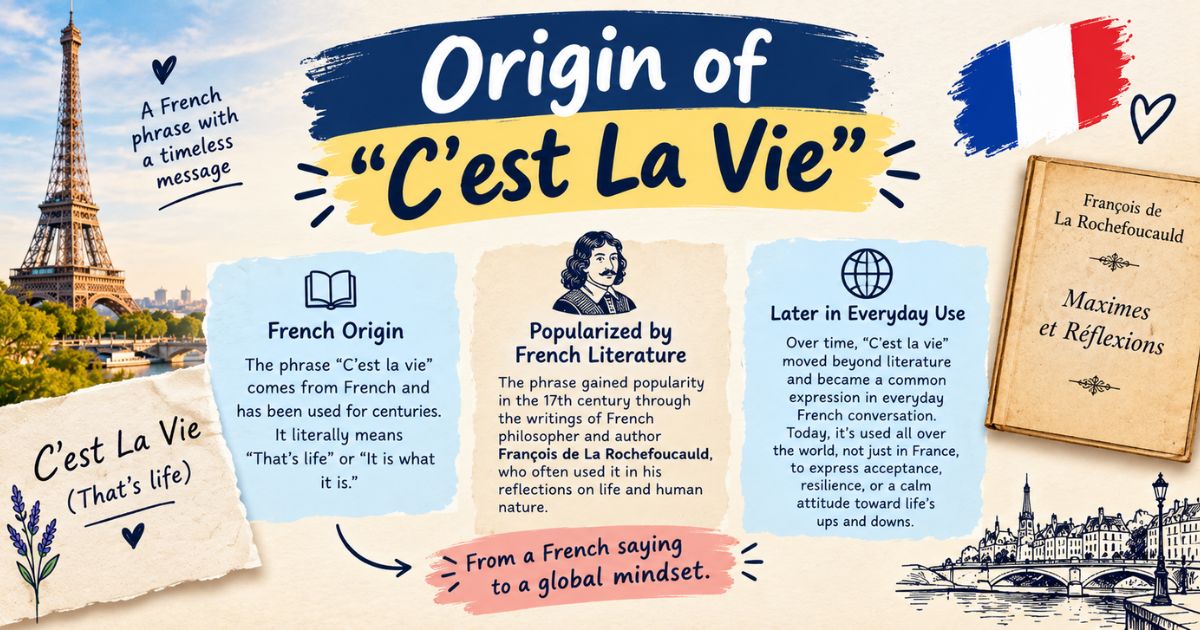
C’est la vie is French. Nobody can point to the exact moment someone first said it, because it grew out of everyday speech. What we do know is that it entered English writing in the late 1800s and has stayed popular ever since.
The phrase fits a long tradition in French culture of treating hardship with a mix of realism and wit. It also sits close to older philosophical ideas such as fatalism and Stoicism: do what you can, then accept what you cannot control.
How It Spread Into English
- Travel and literature: English writers borrowed French expressions to sound worldly.
- War and diplomacy: French was widely known among educated English speakers, so phrases like this crossed over easily.
- Music and film: Many songs and movies use “C’est la vie” as a title, which kept it in public view.
- Social media: Captions, memes, and quotes made it a short, shareable way to shrug off bad news.
Today it is listed as a loanword in major English dictionaries, which means it is a normal part of English, not just French.
C’est La Vie in English
The closest English translation is “that’s life.” Depending on the situation, you can also translate it in other ways.
English Equivalents
- That’s life.
- Such is life.
- Oh well.
- That’s just the way it goes.
- It is what it is.
- Life goes on.
- You win some, you lose some.
Which Translation Fits Best?
| Situation | Best English version |
| Missed a train | “Oh well, that’s life.” |
| Lost a game | “You win some, you lose some.” |
| Plan fell apart | “Such is life.” |
| Something you cannot change | “It is what it is.” |
A Common Mix-Up
Some people confuse ” c’est la vie” with “this is life!”, an expression of joy. They are not the same. C’est la vie is about accepting bad luck, not celebrating good luck, although the word-for-word translation looks similar.
When Should You Use “C’est La Vie”?
Use it when something goes wrong in a small or moderate way and you want to show you are letting it go.
Good Times to Use It
- After a minor setback, such as bad weather ruining your picnic.
- When plans change at the last minute.
- When you want to lighten a mood with gentle humor.
- When you accept a result you cannot change, like missing a deadline you could not control.
- In casual chats, texts, and social media captions.
Example Sentences
- “The flight got cancelled again. C’est la vie.“
- “I did not get the job, but c’est la vie. On to the next one.”
- “The cake collapsed. C’est la vie. We’ll buy dessert.”
- “He forgot our anniversary, c’est la vie,” she joked.
When NOT to Use It
Avoid it when someone is dealing with serious pain, such as grief, illness, or loss. Saying “c’est la vie” to a grieving friend can sound cold and dismissive.
| Use it | Avoid it |
| Minor setbacks | Funerals or serious loss |
| Casual conversation | Formal complaints |
| Self-talk and humor | Brushing off someone’s real problem |
Tip: It works best when you say it about your own situation. Using it to dismiss another person’s problem can feel rude.
C’est la Vie Tattoo

The phrase is a popular tattoo choice because it is short, elegant, and meaningful. It reminds the wearer to stay calm and keep moving forward.
Popular Tattoo Styles
- Script lettering: Flowing cursive on the wrist, collarbone, or ribcage.
- Minimalist text: Small black lettering behind the ear or on the ankle.
- With imagery: Paired with roses, an Eiffel Tower outline, a butterfly, or a clock.
Before You Get It Inked
- Check the spelling. It is c’est la vie, with an apostrophe. Not “cest la vie” or “say la vie.”
- Keep the apostrophe clear. Tiny punctuation can blur over time, so ask your artist to size it properly.
- Pick placement wisely. Short phrases look good on narrow spots like the wrist or forearm.
- Think about meaning. Be sure the “accept and move on” message matches how you want to remember it.
C’est la Vie Language
C’est la vie belongs to the French language, one of the Romance languages that grew out of Latin. It is now a recognized borrowed phrase in English, much like déjà vu, carte blanche, or joie de vivre.
Quick Language Facts
- Language: French
- Part of speech: Idiomatic expression (a set phrase)
- Register: Informal to neutral
- Also used in: English, German, Spanish, and many other languages as a borrowed phrase
Similar Phrases in Other Languages
| Language | Phrase | Meaning |
| Spanish | Así es la vida | That’s how life is |
| Italian | Così è la vita | Such is life |
| German | So ist das Leben | That’s life |
| Dutch | Het is niet anders | It is what it is |
Related French Phrases
- La vie est belle: Life is beautiful.
- Tant pis: Too bad.
- Ça ne fait rien: It doesn’t matter.
- Qu’à cela ne tienne: Never mind that.
Cest la Vie Meaning in One Word
If you need just one word, the best choices are:
- Acceptance
- Resignation (in a mild, calm sense)
- Fate
The strongest single word is “acceptance.” It captures the idea of seeing a situation clearly and moving on without bitterness.
Other one-word fits include “whatever,” “unavoidable,” and “destiny,” though these can shift the tone.
Cest la Vie Reply
What should you say when someone tells you “c’est la vie”? Your reply depends on the mood.
Friendly and Agreeing
- “Exactly. Life goes on.”
- “True, c’est la vie.”
- “You’re right. Let’s move on.”
Supportive
- “Sorry that happened, but you’re handling it well.”
- “Want to grab a coffee and forget about it?”
Playful
- “Oui, c’est la vie!“
- “Such is life, my friend.”
- “Well, tomorrow’s a new day.”
Sample Exchange
Friend: “I missed the last bus again.” You: “Ouch. C’est la vie. Let’s take a cab.”
Reply Quick Guide
| Mood | Good reply |
| Casual | “Yep, that’s life.” |
| Kind | “Hang in there.” |
| Funny | “Oui, oui, c’est la vie!“ |
| Encouraging | “Tomorrow will be better.” |
The Philosophy Behind “C’est La Vie”
Beyond a casual shrug, the phrase reflects a way of thinking. It asks you to separate what you can control from what you cannot. You still plan, work, and try. When the result goes the other way, you do not stay stuck in frustration.
This mindset offers a few practical benefits:
- Less stress: You stop replaying things you cannot change.
- Faster recovery: Letting go makes it easier to try again.
- Better perspective: A spilled coffee looks smaller when you remember the bigger picture.
Importantly, c’est la vie is not the same as giving up. It does not mean you should ignore real problems or stop fighting for what matters. It simply gives you a calm way to deal with the moments that are out of your hands.
Common Mistakes When Using “C’est La Vie”
Even a simple phrase can trip people up. Watch out for these errors:
- Misspelling it. Writing “say la vie,” “se la vie,” or “c’est la vie” is very common. The correct form is c’est la vie.
- Using it for serious loss. It can sound cold when someone is grieving or in real distress.
- Overusing it. If you say it after every minor annoyance, it loses its charm and can sound sarcastic.
- Confusing it with “this is life!” One expresses acceptance of bad luck. The other celebrates a happy moment.
- Wrong pronunciation. Remember the silent final “e” in vie.
Pro tip: Pair it with a light tone. A small smile or a touch of humor makes the phrase feel warm instead of dismissive.
Also Read This : TBH Mean in Text
Related Terms and Synonyms (Quick Reference)
- Que sera, sera (what will be, will be)
- Carpe diem (seize the day)
- Laissez-faire (let it be)
- Joie de vivre (joy of living)
Conclusion
C’est la vie is a short phrase with a big idea: sometimes things go wrong, and the healthiest move is to accept it and keep going. It means “that’s life,” it comes from French, and it has become a familiar part of everyday English.
Use it for small setbacks, say it with a smile, and skip it when someone is truly hurting. Whether you are writing a caption, planning a tattoo, or just replying to a friend, you now know how to use it correctly and confidently.


1 thought on “C’est La Vie Meaning: Best Definition, Origin & Usage 2026 ”