
Ever gotten a text that just says “cya” and paused for a second, wondering exactly what your friend meant? You’re not alone. This tiny three-letter abbreviation shows up everywhere in texts, group chats, comments, and even office emails but it doesn’t always mean the same thing.
In this guide, you’ll learn the real cya meaning in text, where it comes from, how people use it in different situations, and how it’s different from similar abbreviations like CU. By the end, you’ll never second-guess a “cya” text again.
What Does CYA Mean?
At its core, CYA is a casual, phonetic abbreviation of “see ya,” which itself is a relaxed version of “see you.” It’s typically used to say goodbye in an easy, friendly way.
Instead of typing out a full sentence, people shorten it to CYA because it’s faster, casual, and gets the same point across. Unlike most texting acronyms that use the first letter of each word, CYA is based on how the words sound when spoken quickly. “see ya” becomes “C-Y-A.”
What Does CYA Mean in Text Messages?
In everyday texting, CYA almost always means “see you” or “see you later.” It’s a lighthearted way to end a conversation without sounding too formal or distant.
For example, if a friend texts “Gotta run, cya!” they’re simply saying goodbye and expecting to talk or meet again soon. It carries a friendly, upbeat tone rather than a serious one.
In casual chats, CYA usually signals:
- The conversation is wrapping up
- No hard feelings or awkwardness just a normal goodbye
- The sender expects future contact
What Does CYA Stand For?
CYA can technically stand for two different phrases, depending on context:
| Meaning | Full Form | Common Setting |
| Primary meaning | See You (Around) | Texting, social media, casual chats |
| Secondary meaning | Cover Your A** | Workplace, professional slang, emails |
Most of the time, especially in texting between friends, CYA stands for “see you.” The workplace version is far less common in personal messages but still worth knowing, since it pops up in office culture and online forums.
Why People Use CYA in Texting
People reach for CYA instead of typing a full goodbye for a few simple reasons:
- Speed Texting favors short, quick phrases.
- Casual tone It feels relaxed and friendly rather than formal.
- Habit Abbreviations like this have been part of internet culture since early instant messaging.
- Universality Most people instantly recognize what it means, so there’s no need to spell it out.
It’s the texting equivalent of giving someone a quick wave instead of a long, formal handshake.
There’s also a social layer to it. Using shorthand like CYA signals familiarity; it tells the other person you’re comfortable enough with them to skip the “proper” version of a sentence.
Between close friends, family members, or coworkers you talk to daily, dropping in a quick CYA feels natural rather than lazy. It’s less about cutting corners and more about matching the rhythm of a fast, back-and-forth conversation, where long goodbyes would actually feel out of place.
Where You Might See CYA Online
CYA isn’t limited to text messages. You’ll spot it in plenty of digital spaces, including:
- Text messages and SMS
- Instagram and Facebook comments
- Snapchat captions
- Discord and gaming chats
- Twitter/X replies
- Casual work Slack messages (usually the “see you” version)
Because it’s so widely recognized, CYA has become one of those universal internet shorthand terms that barely needs explaining anymore.
Examples of CYA in Sentences
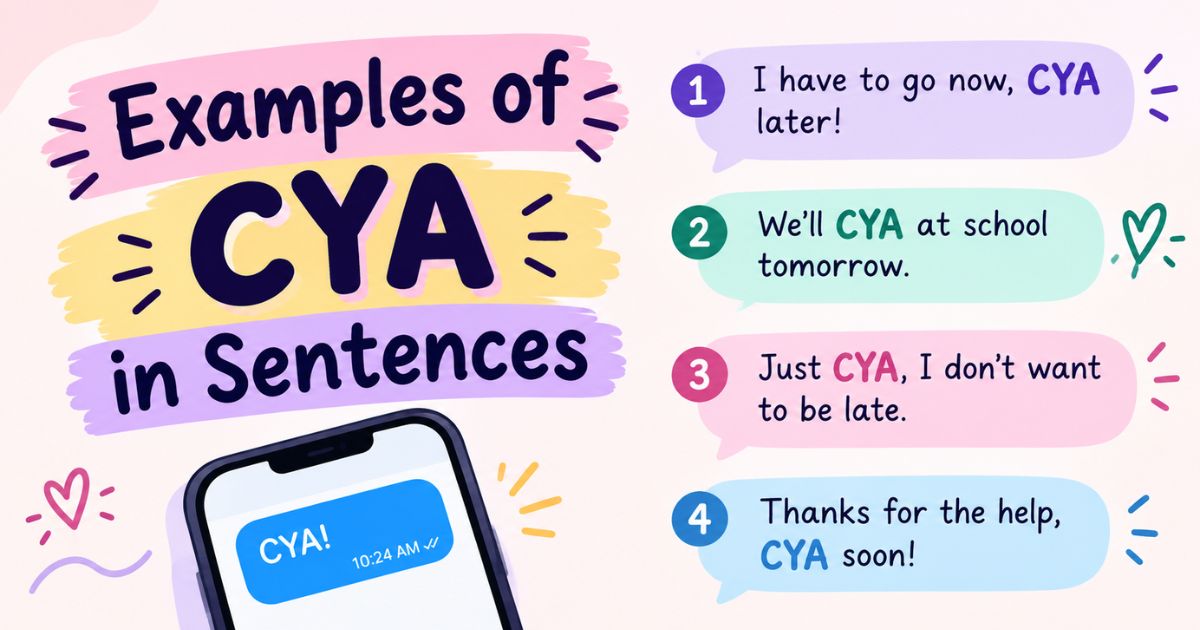
Here are a few natural examples showing how CYA fits into everyday conversations:
- “Heading out now, cya tomorrow!”
- “Great catching up. Cya soon!”
- “I’m logging off, cya later.”
- “Class is over, cya guys next week.”
Notice how in every example, CYA is used as a light, friendly sign-off rather than anything serious.
Another Meaning of CYA (Less Common)
While “see you” is the go-to meaning in texting, CYA also stands for “Cover Your A,”** a phrase used mostly in professional or workplace settings.
This version means to protect yourself from blame, criticism, or future problems by keeping records, sending confirmation emails, or documenting decisions. For example, a coworker might say, “Send that follow-up email just CYA,” meaning “protect yourself in case something goes wrong later.”
This meaning is almost never used between friends in casual texting. Context makes the difference obvious if it’s a personal chat, it’s “see you.” If it’s workplace advice about avoiding blame, it’s the other meaning.
Difference Between CYA and CU
Both CYA and CU are commonly texting goodbyes, but they’re not identical.
| Abbreviation | Meaning | Tone | Common Use |
| CYA | See You (Around) | Friendly, casual | Ending a chat, general goodbye |
| CU | See You | Very brief, informal | Quick goodbyes, gaming chats |
CU is even shorter and more clipped than CYA, often used in fast-paced settings like gaming or live chat. CYA feels slightly warmer and more conversational, almost like saying “catch you later” out loud.
Situations Where People Use CYA
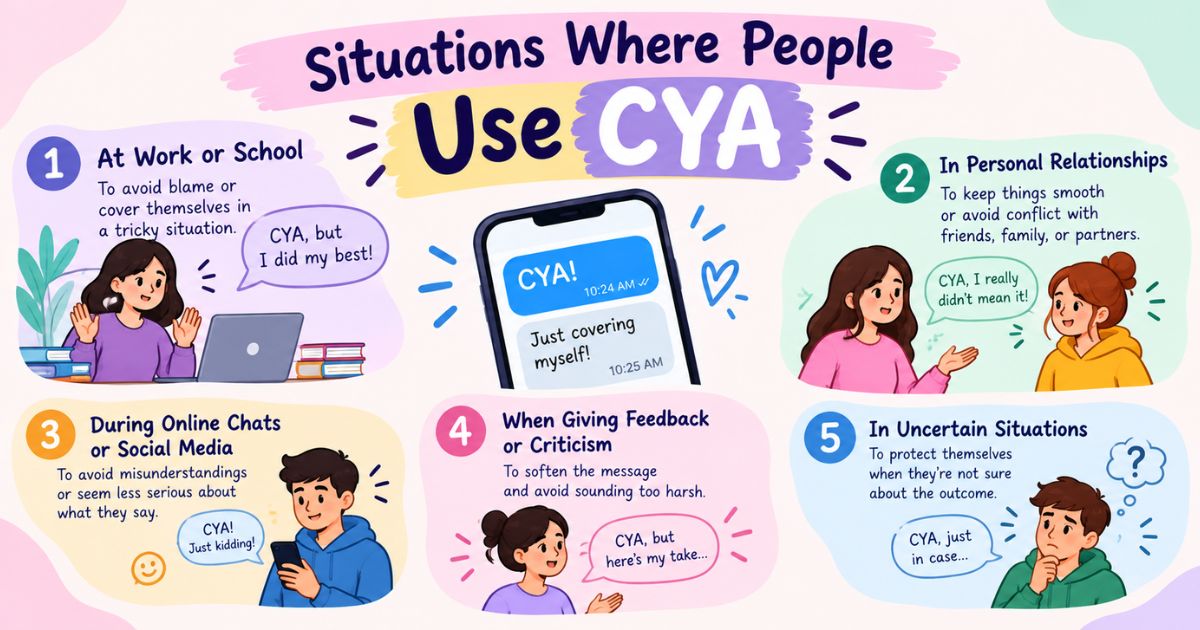
CYA fits naturally into many everyday scenarios, such as:
- Ending a phone or video call follow-up text
- Wrapping up a group chat conversation
- Signing off from an online gaming session
- Saying goodbye after meeting someone in person
- Closing out a casual work message with a colleague
Because it’s flexible and low-effort, CYA works in almost any informal setting where a full goodbye sentence would feel unnecessary.
Why Internet Abbreviations Are Popular
Abbreviations like CYA didn’t appear overnight; they grew out of necessity. In the early days of texting and instant messaging, character limits and slow typing speeds pushed people to shorten everything possible.
Over time, these shortcuts became part of everyday digital language because they:
- Save time while typing
- Keep conversations feeling casual and natural
- Create a shared, informal “code” among friends and online communities
- Work well across different platforms and devices
Even as technology has improved, the habit has stuck around simply because it’s efficient and familiar.
Other Common Texting Abbreviations
CYA is just one of many abbreviations people use daily. Here are a few similar ones you’ll likely recognize:
- BRB – Be right back
- TTYL – Talk to you later
- GTG – Got to go
- IDK – I don’t know
- OMW – On my way
Like CYA, these terms exist to make digital conversations faster and more casual.
Many of these abbreviations also travel together in the same conversations. It’s common to see a text that combines several at once, like “OMW, gtg after, cya!” a full exchange packed into just a few characters.
Learning one or two of these shortcuts naturally makes the rest easier to recognize, since they all follow the same basic idea: strip a common phrase down to its sound or first letters so it’s quicker to type and just as quick to read.
The Growth of Internet Slang
Internet slang has expanded massively since the early days of chat rooms and flip-phone texting. What started as simple space-saving shortcuts has grown into an entire informal language shared across platforms, generations, and countries.
Social media, gaming communities, and messaging apps have all played a role in spreading terms like CYA far beyond their original context. Today, this kind of shorthand is so normalized that it often shows up in casual emails, comment sections, and even marketing copy aimed at younger audiences.
Interestingly, slang like CYA has managed to survive multiple shifts in technology from flip phones with limited character counts, to smartphones with full keyboards and voice-to-text, to now, where autocomplete could easily type out the full phrase in a second.
The fact that people still choose to type “cya” instead of “see you” shows that the appeal isn’t just practical anymore; it’s cultural. Short forms like this have become a style choice, a way of signaling tone and personality rather than just saving keystrokes. That’s part of why new abbreviations keep emerging even as typing gets faster and easier.
How to Remember the CYA Meaning
A simple trick to remember CYA’s meaning is to say it out loud. When spoken quickly, “C-Y-A” sounds almost exactly like “see ya.” That phonetic connection is the easiest way to lock in the meaning.
If you ever come across it in a workplace or serious context and it doesn’t quite make sense as “see you,” it’s likely referring to the “cover yourself” meaning instead.
Also Read This : JS Meaning in Text
When You Should Not Use CYA
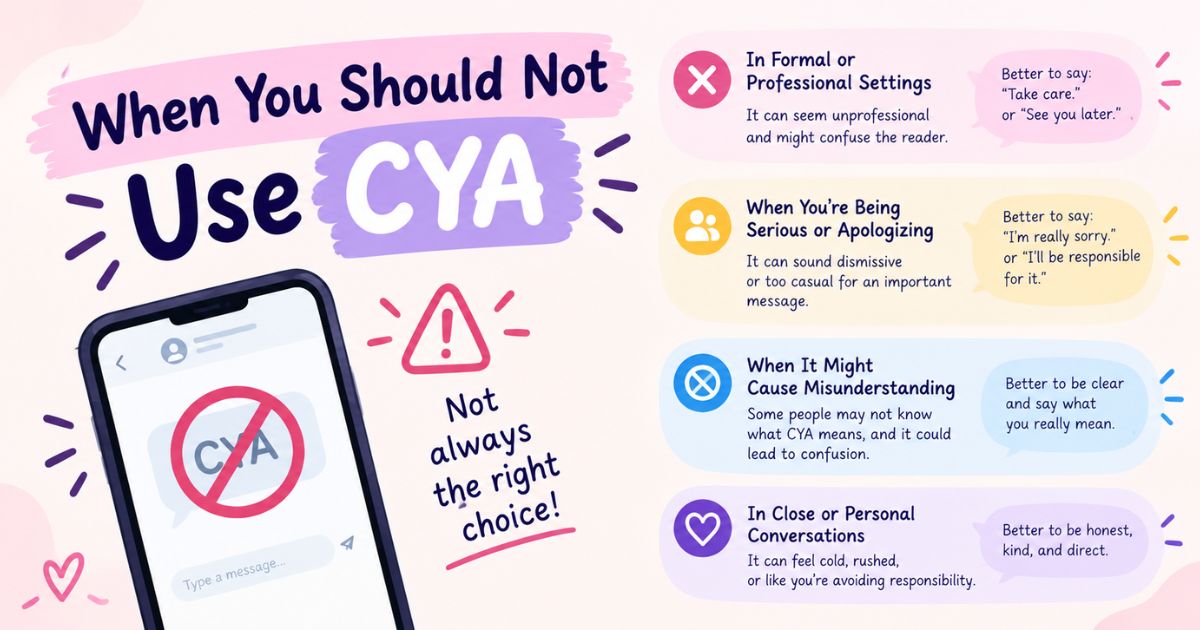
While CYA is fine for casual chats, there are times it’s best avoided:
- Formal emails – Stick to a proper closing like “Best regards.”
- Professional introductions – It can come across as too casual.
- First-time conversations with someone you don’t know well
- Customer service or business communication
Using CYA in the wrong setting can make a message feel unprofessional, even if that wasn’t the intention.
A Simple Conversation Example
Here’s how CYA might naturally appear in a real text exchange:
Alex: Hey, are we still meeting later? Jordan: Yep, see you at 6! Alex: Perfect, cya then!
Short, friendly, and casual exactly how CYA is meant to be used.
Conclusion
So, what does CYA mean in text? In most everyday conversations, it simply means “see you” or “see you later” a quick, friendly way to say goodbye. In rarer cases, especially at work, it can mean “cover your a**,” which is all about protecting yourself from blame.
Knowing the context is key. Between friends, CYA is nothing more than a casual sign-off. In a professional setting, it might carry a completely different message. Either way, now you’ll never be confused the next time someone types “cya” at the end of a chat.


1 thought on “CYA Meaning in Text: What Does CYA Really Mean? [2026] ”