
If you’ve ever been mid-conversation on WhatsApp or Snapchat and someone replied with a plain “idm,” you’ve probably paused for a second. Is it a typo? A brand name? Some new slang you missed?
You didn’t miss much, you just ran into one of the internet’s most low-key useful acronyms. IDM has quietly become a staple of casual texting, especially among people who’d rather type three letters than a full sentence when they genuinely don’t have a strong opinion about something.
This guide breaks down everything the term covers in 2026: its texting meaning, its origin, how it shows up differently depending on who’s sending it and where, and how it compares to lookalikes like IDK and IDC. By the end, you’ll never have to guess again.
What Does IDM Mean in Text & Chat?
In everyday texting and chat apps, IDM stands for “I Don’t Mind.” It’s used when someone is being asked to choose between options, and they genuinely have no strong preference either way.
It’s the digital version of shrugging your shoulders and saying “whatever’s fine with me.” Instead of typing out a full sentence, people shorten it to three letters that get the same message across instantly.
Example:
Friend: “Should we get tacos or ramen tonight?” You: “idm, you pick 😊”
Some people also use it to mean “It Doesn’t Matter,” which carries a nearly identical tone of mild indifference paired with a willingness to go along with whatever the other person wants.
Idm Meaning in English
In plain English, IDM simply translates to “I don’t mind” a short way of saying you’re okay with something, flexible about a decision, or not bothered either way. It doesn’t carry any negative weight; it’s neutral, easygoing, and agreeable.
Idm Meaning from a Girl
When a girl sends “idm” in a chat, it almost always still means “I don’t mind” but tone and context matter more here than the letters themselves. In a casual group chat, it’s just her being easygoing about plans.
In a one-on-one or flirty conversation, “idm” can also be read as a soft, low-pressure way of agreeing to something without seeming overly eager to think of it as the texting equivalent of playing it cool. If you’re unsure, the safest move is to ask a quick follow-up question rather than assume a hidden meaning.
When Should You Use IDM in a Conversation?
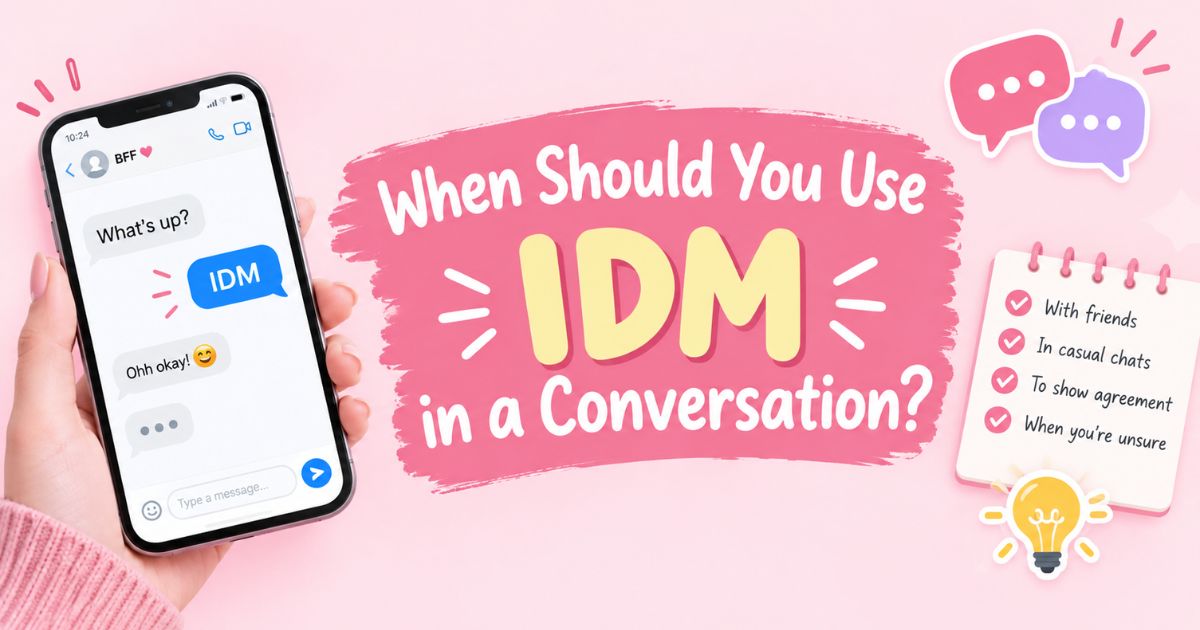
IDM works best in casual, low-stakes situations where a fast reply keeps the conversation moving. Good moments to use it include:
- Choosing between food, movies, or hangout spots
- Agreeing to a time or place change
- Responding to a friend’s suggestion when you’re genuinely flexible
- Quick group chat decisions where nobody wants to overthink it
Avoid using IDM in professional emails, formal messages, or situations where clarity really matters (like confirming a job offer or a medical appointment). In those cases, a full sentence like “That works for me” reads as more polished and less ambiguous.
IDM vs. IDK and IDC: What Is the Difference?
These three acronyms get mixed up constantly because they all start with “I D,” but they mean very different things. Here’s a quick side-by-side comparison.
| Acronym | Full Form | Meaning | Tone |
| IDM | I Don’t Mind | You’re flexible and open to any option | Neutral, easygoing |
| IDK | I Don’t Know | You genuinely have no answer or information | Uncertain |
| IDC | I Don’t Care | You have no interest in the outcome at all | Can sound dismissive or apathetic |
The key distinction: IDM signals flexibility, IDK signals uncertainty, and IDC signals indifference (sometimes bordering on rudeness, depending on tone). Using IDC when you mean IDM can accidentally come across as cold, so it’s worth knowing which one actually fits the moment.
Full Form, Stands For & Short Meaning of IDM
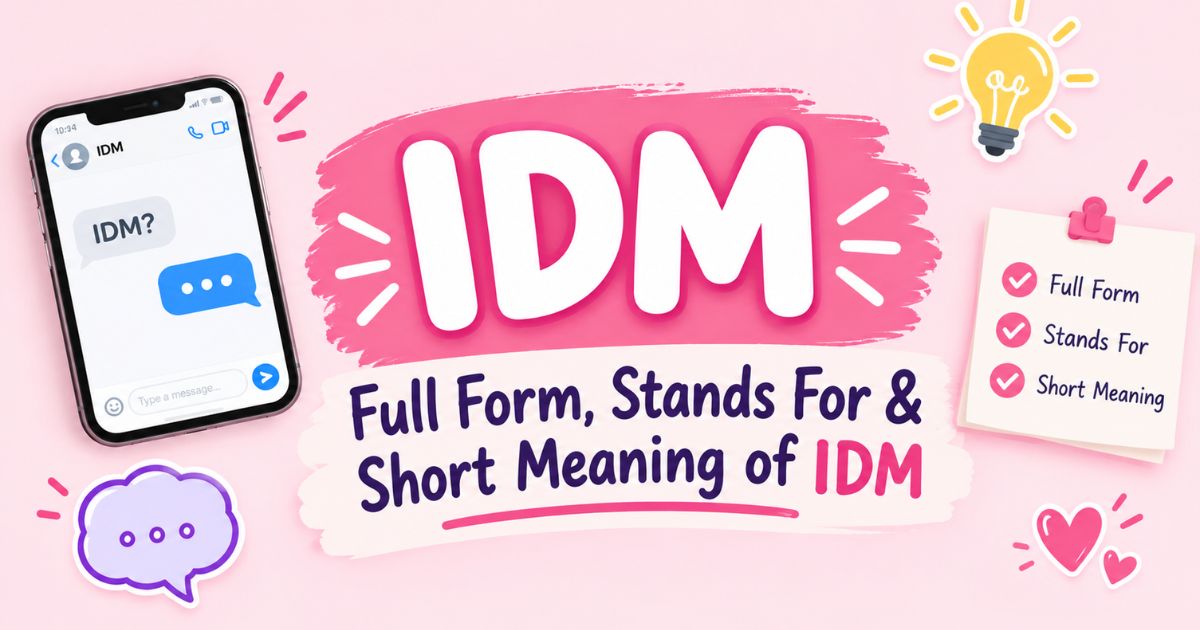
Depending on where you see it, IDM can stand for several different things. In texting and social media, though, one meaning dominates:
- Most common (texting/chat): I Don’t Mind
- Also used casually: It Doesn’t Matter
- In music: Intelligent Dance Music
- In tech/business: Identity Management
For everyday chat purposes, if you see IDM with no other context clues, “I Don’t Mind” is the safest and most likely interpretation roughly nine times out of ten.
Origin, History & First Known Use of IDM
Like most internet abbreviations, IDM wasn’t invented by one person on one specific date; it evolved naturally out of necessity.
During the early SMS and instant-messaging era, character limits and slow numeric keypads pushed people to shorten common phrases. “I don’t mind” became “idm” for the same reason “I don’t know” became “idk.”
The term picked up real momentum alongside the rise of smartphone texting and character-limited platforms like early Twitter, where brevity wasn’t just convenient it was often required.
As messaging apps like WhatsApp, Instagram DMs, and Snapchat grew, IDM carried over naturally into that space, becoming a normal part of casual digital vocabulary rather than a fleeting trend.
By the 2020s, it had settled comfortably into everyday teen and young-adult texting culture, sitting alongside other staples like “idc,” “idk,” and “tbh.”
How People Use IDM in Daily Conversations
In practice, IDM shows up most often when someone is asked to make a low-stakes decision. A few real-world patterns:
- Answering “what do you want to do” questions “idm, up to you”
- Agreeing to schedule changes “Can we push it to 6? / idm at all”
- Responding to opinion-based questions “Which filter looks better? / idm, both are cute”
- Signaling you’re easy to please in group planning threads
It’s rarely used to open a conversation, it’s almost always a response, since it requires something to be flexible about in the first place.
IDM Meaning Across WhatsApp, Instagram, TikTok & Snapchat
While the core meaning stays the same everywhere, the way IDM gets used shifts slightly depending on the platform’s culture.
On WhatsApp, IDM usually appears in one-on-one chats or family/friend group threads when finalizing plans for dinner spots, meeting times, or weekend activities. It keeps fast-moving group conversations efficient.
On Instagram, you’ll spot IDM in DMs and comment replies, often when someone’s asked for their opinion on a post, outfit, or caption idea. It’s a quick, casual nod of approval or flexibility.
TikTok
On TikTok, IDM mean shows up in comment sections and captions, frequently in a lighthearted or joking tone sometimes even used playfully rather than literally, matching the platform’s informal humor.
Snapchat
Snapchat is arguably where IDM mean feels most at home. Because Snapchat conversations tend to be quick, visual, and disappearing, short slang like IDM mean fits naturally into snaps and chat replies where typing less is part of the appeal.
Different Meanings of IDM in Other Fields
Outside of texting, IDM mean has completely unrelated meanings depending on the industry or context.
Intelligent Dance Music
In music, IDM mean stands for Intelligent Dance Music, a genre of electronic music known for its complex rhythms, experimental sound design, and departure from typical dance-floor structures.
Artists associated with this genre prioritize intricate production over straightforward beats, and the term is widely used on music forums, streaming platforms, and by producers describing their style.
Identity Management
In technology and business, IDM (or IdM) refers to Identity Management the systems and processes organizations use to manage user identities, permissions, and access to digital resources.
This is common in IT departments, cybersecurity discussions, and enterprise software documentation, and has nothing to do with the casual texting meaning.
Common Confusions, Mistakes & Wrong Interpretations
Because IDM mean shares letters with several other terms, mix-ups happen often:
- Mistaking it for “IDM” the software Internet Download Manager, a popular download tool, is a completely separate thing and unrelated to texting slang.
- Confusing it with IDC assuming someone doesn’t care when they actually mean they’re fine either way.
- Reading too much into it in flirty contexts sometimes “idm” really is just indifference, not a hidden signal.
- Using it in formal writing it can come across as unprofessional or overly casual in emails or workplace messages.
Similar Terms, Alternatives & Related Slang
If you want variety beyond IDM mean, here are commonly used alternatives with similar meanings:
- IDC – I Don’t Care
- IDK – I Don’t Know
- NVM – Never Mind
- WYW – Whatever You Want
- UTM – Up to Me/You (context-dependent)
- Whatevs – Casual version of “whatever”
Examples of IDM in Real Chat Situations
Here are a few natural, real-world exchanges showing IDM mean in context:
- Planning a hangout: “Want to meet at the mall or the park?” → “idm, either is good”
- Group project chat: “I can present first or last, doesn’t matter to me either.” → “idm too, whoever wants to go can go”
- Casual dating text: “Coffee or a walk for our first date?” → “idm, surprise me”
How to Reply When Someone Says IDM
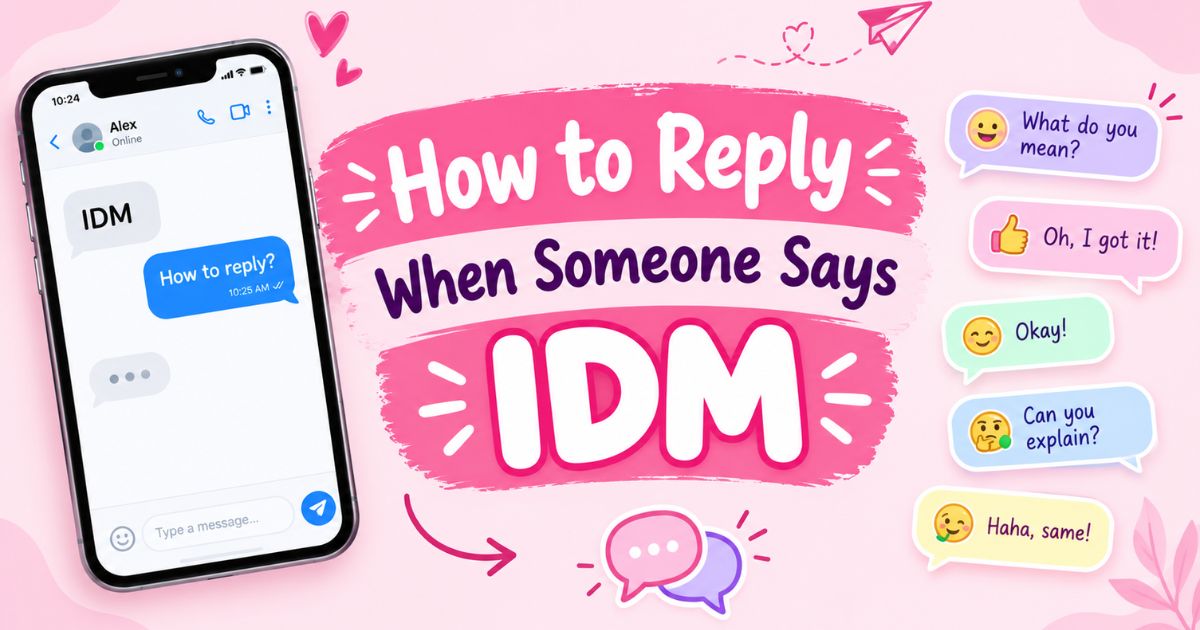
When someone replies with IDM mean, it’s your cue to make the final call. Good responses include:
- Picking an option yourself and confirming it
- Offering one more choice to see if they lean one way
- Simply moving forward with a plan, since they’ve already signaled flexibility
Avoid leaving the conversation stuck in a loop of “idm mean” back and forth one person eventually needs to decide.
Is IDM Still Popular? Trends & Online Usage
Yes IDM mean remains widely used heading into 2026, especially among younger texters on Snapchat, Instagram, and group messaging apps.
It hasn’t faded the way some older internet slang has, largely because it fills a genuinely useful gap: expressing flexibility without sounding indifferent or dismissive.
As predictive text and AI-assisted messaging become more common, short, efficient phrases like IDM mean are likely to stick around rather than disappear.
Also Read This : SF Secretly Mean in Chats
Conclusion
At its core, IDM mean is a simple, friendly way to say “I’m flexible, you choose.” While it can carry different meanings in music (Intelligent Dance Music) or tech (Identity Management), in everyday texting and social media, “I Don’t Mind” is by far the most common interpretation.
Knowing the difference between IDM, IDK, and IDC and reading the context around each message will help you avoid mix-ups and keep your conversations smooth, casual, and clear.


1 thought on “What Does IDM Mean in Text & Chat? Full Meaning (2026) ”