
You’ve seen it on a phone screen, in a movie about a shipwreck, and maybe in a text from a friend. So what does SOS actually meaning? Most people say “Save Our Souls” or “Save Our Ship.” Both answers are popular. Both are wrong.
SOS is an international distress signal. It doesn’t stand for anything. It’s a Morse code pattern (three dots, three dashes, three dots) picked because it’s easy to send and impossible to confuse with other messages.
This guide covers the SOS full form myth, where the signal really came from, what it means on your phone and in chat, and how to read it in any situation.
What Does SOS Stand For? (Quick Answer)
SOS isn’t an acronym or an abbreviation. It has no official full form. The letters were chosen only because they make a distinctive Morse code rhythm:
· · · — — — · · ·
Morse operators send it as one continuous run. That’s why it’s technically called a prosign rather than three separate letters.
| Question | Short Answer |
| Is SOS an acronym? | No |
| Official SOS full form? | None exists |
| Morse code pattern | · · · — — — · · · |
| Common (false) full forms | Save Our Souls, Save Our Ship |
| What it signals | “I’m in danger and need help now” |
The Real Origin of SOS: A 1905 German Innovation
The story starts in the early days of wireless telegraphy. Ships had radios, but there was no shared emergency code. Operators used whatever their company preferred.
Here’s how the signal came together:
- Early 1900s: Different wireless companies used different distress calls. The most famous was CQD, introduced by the Marconi Company in 1904.
- 1905: The German government introduced the three-dot, three-dash, three-dot sequence in its radio regulations. The goal was a signal that stood out from routine telegraph traffic.
- 1906: The International Radiotelegraph Convention in Berlin adopted SOS as the international standard.
- 1908: The rules took effect worldwide.
- 1912: During the Titanic disaster, operators sent both CQD and SOS. The event helped cement SOS in public memory.
Why that pattern? It’s simple. A tired operator on a sinking ship can send it without thinking. A listener can pick it out through static, even without knowing Morse code.
Does SOS Stand for Anything? Debunking the Myth
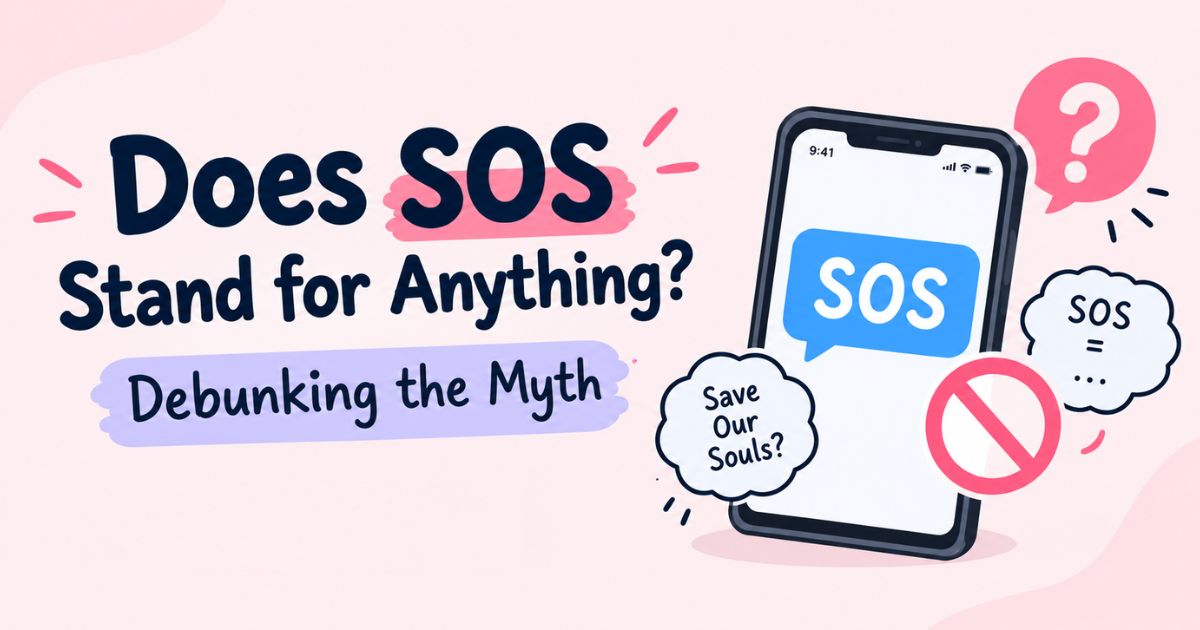
No. But people love a good story, so several explanations stuck.
Popular Backronyms
A backronym is a phrase invented after the fact to fit existing letters. These are the usual suspects:
- Save Our Souls
- Save Our Ship
- Send Out Succour
- Stop Other Signals
None of them appeared in the original regulations. The signal existed first. The phrases came later, mostly because “SOS” is easier to remember when it means something.
Why the Myth Won’t Die
Humans like labels. Three random letters feel incomplete, so we fill in the blanks. Movies, songs, and cartoons helped. The “Save Our Souls” version sounds dramatic, and it sticks.
If you hear someone say it, you don’t need to correct them. Just know that the true SOS full form is… there isn’t one.
SOS in Emergencies: When Every Second Counts
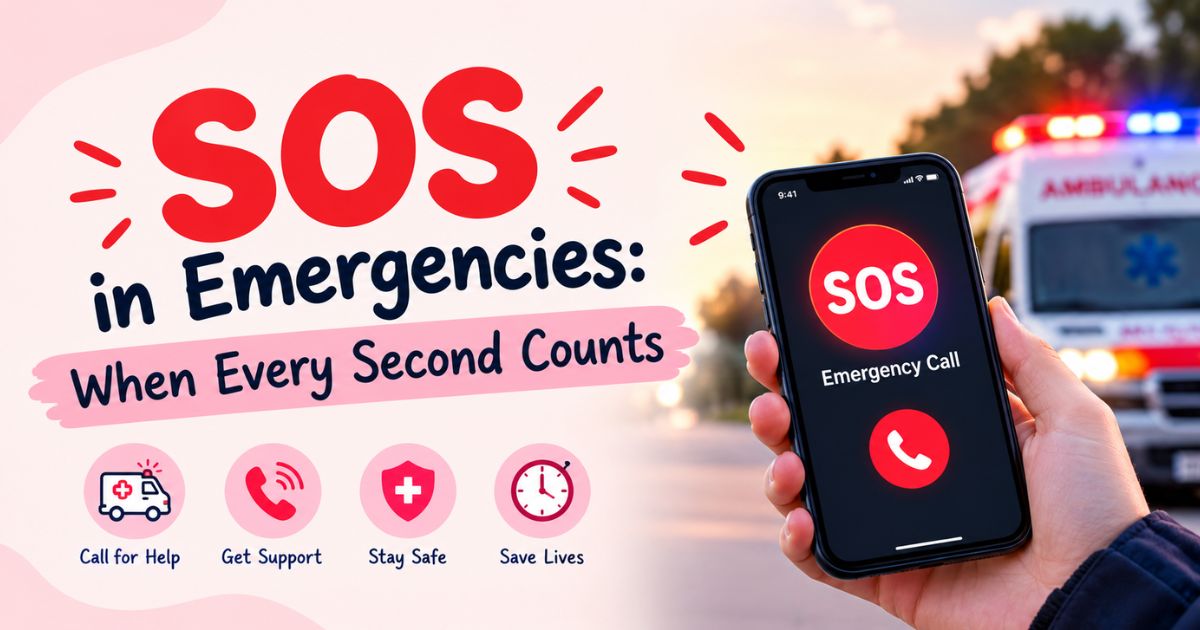
In its original role, SOS means one thing: life or property is in immediate danger. It isn’t for minor problems.
Today, SOS shows up in many forms:
- Radio and maritime: Ships now rely mostly on digital systems like satellite beacons, but the SOS signal remains recognized.
- Wilderness survival: Three of anything (three whistle blasts, three fires, three flashes of light) is a widely taught distress pattern. SOS in Morse can be flashed with a torch or mirror.
- Ground signals: Stones, branches, or tracks in sand can spell “SOS” so aircraft can spot it.
- Personal safety devices: Satellite messengers and hiking beacons often have a dedicated SOS button.
SOS Meaning in Phone: Emergency SOS and “SOS Only”
This is one of the most searched meanings, and it confuses a lot of people.
What “SOS” or “SOS Only” in your iPhone status bar means: your phone can’t connect to your own carrier, but it can still make emergency calls using any available network. It does not mean you’ve triggered an alert, and it doesn’t mean your phone is broken.
Common reasons it appears:
- You’re in a weak-signal area
- Your carrier has an outage
- Your SIM card or account has an issue
- Your phone is in the middle of a network handoff
Quick fixes: move to a better-signal area, toggle Airplane Mode on and off, restart the phone, or check your carrier’s outage page.
Emergency SOS as a feature is different. On many phones you can trigger it on purpose, usually by pressing the side or power button several times, or by holding certain button combinations.
The phone then calls local emergency services and can share your location with your emergency contacts. On iPhone 14 and later, Emergency SOS via satellite lets you text emergency services when there’s no cellular coverage. Button combinations vary by model and software version, so check your phone’s settings.
| Phone Display | What It Means | Can You Call Emergency Services? |
| SOS | No home carrier, but emergency network available | Yes |
| SOS Only | Same as above | Yes |
| No Service | No network found at all | Not reliably |
| Emergency SOS (feature) | You activated the emergency alert | Yes, it calls automatically |
SOS vs Other Distress Signals: What’s the Difference?
SOS isn’t the only signal out there. Here’s how it compares.
| Signal | Type | Origin | Used For |
| SOS | Morse code (· · · — — — · · ·) | German regulations, 1905 | Telegraph, light, sound signals |
| Mayday | Spoken, said three times | From French m’aider (“help me”), proposed in 1923 | Voice radio, life-threatening emergencies |
| Pan-Pan | Spoken, said three times | From French panne (breakdown) | Urgent but not life-threatening situations |
| CQD | Morse code | Marconi Company, 1904 | Older distress call, largely retired |
The simple rule: SOS is for Morse or visual signals. Mayday is what you say on the radio. Pan-Pan means “we have a serious problem, but nobody’s life is at stake right now.”
SOS in Texting and Social Media: The Casual Side
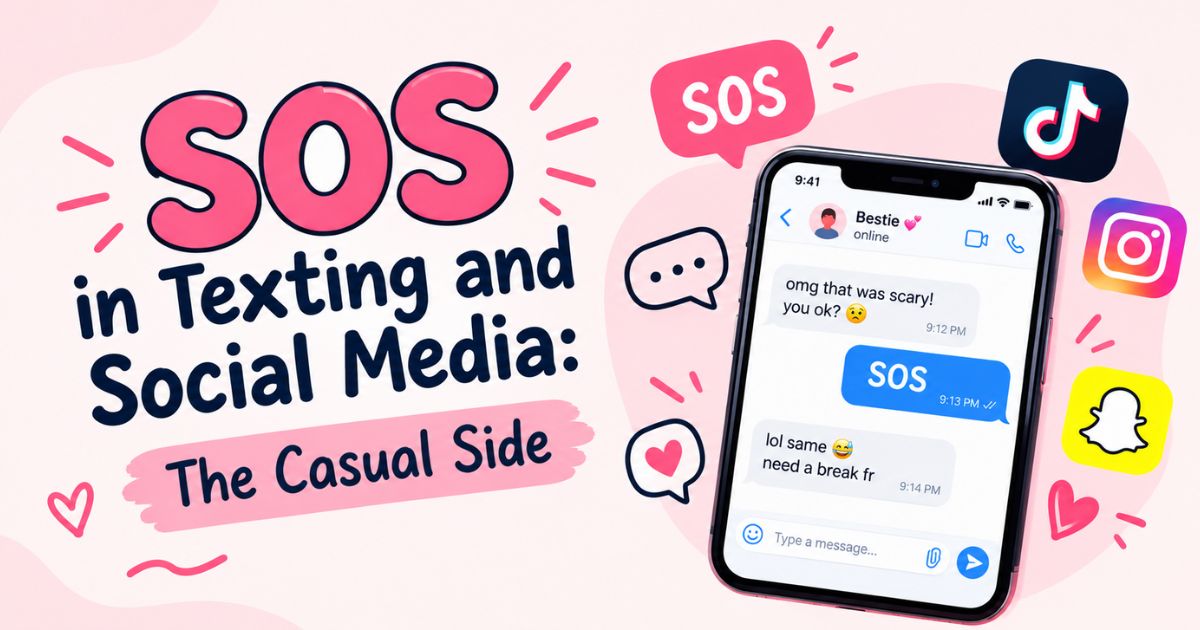
Outside emergencies, SOS has picked up a second life as slang. Context tells you which meaning is in play.
SOS Meaning in Chat
In group chats and on social media, SOS usually means “I need help”, but not always in a literal sense. It’s often dramatic or joking.
- “SOS, I have nothing to wear tonight.” (playful)
- “SOS, my laptop just died before my deadline.” (stressed but not dangerous)
- “SOS, can someone explain this assignment?” (a quick call for help)
If a close friend or family member sends a plain “SOS” with no joke attached, check in. A one-word message from someone you trust can be real.
Other Slang Meanings of SOS
| Meaning | Where You’ll See It |
| Same Old Stuff | Casual chat, when nothing’s changed |
| Same Old S***… | Informal, venting, usually among friends |
| Secretary of State | News and politics |
| “Sos” (Spanish) | In parts of Latin America, vos sos means “you are” |
SOS Meaning Slang “Sorry”: Is That Real?
You might see this search term, but “sorry” isn’t a recognized meaning of SOS. Sometimes people shorten “sorry” to “sos” as a typo or a playful abbreviation, particularly when typing fast. It isn’t standard slang. If someone writes “sos” after a mistake, the context will make it obvious, and a quick “sorry?” back clears it up.
How to Know What SOS Means in Any Context
Don’t guess. Run through this short checklist:
- Where did you see it? A phone status bar means network issue. A ship or hiking device means emergency. A text means look at the tone.
- Who sent it? A friend joking around is different from a family member who never uses slang.
- What’s around it? Emojis, jokes, and exclamation marks usually signal casual use.
- Is there a time element? “SOS now” or “SOS call me” can signal urgency.
- Still unsure? Ask. Replying “You okay?” costs nothing.
Quick Context Guide
| Context | Most Likely Meaning |
| Ship, plane, hiker, or radio | Real emergency |
| iPhone or Android status bar | Emergency calls only, no regular signal |
| Group chat with jokes | “I need help,” lightly |
| Message from a worried family member | Treat as urgent, call back |
| News headline | Possibly Secretary of State |
Real-Life Examples of SOS in Action
Titanic (1912): After striking an iceberg, the ship’s wireless operators sent distress calls, including CQD and SOS. The disaster pushed the world toward stricter radio safety rules.
Hikers and trekkers: Lost walkers have used torch flashes, whistle blasts, and ground markings to signal rescuers. Even people unfamiliar with Morse code often know to flash “three short, three long, three short.”
Phone emergencies: Drivers stuck in remote areas with no carrier coverage have used Emergency SOS features to reach rescuers. Features like satellite messaging exist for this exact situation.
Pop culture: Songs, movies, and cartoons keep the signal alive. Stranded characters spelling “SOS” in sand on a desert island is practically a cliché, which proves how widely understood it is.
Also Read This : TS Mean in Text
Final Thoughts
SOS means “I need help right now.” It doesn’t stand for “Save Our Souls,” and it never did. It was chosen in 1905 because the pattern is clean, memorable, and hard to mistake.
Today it works on three levels: as a real distress signal for emergencies, as a phone status that tells you only emergency calls are available, and as casual slang when your group chat needs a favor. Read the context, trust your instincts, and if a message feels serious, treat it that way.
Remember: If you’re ever in real danger, contact your local emergency number immediately. Don’t wait.



1 thought on “SOS Meaning: What Does SOS Stand For? The Real Answer 2026”