If you’ve seen ISK pop up in a text, a Snapchat reply, or an Instagram comment and had no idea what it meant, you’re not alone. This tiny abbreviation shows up everywhere in casual digital conversation, yet almost nobody explains it clearly the first time you see it.
In this guide, you’ll get a simple, no-fluff breakdown of what ISK means, where it came from, how it’s used across different apps, and how to reply when someone sends it to you. By the end, you’ll never have to Google it again.
What Do ISK Mean in Text?
ISK most commonly stands for “I Should Know.” People use it when they’re expected to already know something — whether they actually remember it or not.
It’s a casual, tone-driven abbreviation, which means its exact meaning shifts slightly depending on the conversation. In some chats, it signals mild embarrassment (“I should know this, but I forgot”). In others, it signals confidence (“I should know, because I’ve been through it myself”).
Quick examples:
- “What’s her last name again? ISK 😅” (I should know this, but I blanked)
- “Long distance relationships are tough… ISK.” (I know from experience)
- “ISK, I studied that exact question yesterday.” (Acknowledging prior knowledge)
There’s also a second, completely unrelated meaning worth knowing: ISK is the official currency code for the Icelandic Króna, Iceland’s national currency. Context almost always makes it obvious which meaning applies — texting slang shows up in casual chats, while the currency code shows up in financial or travel-related content.
Clear Meaning of ISK in Simple Words
Strip away the context and tone, and ISK boils down to one simple idea: “I’m supposed to know this.”
Think of it as a shorthand admission. Instead of typing out a full sentence, people compress the thought into three letters. It’s similar to how “IDK” replaced “I don’t know” — except ISK carries a slightly different emotional flavor. Where IDK expresses pure uncertainty, ISK expresses an expectation of knowledge, even if that knowledge isn’t fully there in the moment.
In plain terms:
- ISK = a quick way of saying “I should already know that.”
- It can express mild embarrassment, self-awareness, or lived experience.
- The tone (emojis, punctuation, capitalization) usually tells you which one applies.
What Does “I Should Know” Really Mean?
“I Should Know” is a phrase people use when they feel a sense of responsibility or expectation around a piece of information. It doesn’t always mean the person actually knows the answer — often, it means the opposite.
There are generally three emotional undertones behind it:
- Genuine confidence – “I should know, I’ve done this a hundred times.”
- Mild embarrassment – “I should know this, but I’ve completely forgotten.”
- Self-aware humor – “ISK, I really should pay more attention 😂”
This flexibility is exactly why ISK confuses so many people the first time they see it. It isn’t a rigid definition like “LOL” or “BRB” — it depends heavily on the sentence around it and the emoji (if any) that follows.
Origin and History of ISK
Like most modern texting abbreviations, ISK didn’t originate from a single viral post or celebrity tweet. It grew organically out of the broader trend of shortening common phrases for faster typing, a pattern that dates back to early SMS messaging and AOL Instant Messenger culture in the late 1990s and early 2000s.
As texting matured into Twitter, Snapchat, and eventually TikTok, abbreviations like IDK, TBH, NGL, and ISK became part of everyday shorthand. ISK likely gained traction as a natural evolution of “I should know” being typed quickly, especially on mobile keyboards where autocorrect and speed typing often blur exact phrasing.
It’s worth noting that ISK also has older, unrelated roots:
- As a currency code, ISK has represented the Icelandic Króna since it was introduced through ISO 4217 standards.
- In gaming communities, particularly EVE Online, ISK refers to “InterStellar Kredits,” the game’s in-universe currency.
These separate histories occasionally overlap in search results, which is part of why the meaning can feel confusing at first glance.
What Does ISK Mean on Snapchat?
On Snapchat, ISK usually keeps its core meaning: “I should know.” Snapchat conversations move fast, and abbreviations help keep replies quick between snaps.
Example:
Friend: What time are we meeting up? You: ISK 😅 let me check the group chat
Here, ISK signals that the person feels like they should have that information handy but currently doesn’t.
Some users also type ISK as a fast, accidental substitute for IDK (“I don’t know”), since the S and D keys sit close together on mobile keyboards. If a message doesn’t quite make sense as “I should know,” it’s worth considering that it might simply be a typo for “I don’t know.”
What Does ISK Mean From a Boy?
When a guy sends “ISK” in a text, the meaning doesn’t change based on gender — but the emotional context often does. A few common scenarios:
- Casual deflection: He might be avoiding giving a direct answer to a question about feelings or plans.
- Genuine uncertainty: He may not have a firm answer yet and is being upfront about it.
- Playful teasing: Paired with emojis like 😏 or 😂, ISK can be a light, flirty way of dodging a question.
If a guy responds “ISK” to something more personal — like “do you like me?” — it usually reflects hesitation rather than a hard no. Tone, timing, and follow-up messages matter more than the abbreviation itself.
What Does ISK Mean on Instagram?
On Instagram, ISK typically shows up in comments, DMs, or story replies. It’s used the same way as in regular texting — to express recognition, mild embarrassment, or familiarity with something.
Example comment:
“I’ve definitely seen this trend before… ISK 😂”
In this case, the commenter is acknowledging that they’re already aware of whatever the post is referencing, often with a slightly humorous or self-aware tone.
ISK Meaning Currency
Outside of texting slang, ISK is the ISO 4217 currency code for the Icelandic Króna, the official currency of Iceland. You’ll see this usage in:
- Currency exchange platforms
- Travel and finance websites
- Banking and investment apps
If ISK appears in a financial article, a currency converter, or a travel budgeting tool, it almost certainly refers to the Icelandic Króna rather than the texting abbreviation.
What Does ISK Mean in TikTok?
TikTok comment sections move fast, and ISK shows up there in the same casual sense as everywhere else — “I should know.” People often use it to react to a video topic they’re already familiar with.
Example:
“ISK, I went through the exact same thing last year 😭”
It’s not one of TikTok’s most iconic abbreviations (compared to something like “no cap” or “it’s giving”), but it does appear regularly in comment threads discussing personal experiences.
ISK Meaning in WhatsApp
WhatsApp conversations tend to be more personal and ongoing, often between close friends or family. ISK on WhatsApp usually appears when someone is asked a question they feel they should be able to answer.
Example:
Friend: What time does the store close? You: ISK, let me check real quick
Because WhatsApp chats are frequently informal and rapid-fire, ISK fits naturally alongside other shorthand like “omw,” “brb,” and “np.”
How ISK Is Used in Texting
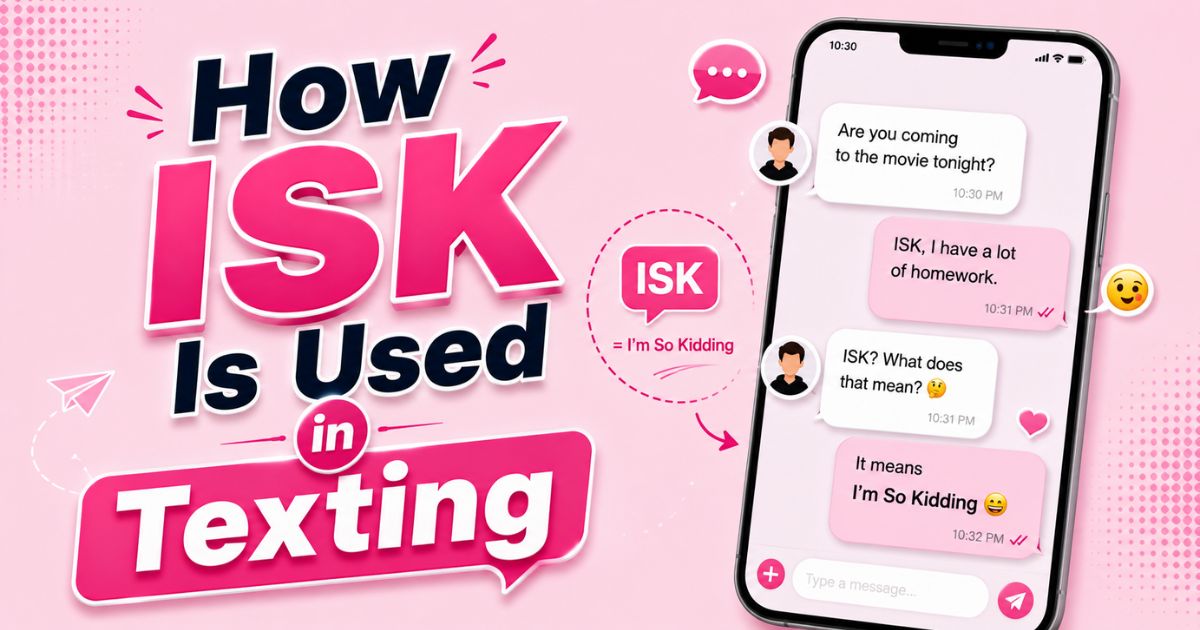
ISK generally shows up in three grammatical positions:
- At the start of a sentence – “ISK, I forgot to reply yesterday.”
- In the middle of a sentence – “You already finished? ISK I thought we had more time.”
- As a standalone reply – “ISK 😅”
It functions almost like a sentence-level abbreviation rather than a single word, replacing the full phrase “I should know” in one quick burst.
Real-Life Examples With Short Dialogues
Example 1 — Forgetting Something Obvious
A: Do you remember what room the meeting’s in? B: ISK… I’ll check the calendar 😅
Example 2 — Speaking From Experience
A: Freshman year is rough. B: ISK, I barely survived mine.
Example 3 — Playful Deflection
A: So do you actually like him? B: ISK lol, ask me tomorrow 😏
Example 4 — Mild Self-Deprecation
A: You forgot again? B: ISK, I need to write things down.
Personality Traits Behind Using ISK
The way someone uses ISK can reveal a bit about their communication style:
- Self-aware texters often use ISK to acknowledge small mistakes without over-explaining.
- Casual communicators use it to keep replies short and low-effort in fast-moving group chats.
- Playful personalities pair ISK with emojis to soften teasing or flirtation.
- Reflective types use “ISK…” with a trailing ellipsis to show genuine hesitation or thoughtfulness.
None of these usages are inherently negative — ISK is generally a neutral, low-stakes way to keep a conversation moving.
Table: ISK Meaning at a Glance
| Context | Most Likely Meaning | Typical Tone |
|---|---|---|
| Standard texting | I Should Know | Casual, self-aware |
| Snapchat | I Should Know (or typo for IDK) | Quick, informal |
| Instagram comments/DMs | I Should Know | Reflective, humorous |
| TikTok comments | I Should Know | Relatable, casual |
| I Should Know | Personal, friendly | |
| From a guy (personal question) | Hesitation or deflection | Playful or uncertain |
| Finance/travel content | Icelandic Króna (currency code) | Neutral, formal |
| Gaming (EVE Online) | InterStellar Kredits | Community-specific |
When Should You Use ISK?
ISK works best in low-stakes, casual conversations where a full sentence feels unnecessary. Good moments to use it include:
- Replying to a question you’re expected to know the answer to
- Reacting to a relatable story or experience
- Softening an admission that you forgot something small
- Keeping a fast-paced group chat moving without overexplaining
It’s less appropriate in formal writing, professional emails, or serious conversations where clarity matters more than brevity.
Modern Usage of ISK in 2026
Heading into 2026, ISK remains a niche but steady part of internet shorthand. It hasn’t reached the mainstream recognition of terms like “IDK,” “NGL,” or “TBH,” but it continues to circulate across TikTok, Snapchat, Instagram, Discord, and Reddit — particularly among younger users comfortable with condensed, tone-based texting.
Its staying power comes from its flexibility: unlike rigid abbreviations with one fixed meaning, ISK adapts to whatever emotional context the sender needs, which keeps it useful even as slang trends shift quickly.
ISK vs Similar Text Slang
| Term | Full Meaning | Core Difference From ISK |
|---|---|---|
| IDK | I Don’t Know | Expresses pure uncertainty, no expectation of knowing |
| TBH | To Be Honest | Signals honesty, not self-awareness about knowledge |
| IMO | In My Opinion | Shares a viewpoint rather than admitting familiarity |
| NGL | Not Gonna Lie | Introduces an honest confession, unrelated to “knowing” |
| SMH | Shaking My Head | Expresses disbelief or disappointment |
The key distinction: ISK implies an expectation — that the person feels they should already know something — while most similar abbreviations simply state a fact or opinion without that layer of self-awareness.
Common Mistakes and Misconceptions
- Mistaking ISK for a typo of IDK. Sometimes it genuinely is a typo, but often it’s intentional slang with a different meaning.
- Assuming ISK always means confidence. It frequently signals the opposite — forgetfulness or mild embarrassment.
- Confusing texting slang with the currency code. In financial or travel content, ISK almost always refers to the Icelandic Króna.
- Treating ISK as offensive. It isn’t. It’s a neutral, informal abbreviation with no negative connotation.
How to Reply When Someone Says ISK
Your reply depends on the context:
- If they seem embarrassed: “No worries, happens to everyone!”
- If they’re speaking from experience: “Yeah, I figured you’d relate.”
- If it feels like deflection (especially from a crush): “Okay, but really — what do you think?”
- If it’s just casual banter: A simple 😂 or “same” keeps the tone light.
There’s no need to overanalyze a single ISK — treat it the way you’d treat any other casual abbreviation.
Why People Use Short Forms Like ISK
Texting culture rewards speed and low effort. Short forms like ISK exist because:
- They save time when typing on small mobile keyboards
- They convey emotional nuance without long explanations
- They fit the fast, back-and-forth rhythm of modern messaging apps
- They signal familiarity with current internet culture
In short, abbreviations like ISK aren’t laziness — they’re an efficient form of digital shorthand.
Situations Where ISK Sounds Sarcastic
ISK can take on a sarcastic edge depending on punctuation and context. For example:
- “Oh sure, ISK, I definitely remembered your birthday this time 🙄” — clearly sarcastic, implying the opposite is true.
- “ISK, because I totally read the syllabus 😅” — self-deprecating sarcasm about not actually knowing something.
Sarcastic ISK usage almost always pairs with an eye-roll emoji, exaggerated punctuation, or an obviously false claim, making the tone easy to spot once you know what to look for.
Generational Use of ISK
ISK is most common among Gen Z and younger millennials, who grew up texting in abbreviations and are comfortable with tone shifting based on emojis and punctuation rather than full sentences. Older generations tend to either avoid the term entirely or mistake it for a simple typo of “IDK,” since it hasn’t achieved the same widespread recognition as more established texting slang.
ISK in Online Communities
Beyond everyday texting, ISK also shows up in more specific communities:
- Gaming communities, particularly EVE Online players, use ISK to refer to “InterStellar Kredits,” the game’s virtual currency.
- Finance and travel forums use ISK strictly as the currency code for the Icelandic Króna.
- Reddit and Discord users apply the texting-slang version (“I Should Know”) the same way it’s used in regular chats — casually and tone-dependent.
Recognizing which community you’re in usually makes the intended meaning obvious.
Also Read This : What Does STU Mean?
Short Practice Section for Beginners
Try identifying the meaning in each example below:
- “ISK 😂 I literally just watched that video yesterday.”
- “The trip cost 45,000 ISK.”
- “ISK, but I think we’re meeting at 6.”
Answers: 1) I Should Know (texting slang), 2) Icelandic Króna (currency), 3) I Should Know (texting slang, uncertain tone).
Quick Checklist: Is It Okay to Use ISK?
- ✅ You’re texting a friend or peer casually
- ✅ The context isn’t formal or professional
- ✅ You want to keep the reply short and low-pressure
- ❌ You’re writing a formal email or message to someone you don’t know well
- ❌ Clarity is more important than brevity in that moment
- ❌ The recipient may not be familiar with internet slang
Advantages of Using ISK
- Saves time in fast-paced conversations
- Adds a casual, relatable tone to texts
- Softens admissions of forgetfulness without over-explaining
- Works across nearly every major messaging platform
Disadvantages of Using ISK
- Can be misread as a typo for “IDK,” causing confusion
- Lacks a single fixed meaning, so tone must do extra work
- Not appropriate for formal or professional communication
- Less universally recognized than terms like “LOL” or “BRB”
Final Thoughts
At its core, ISK simply means “I Should Know.” It’s a small, flexible piece of internet shorthand that shows up across texting, Snapchat, Instagram, TikTok, and WhatsApp — usually to express mild embarrassment, quiet confidence, or playful self-awareness. Outside of texting, don’t forget its second identity as the currency code for the Icelandic Króna.
The next time ISK shows up in your messages, you’ll know exactly what it means — and honestly, isn’t that the whole point?