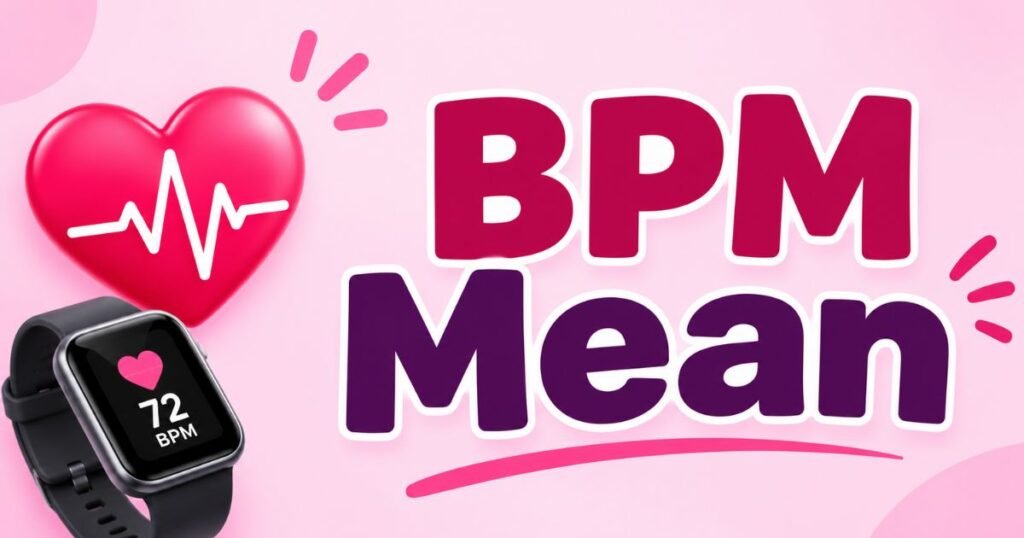
BPM stands for beats per minute. It tells you how many times something beats in 60 seconds. That “something” can be your heart, a song, or even a drum machine.
You will see BPM on fitness watches, music apps, DJ software, and in casual chats. The meaning changes a little with each setting. This guide explains every common use in plain words, with examples you can try yourself.
BPM – Quick Meaning
BPM is short for beats per minute. It is a speed counter. A higher number means faster beats. A lower number means slower beats.
Here is the quick version:
- In health: how many times your heart beats each minute.
- In music: the speed, or tempo, of a song.
- In slang: a playful way to say your heart is racing or your mood is intense.
- In business: sometimes it stands for Business Process Management, which has nothing to do with beats.
Most of the time, when people ask “what does BPM mean,” they mean one of the first two. Context tells you which one.
BPM meaning slang
In texts and social posts, BPM is sometimes used as a joke. Someone might write, “My BPM went crazy when she replied.” They mean their heart started pounding.
It is not a formal slang term like “LOL” or “BRB.” It is more of a casual shortcut. People use it to show strong feelings such as nerves, love, fear, or excitement.
Here are a few examples:
- “That jump scare sent my BPM through the roof.”
- “Waiting for exam results. BPM is at 140.”
- “Your voice message made my BPM spike.”
Notice that the number is often exaggerated. Nobody is checking a monitor. It is just a fun way to describe a rush of emotion.
Bpm meaning in heart rate
Heart rate is the most common medical use of BPM. It counts how many times your heart beats in one minute. You can feel it on your wrist or neck. Most smartwatches track it all day.
For most healthy adults, a resting heart rate is between 60 and 100 BPM. Very fit people, like runners and swimmers, may sit lower, often between 40 and 60 BPM. Children usually have faster rates than adults.
Your heart rate changes during the day. Exercise raises it. Sleep lowers it. Stress, caffeine, and fever can push it up too.
| Situation | Typical BPM (healthy adult) |
| Deep sleep | 40 to 60 |
| Resting, awake | 60 to 100 |
| Light walking | 90 to 110 |
| Hard exercise | 140 to 180 |
A rough way to estimate your maximum heart rate is 220 minus your age. This is only a guide. It does not fit everyone.
Bpm meaning in music
In music, BPM shows the tempo. That is how fast a song moves. A song at 60 BPM has one beat every second. A song at 120 BPM has two beats every second.
DJs use BPM to mix songs smoothly. If two tracks have close BPM values, the beats line up and the transition sounds clean. Producers also set BPM first when they start a new track in software.
Different styles tend to live in different ranges. These are rough numbers, and many songs break the pattern.
| Genre | Common BPM range |
| Slow ballads | 60 to 80 |
| Hip hop | 80 to 100 |
| Pop | 100 to 130 |
| House | 120 to 130 |
| Techno | 125 to 150 |
| Drum and bass | 160 to 180 |
Runners also use BPM. Many pick playlists that match their steps per minute, often around 150 to 180 BPM.
Bpm meaning in health

Outside of a simple pulse check, BPM also shows up in wider health talk. Doctors look at it as one sign of how your body is doing. It is never the full story, but it is a useful clue.
A very high resting rate may point to stress, dehydration, illness, or a heart rhythm problem. A very low rate can be normal for athletes, but it can also cause dizziness or fainting in others. If your numbers feel off and you have symptoms, talk to a doctor.
BPM is also used for breathing in some places. Normal adults breathe about 12 to 20 times per minute. Some people write this as breaths per minute, though “BrPM” or “RR” is the cleaner label.
Good habits help keep your heart rate in a healthy range:
- Move your body most days.
- Sleep enough.
- Limit caffeine and nicotine.
- Drink water.
- Find ways to calm stress, like slow breathing or a short walk.
Origin & Background
The idea of counting beats is old. Doctors have checked the pulse by hand for thousands of years. They simply counted beats against a clock or a sand timer.
In music, the big step came with the metronome. Johann Maelzel patented a version of it in 1815. It clicked at a steady speed that players could set by number. Composers soon began writing tempo marks like “quarter note equals 120.” That is the root of BPM as we use it now.
Technology made BPM an everyday language. Electronic music in the 1980s and 1990s relied on drum machines and sequencers, which show tempo as a BPM number. Later, fitness bands and phone apps put heart rate BPM on millions of wrists.
So the phrase grew from two paths. One came from medicine. The other came from music. They share the same simple idea, which is counting beats in a minute.
Real-Life Conversations
Seeing BPM in real chats makes the meaning clear. Here are a few short examples.
Example 1: Fitness
Sam: Did you check your watch after the run? Priya: Yes. My BPM hit 168 on the last hill. Sam: Wow. That’s high. Was it hard? Priya: Super hard, but I felt great.
Example 2: Music
Leo: What tempo is that track? Mia: About 128 BPM. Leo: Perfect. It will blend well with my house set.
Example 3: Slang
Ana: Did he text you back? Zara: Yes! My BPM is off the charts right now. Ana: Ha, I can tell. Tell me everything.
Example 4: Health
Dad: The doctor said my resting BPM is 58. Nora: Is that bad? Dad: No. Since I walk every day, it’s a sign of a strong heart.
Emotional & Psychological Meaning
Your heart rate and your feelings are closely linked. When you feel scared, excited, or angry, your body releases stress hormones. Your heart beats faster. This is why people say their “BPM went up” in emotional moments.
Calm feelings do the opposite. Slow breathing, quiet music, and relaxed thoughts often lower your heart rate. This is one reason meditation and deep breathing are popular for anxiety.
Music has a similar effect. Slow songs around 60 to 80 BPM often feel soothing. Fast songs above 130 BPM often feel energetic. Many people pick songs by mood without thinking about the number.
Using BPM as slang also carries emotion. It tells others, “This moment affected me.” It is a small, playful way to share feelings without writing a long message.
Be careful, though. A racing heart is not always about feelings. If it happens often without a clear cause, it is worth a medical check.
Usage in Different Contexts
BPM shows up in many places. The meaning depends on where you read it.
| Context | What BPM means | Example |
| Fitness | Heart beats per minute | “Keep your BPM under 150 during warm-up.” |
| Music | Tempo of a song | “This beat is 95 BPM.” |
| Medical | Pulse or heartbeat rate | “Resting BPM: 72.” |
| Social media | Joke about strong feelings | “My BPM after that goal!” |
| Business | Business Process Management | “Our team uses BPM software.” |
| Gaming | Rhythm speed in music games | “Higher BPM songs are harder to play.” |
The business meaning is the odd one out. Business Process Management is about improving how work flows inside a company. If you see it in a job ad or software review, it is almost always this one.
Common Misunderstandings
Many people mix up a few points about BPM. Here are the most common ones.
- “Higher BPM always means unhealthy.” Not true. A fast heart rate during a workout is normal. Only a high rate while resting needs attention.
- “Lower BPM is always better.” Not always. Athletes often have low rates. But a very low rate with dizziness is a problem.
- “Music BPM and heart BPM are the same.” They use the same unit, but they measure different things. One is song speed. The other is your pulse.
- “BPM is the same as rhythm.” Rhythm is the pattern of beats. BPM is only the speed.
- “Smartwatch numbers are perfect.” They are usually close, but they can be off, especially during fast movement.
Knowing these points helps you read numbers with more care.
Comparison Table
This table puts the main meanings side by side.
| Feature | Heart rate BPM | Music BPM | Slang BPM |
| What it counts | Heartbeats | Song beats | Feelings (not counted) |
| Who uses it | Doctors, athletes | DJs, producers | Friends online |
| Tool used | Watch, pulse check | Metronome, software | None |
| Typical range | 40 to 200 | 60 to 200 | Often exaggerated |
| Purpose | Track health | Match tempo | Show emotion |
Variations / Types of BPM
BPM can be split into a few useful types. Each one has its own focus.
Heart rate types
- Resting BPM: your pulse when calm and still.
- Active BPM: your pulse during movement.
- Maximum BPM: the highest rate your heart can safely reach.
- Recovery BPM: how fast your pulse drops after exercise. A quick drop is a good sign.
Music types
- Fixed BPM: the tempo stays the same through the song.
- Variable BPM: the tempo changes, which is common in live bands and film scores.
- Half-time and double-time: a song can feel twice as slow or twice as fast without changing its actual beat grid. For example, 140 BPM can feel like 70.
Other uses
- Breaths per minute: sometimes shortened to BPM in casual talk.
- Business Process Management: a work method, not a count of beats.
How to Respond When Someone Uses “BPM”
Your reply depends on the setting. A quick read of the context will guide you.
If it is slang, match their mood. Keep it light and friendly.
- “Ha, sounds like you’re really excited!”
- “Take a breath. What happened?”
If it is about health, be kind and calm. Avoid giving medical advice unless you are a professional.
- “That’s good to hear. Is your doctor happy with it?”
- “If it feels too high, maybe get it checked.”
If it is about music, ask about the track or style.
- “Nice tempo. Is it for a workout mix?”
- “What genre is that?”
If you are not sure, simply ask. A short question like “Do you mean heart rate or music?” clears things up fast. Nobody minds a quick check.
Also Read This : ION Mean in Text
Regional & Cultural Usage
BPM is used all over the world, and the meaning stays steady. The term comes from English, but fitness apps, DJs, and doctors in many countries use it in the same way.
Small differences exist in how people talk about it. In the United States and the United Kingdom, “BPM” is common in gyms and music studios. In South Asia, many people first learn the word through smartwatches, fitness apps, and music production videos. Some places use local terms for pulse in daily speech but still read BPM on devices.
Music culture adds more flavor. Dance scenes in Europe often favor faster electronic tempos. Reggaeton usually sits around 90 BPM. Bollywood and pop tracks vary widely. Each style has its own feel, and BPM helps describe it.
The slang use spreads mostly through social media. Younger users in English-speaking online spaces use it the most. It may be less familiar in older groups or in places where the abbreviation is not common.
Conclusion
BPM means beats per minute. It is a simple measure of speed, but it fits many parts of life. For your body, it shows how hard your heart is working. For music, it shows how fast a song moves. In chats, it can show how strong a feeling is.
Once you know the context, the meaning is easy to spot. Read the setting, check the topic, and the right answer usually appears.