
You are chatting with a friend. They tell you about their stomach problems in full detail. You reply with “TMI!” and move on.
That one short word does a lot of work. It is quick, funny, and a little bit blunt. In this guide, you will learn what TMI means in chat, where it came from, how people use it on different apps, and how to reply when someone sends it to you.
TMI Meaning in Chat – Quick Meaning
TMI stands for “too much information.” People type it when someone shares more than they wanted to hear. The detail may be gross, personal, awkward, or just unnecessary.
It is not always a rude word. Often it is a joke. Sometimes it is a gentle way to say, “Please stop here.” The tone depends on the people, the topic, and the emoji that comes with it.
| Part | Details |
| Full form | Too Much Information |
| Type | Internet slang, text slang |
| Main use | Reacting to an overshare |
| Tone | Funny, light, sometimes serious |
| Common spots | Texts, DMs, group chats, comments |
TMI meaning tiktok
On TikTok, TMI usually shows up in two ways. The first is in the comments. Someone shares a private story in a video, and viewers write “TMI” or “TMI but I love it.”
The second is in the video itself. Creators say “TMI, but…” before they share a funny or embarrassing story. It works like a warning label. It also pulls people in, because everyone wants to hear the story that comes next.
Here, TMI is often a good thing. It can mean “this is wild, keep going.”
Tmi meaning in friendship
Among close friends, TMI is a joke most of the time. Good friends overshare. They tell stories about dates, bad days, and strange habits. A quick “TMI” keeps the mood playful.
It can also be a soft boundary. If a friend keeps talking about something you find uncomfortable, a short “TMI, bestie” lets you step back without a fight. The friendship stays safe.
Friends also use it to tease. If you say you ate cold pizza for breakfast, they may reply, “TMI, but respect.”
TMI meaning Urban Dictionary
Urban Dictionary is a site where users write their own definitions of slang. Most entries for TMI say the same thing. It is a reaction to someone telling you something you did not need to know.
Keep in mind that these entries come from the public. They are not official. They are useful for seeing how people use a word, but the tone can be joking or exaggerated. For daily chat, the simple meaning is all you need.
TMI meaning from a girl
Some people search for what TMI means when a girl sends it. The truth is that gender does not change the meaning. The word means “too much information” no matter who types it.
What matters is the context. Read the whole message and watch the tone.
- “TMI 😂” usually means she is amused.
- “Okay, that’s TMI.” may mean she is a bit uncomfortable.
- “TMI, but go on.” means she wants to hear more.
- A plain “TMI.” with no emoji may be a signal to change the topic.
Origin and Background of TMI
The phrase “too much information” is older than texting. People said it out loud in the 1980s and 1990s when someone shared a detail that was too personal. The short form TMI became popular in the 1990s, and dictionaries trace its first recorded use to that decade.
Then came texting and early internet chat. Messages were short, and typing was slow. Abbreviations like LOL, BRB, and OMG became normal. TMI fit right in. It was only three letters, and everyone understood it.
Social media gave it a second life. Sharing personal moments is part of life on Instagram, X, Snapchat, and TikTok. With so much sharing, people needed a quick way to say “that’s a bit much.” TMI did the job.
Today, it is part of everyday English. You can say it out loud, type it, or put it in a caption.
Real-Life Conversations Using TMI
Examples make slang easier to understand. Here are a few short chats that show how TMI works.
Example 1: Playful
Sam: I had three bowls of cereal at midnight and then fell asleep on the couch. Riya: TMI 😂 but same.
Example 2: Setting a boundary
Ali: My doctor told me all about my test results. Do you want the full details? Zain: Maybe skip that. TMI for lunchtime.
Example 3: Used by the sharer
Mia: TMI, but I just cried at a dog food ad. Hana: Honestly relatable.
Example 4: In a group chat
Dev: Forgot to wash my hair for four days. Group: TMI!!! 😭
In each case, the word helps people react without a long reply. It lets the chat stay light, even when the topic is awkward.
The Emotional and Psychological Meaning Behind TMI
TMI is more than slang. It says something about how people feel when they talk to each other.
Every person has a comfort zone. Some are open about everything. Others like privacy. When a story goes past that zone, we feel a small jolt. TMI is how we express it in one word.
For the person who overshares, there are reasons too. They may feel close to you and trust you. They may be nervous and talk too much. They may want attention or support. Most of the time, they do not mean harm.
Humor also plays a big role. Saying “TMI” turns an awkward moment into a joke. It protects the relationship and lets both people save face.
Here is what TMI can quietly say:
- “I am surprised.”
- “I need a little distance from this topic.”
- “That was funny, but too real.”
- “We are close enough that I can tease you.”
Usage of TMI in Different Contexts
The same three letters can feel very different in different places. Think about who you are talking to before you use it.
| Context | How TMI is used | Safe to use? |
| Close friends | Joking reaction to an overshare | Yes |
| Family chats | Light teasing or a boundary | Usually |
| Social media | Comment on a personal post | Yes, keep it kind |
| Dating chats | Playful, but can sound rude | With care |
| Work chat | Rarely fits the tone | Avoid |
| Formal email | Does not belong | No |
With friends, go ahead and use it freely. It is part of the fun.
With family, keep it gentle. A parent or older relative may not know the slang, or may feel hurt.
In dating, the tone matters most. A joking “TMI 😅” can be cute. A cold “TMI.” can end the mood fast.
At work, it is better to stay neutral. If a coworker shares too much, you can say, “Let’s keep this to work topics.” It is clear and kind.
Common Misunderstandings About TMI
Many people think TMI always means “you are being rude” or “I am annoyed.” That is not true. Here are the most common mix-ups.
- It is always negative. Not so. Plenty of people say it with a laugh.
- It means the person did something wrong. Oversharing is not a crime. It is just a mismatch in comfort levels.
- It only means gross details. It can also cover money, love life, family drama, or health.
- It is the same everywhere. Humor and comfort limits change from group to group.
- Using it is always rude. If you say it kindly, it is just honest.
Another mix-up involves the phrase “TMI, but.” People think it is an apology. In truth, it is more like a heads-up. The speaker knows the story may be too much and wants to share it anyway.
Text has no voice or face. So a short “TMI” can be read the wrong way. When in doubt, add an emoji or a few extra words.
Comparison Table
TMI is often mixed up with other terms. This table shows how they differ.
| Term | Meaning | Who says it | Tone |
| TMI | Too much information | The listener, or the sharer as a warning | Light to firm |
| Oversharing | Telling more than is wise or needed | Describes the person who shares | Neutral to critical |
| TMI, but… | A heads-up before a personal story | The person about to share | Playful |
| Too personal | The topic is private | The listener | Serious |
| Spill the tea | Share the juicy gossip | A friend who wants details | Excited |
| Say less | Stop talking, I get it | The listener | Casual |
The key difference is that TMI is a reaction. Oversharing is the act itself. “Spill the tea” is the opposite. It asks for more detail, while TMI says there is enough.
Variations and Related Expressions
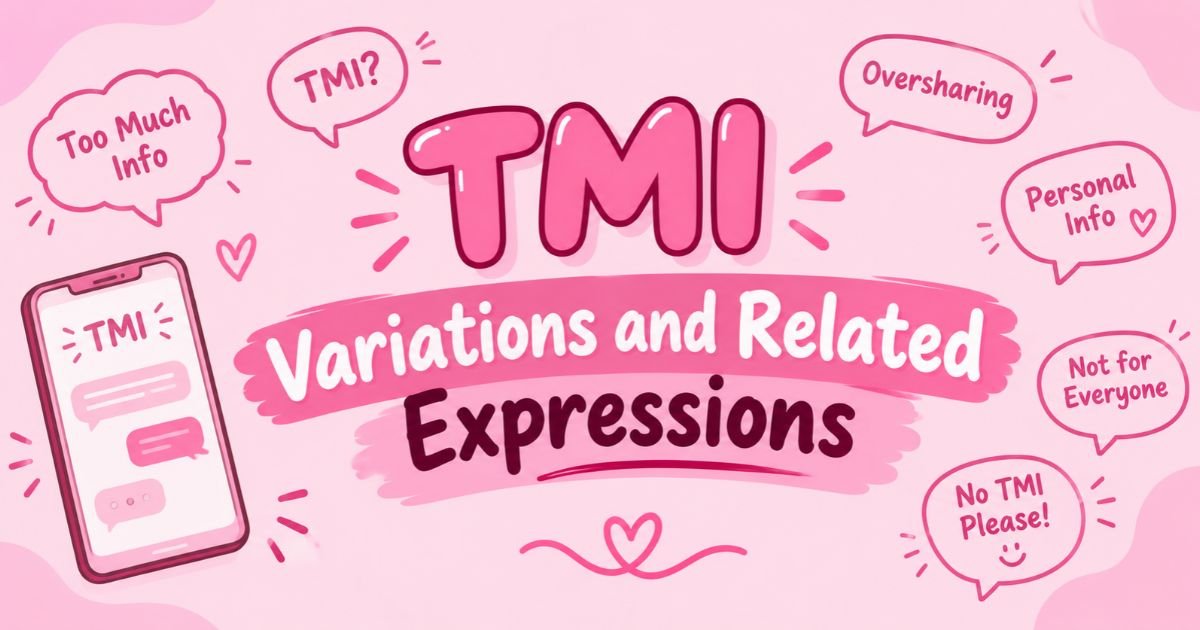
Language keeps changing. People have made many versions of TMI. Some are written, and some are spoken.
- Too much info: The full phrase. Fine for any setting.
- TMI alert: A joking warning before a story.
- TMI, but…: The classic lead-in to an overshare.
- Not TMI: Used when you do want to hear the details.
- Overshare: The word for the act.
- I did not need to know that: A longer, more direct reply.
- Way too much: A short way to say the same thing.
- Spare me the details: A polite but firm option.
- Yikes: A one-word reaction to an awkward share.
- Say less: A casual way to say, “I’ve heard enough.”
You can mix them to fit your style. “TMI alert, but I just bought my third plant this week” sounds natural and fun.
How to Respond When Someone Uses TMI
Maybe someone just sent you “TMI.” What now? First, read the tone. Then pick the reply that fits.
If they are joking: Laugh along. Try “Haha, you asked!” or “Okay, I’ll stop. Maybe.”
If they seem uncomfortable: Back off right away. Say, “Sorry, got carried away. New topic?” A quick apology keeps things warm.
If you want to share anyway: Check first. “Okay, last bit and then I’m done” gives them a choice.
If it was a topic you needed to talk about: Be honest. You can say, “I know it’s a lot, but I really need to talk about this. Is that okay?”
A few simple tips:
- Do not take it personally.
- Ask yourself if the topic fits the group.
- Share heavy matters with people who are ready to listen.
- If someone often says TMI to you, try a lighter style around them.
If the topic is a real struggle, such as health, grief, or stress, a “TMI” reply can sting. In that case, it is kind to say, “I’m sorry if that was too much. I just needed someone to hear me.”
Also Read This : WYLL Mean in Text
Regional and Cultural Usage
TMI is used all over the English-speaking world. In the United States, it is very common in texts and on social media. In the UK, Canada, and Australia, people use it just as often. You will also see it in India, Pakistan, and other places where English mixes with local languages.
In many South Asian chats, people blend TMI with Urdu or Hindi. A line like “Yaar, TMI ho gaya” is a common mix. Other places do the same with their own words. The slang travels well because it is short and the meaning is clear.
Culture changes how personal talk feels. In some communities, family matters and health details are private. A comment that sounds harmless in one place may feel shocking in another. In others, people talk openly about almost everything.
Age matters too. Younger users on TikTok and Snapchat say TMI all day. Older users may find it a bit casual. If you are chatting with someone from another culture or age group, a little care goes a long way.
Conclusion
TMI means “too much information.” It is a quick way to react when someone shares more than you expected. It can be funny, kind, or firm.
Use it with friends, and keep the tone friendly. Skip it in formal settings. If someone sends it to you, read the tone and respond with care.

1 thought on “What Does TMI Mean in Chat? Real Meaning and Examples 2026 ”