If you’ve spent any time on TikTok, Instagram, or even in a group chat, you’ve probably seen the letters POV pop up everywhere. It shows up in captions, comments, memes, and casual conversation but what does POV actually mean, and why has it become one of the most-used pieces of internet slang today?
This guide breaks down the full meaning of POV, where it came from, how it’s used across different platforms, and how you can (or shouldn’t) use it yourself. By the end, you’ll understand POV slang meaning inside and out.
What Does POV Mean?
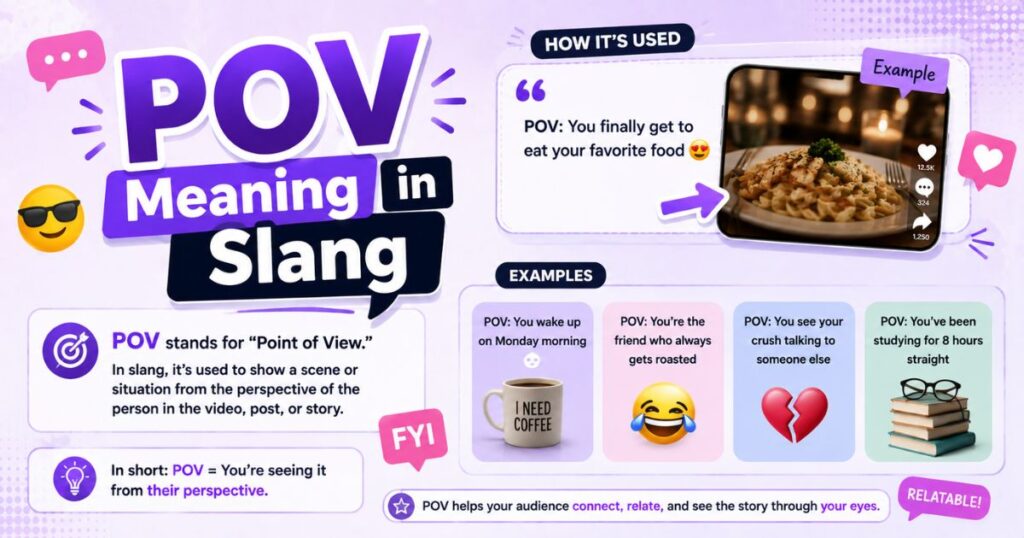
POV stands for “Point of View.” In its simplest form, it describes the perspective from which something is seen, told, or experienced.
Originally a term borrowed from filmmaking and literature, POV has taken on a new life online. In slang, POV is used to invite someone into a specific scenario as if they’re living it firsthand rather than just watching or reading about it.
For example, instead of saying “imagine you’re a barista dealing with a rude customer,” someone online would simply write:
POV: you’re a barista and the customer just asked for a “medium large.”
That single line does the same job as a whole sentence of setup which is exactly why POV has become so popular in fast-scrolling, short-attention-span social media culture.
What makes POV so effective as slang is its economy. In just three letters, it signals to the reader or viewer, “stop, imagine yourself here.” That’s a powerful storytelling shortcut, and it’s part of why POV has stuck around far longer than most internet trends.
Unlike slang that fades after a few months, POV has become a permanent fixture in how people communicate online because it solves a real problem: getting someone to feel a moment instead of just reading about it.
Origin and History of “POV”
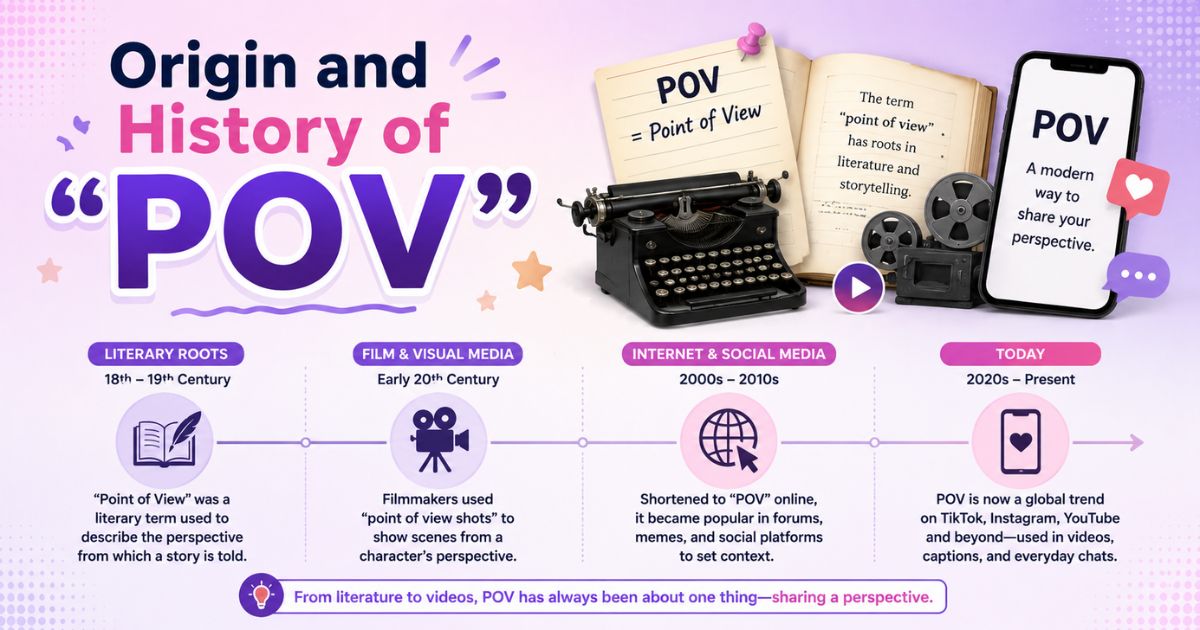
The term “point of view” has existed for centuries in literature and storytelling, referring to the narrative perspective a writer chooses first person, second person, or third person.
The abbreviation POV became common much earlier than social media, mainly in:
- Filmmaking – a “POV shot” is filmed from a character’s exact visual perspective.
- Video games – “first-person POV” vs. “third-person POV” describes camera angles.
- Adult content – POV is also used to describe media filmed from a first-person perspective, a usage that predates its mainstream social slang meaning.
The slang version of POV, however, exploded thanks to short-form video platforms. Creators realized they could use “POV” as a quick storytelling device to pull viewers directly into a role or scene, and the format spread rapidly across the internet.
POV Meaning TikTok
On TikTok, POV isn’t just a word, it’s an entire video format. A “POV video” is filmed as though the camera is the viewer’s own eyes, dropping them straight into a situation.
Common TikTok POV setups include:
- POV: You’re the main character walking into school
- POV: You’re on a first date and it’s going wrong
- POV: Your best friend just told you a secret
Creators often use the hashtag #POV to tag these videos so viewers can find similar content. Some POV videos are literal (filmed from a first-person camera angle), while others are more about immersing the audience emotionally in a relatable or funny scenario, even if the video isn’t shot from a true first-person view.
The POV trend also spawned countless sub-formats. “POV: you’re my toxic trait” videos let creators poke fun at their own habits, while “POV: society if ” clips imagine alternate realities. Duet and stitch features on TikTok made POV even more interactive, letting one creator respond to another’s POV scenario from a different angle, essentially building a shared universe out of a single caption. This collaborative element is part of why POV content keeps evolving instead of feeling repetitive, even years after it first went viral.
How “POV” Is Used on Different Platforms
While TikTok popularized the modern slang use of POV, the term has since spread to nearly every corner of the internet. Each platform uses it slightly differently.
| Platform | Common Use of POV |
| TikTok | Full video format; often tagged with #POV |
| Used in captions, Reels, and Stories to set a scene | |
| Twitter/X | Used as a short text hook, e.g., “POV: it’s Monday again” |
| Snapchat | Used casually in captions on photos/videos |
| Texting | Used to express a relatable feeling or opinion quickly |
| YouTube Shorts | Similar to TikTok first-person style storytelling |
Across all these platforms, the core idea stays the same: POV puts the audience directly into a specific moment or mindset.
POV in Texting vs. Real Life
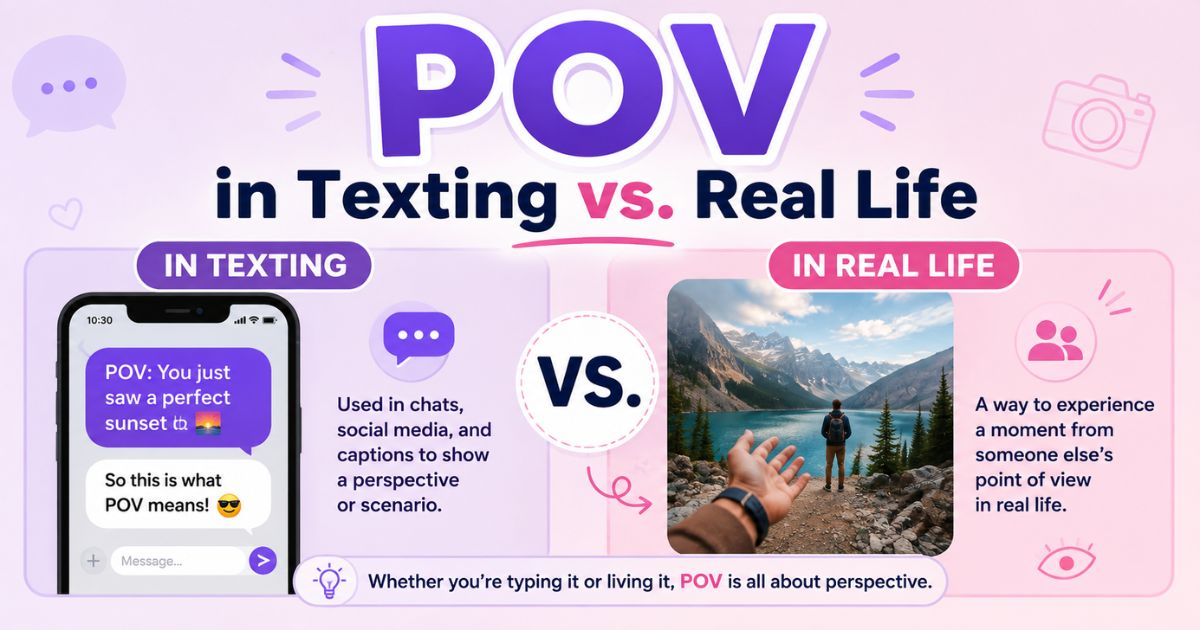
POV isn’t limited to videos, it’s just as common in text messages and everyday conversation.
In texting, POV is usually used to set up a relatable or funny mini-scenario without needing a video at all:
- “POV: you just realized you left your charger at home.”
- “POV: it’s 2am and you’re still replying to texts.”
In real-life conversation, people now say “POV” out loud to emphasize a strong opinion or personal take, almost like saying “in my opinion” but with more attitude. For instance, someone might say, “POV, pineapple belongs on pizza,” meaning “this is my firm stance, don’t argue.”
This shift shows how POV has moved from a purely visual/literary term into an everyday conversational tool for both written and spoken slang.
POV Meaning in Meme
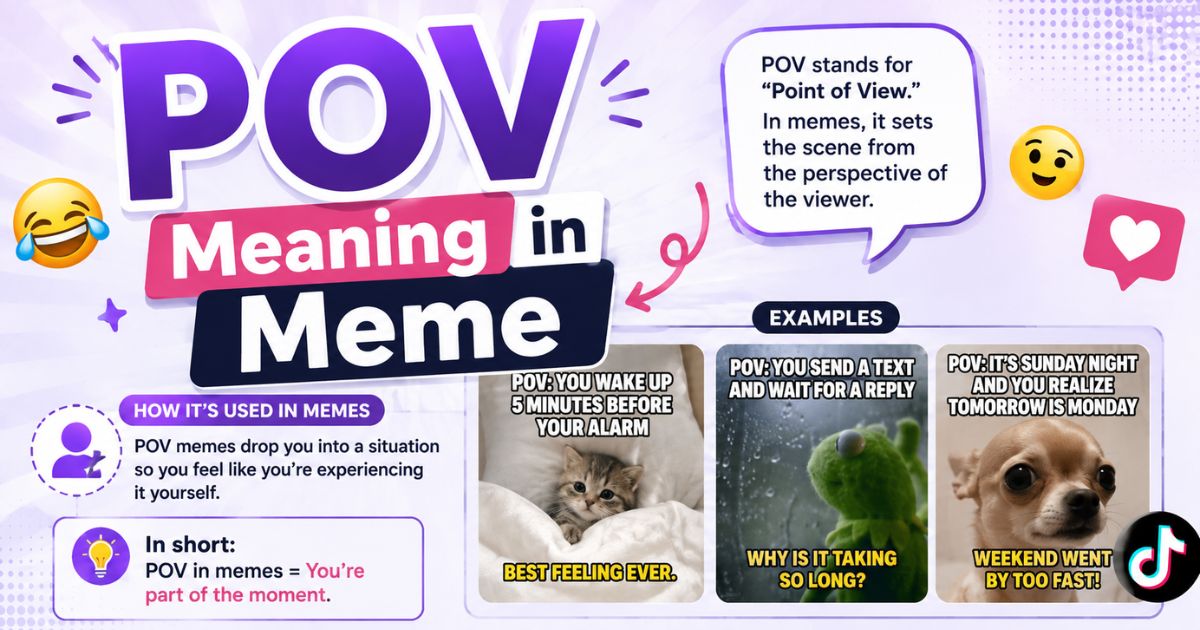
In meme culture, POV is used as a caption format that puts the viewer inside a joke. Instead of explaining a situation, the meme creator simply writes “POV:” followed by a scenario, letting the image or video do the rest.
Typical meme-style POV examples include:
- POV: you’re the last slice of pizza and everyone’s staring at you
- POV: your Wi-Fi buffers right at the best part of the movie
- POV: you hear your name being called across the room and panic
The humor comes from how instantly relatable and specific the scenario feels, even though it’s told in just a few words.
Examples of “POV” in Sentences
Here are some everyday examples showing how flexible POV slang can be:
- Social media caption: “POV: you’re the new intern and everyone already knows your name.”
- Texting a friend: “POV: I just walked into a glass door in front of my crush.”
- Casual conversation: “POV, that was the best concert I’ve ever been to.”
- Sharing an opinion: “POV: coffee before 10 a.m. should be a human right.”
- Storytelling format: “POV: you’re trying to parallel park while five people watch.”
Notice how POV almost always works as a shortcut; it replaces a longer setup with a quick, punchy scene-setter.
What is POV Means in Social Media
On social media specifically, POV means a first-person or immersive perspective used to tell a relatable story, share an opinion, or set up a joke. It’s less about literal camera angles and more about emotional connection making the viewer feel like they’re the one in the scenario.
Social media POV content tends to fall into a few categories:
- Relatable everyday moments (work, school, family)
- Roleplay or acting scenarios (customer service, dating, friendships)
- Opinion-based POVs (strong takes framed as a scene)
- Aesthetic or “vibe” POVs (a mood, outfit, or lifestyle moment)
This flexibility is a big reason POV slang has stayed popular instead of fading out like many internet trends.
Also Read This Blog : POS Meaning in Slang
Variations and Related Slang
POV often appears alongside other internet abbreviations. Here’s how it compares to a few similar terms:
| Term | Meaning | How It Differs from POV |
| IMO | In My Opinion | States an opinion directly, without a scene |
| TBH | To Be Honest | Signals honesty, not perspective |
| IRL | In Real Life | Refers to real-world context, not viewpoint |
| FYP | For You Page | TikTok’s algorithm feed, unrelated to perspective |
| POV | Point of View | Frames a scenario from a specific perspective |
Some newer variations you might also see include “this is your sign” style captions and “main character POV,” which frames a moment as if the viewer is the protagonist of their own story.
Another related phrase gaining traction is “not the POV,” used sarcastically when a scenario feels a little too real or embarrassing. You’ll also spot “tell me you’re X without telling me you’re X,” which works similarly to POV by inviting the audience to fill in a scene based on a single clue. These formats all share the same DNA: they compress a full story or joke into a short, recognizable template that anyone can remix.
Understanding these related terms helps clarify why POV specifically has outlasted so many of them. While formats like “tell me without telling me” require a punchline, POV works as a flexible container it can hold a joke, an opinion, an aesthetic, or a genuine emotional moment, which is why it keeps showing up in new contexts.
Is “POV” Safe for Kids?
Generally, yes the word POV itself is completely harmless slang. It simply means “point of view” and is used the same way in kid-friendly contexts as it is anywhere else.
That said, a few things are worth knowing:
- Some POV-style videos on TikTok or Instagram can involve mature or suggestive content, especially in adult entertainment contexts.
- The word itself carries no negative meaning, but parents may want to be aware of the type of content tagged with #POV, since the hashtag spans a huge range of topics.
- For everyday texting and casual use, POV is no different from any other harmless abbreviation like LOL or BRB.
When to Use (and Avoid) “POV”
POV is versatile, but like most slang, it works best in the right context.
Good times to use POV:
- Casual texting with friends
- Social media captions or video content
- Light, relatable storytelling
- Expressing an opinion in a fun, informal way
Times to avoid POV:
- Formal writing (emails, essays, reports)
- Professional communication with colleagues or clients
- Academic work, unless discussing literary point of view specifically
Using POV in the wrong setting can come across as overly casual, so it’s best kept to informal, social contexts.
Conclusion
At its core, POV means “point of view,” but its slang meaning has grown into something much bigger than a simple abbreviation. From filmmaking roots to a full-blown TikTok video format, POV now shapes how millions of people tell stories, share opinions, and connect with their audience online.
Whether you’re scrolling through memes, texting a friend, or making your own content, understanding POV slang helps you keep up with how language evolves in real time. Next time you see “POV:” pop up on your screen, you’ll know exactly what’s coming, a quick trip into someone else’s perspective.