You’re scrolling through a group chat or a Discord server, and someone drops “POS” out of nowhere. Depending on the conversation, it could be an insult, a warning, or something completely harmless. That three-letter mix-up trips up a lot of people, parents, gamers, and even seasoned texters because POS doesn’t have just one meaning.
This guide breaks down every common definition of POS, where the slang came from, how it shows up differently across platforms like Discord, TikTok, and text messages, and how to tell which meaning applies in any given conversation.
What Does POS Mean?
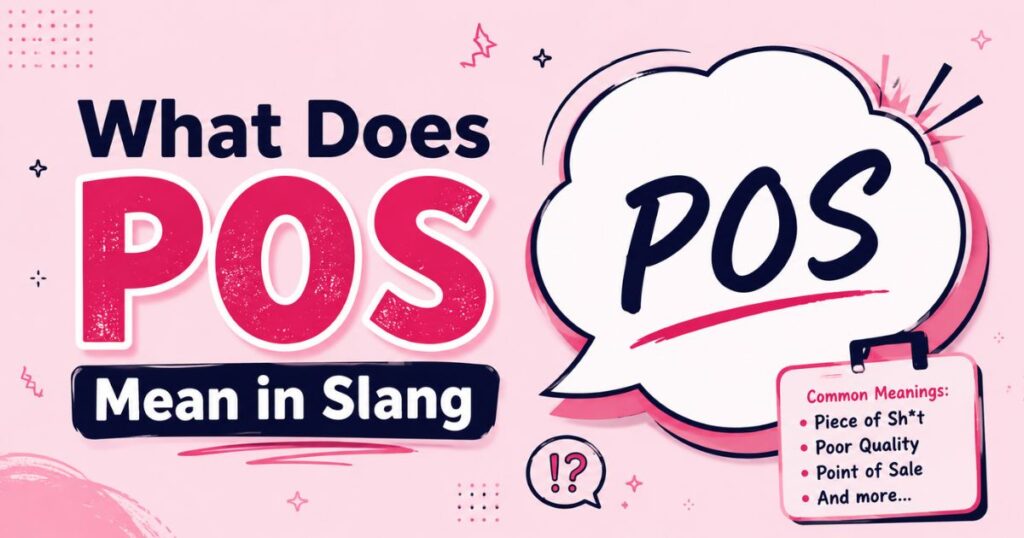
In most casual online conversations, POS stands for “Piece of S*”** a blunt insult used to describe a person, object, or situation that someone finds frustrating, worthless, or badly behaved. It’s the most common slang interpretation across texting apps, comment sections, and gaming chats.
However, POS carries several other meanings depending on where and how it’s used:
| Meaning | Common Context | Tone |
| Piece of S*** | Texting, social media, gaming | Negative / insulting |
| Parent Over Shoulder | Teen texting, instant messaging | Warning / cautionary |
| Point of Sale | Retail, business, banking | Neutral / professional |
| Proof of Stake | Crypto and trading servers | Neutral / technical |
| Positive (tone indicator) | Twitter, TikTok, Discord (written as /pos) | Positive / friendly |
The key to decoding POS is context. A retail manager typing “the POS system is down” means something entirely different from a teenager texting “ugh he’s such a POS.”
Origin and History of “POS”
The abbreviation “Point of Sale” has existed in retail and business language for decades, referring to the location or system where a customer completes a purchase through cash registers, card readers, and checkout software.
The slang version of POS emerged later, alongside the rise of instant messaging in the early 2000s. As teenagers began chatting on platforms like AIM and MSN Messenger, they needed shorthand for two very different needs: venting frustration and warning friends that a parent was nearby. Both “Piece of S***” and “Parent Over Shoulder” trace back to that era of early digital communication, and both stuck around as texting culture evolved into social media and group chats.
More recently, the rise of tone indicators and short tags like /pos, /srs, or /j added to the end of messages gave POS yet another life. On platforms where sarcasm and jokes are easy to misread, /pos tells the reader that a comment is meant sincerely and positively.
Pos Meaning Discord
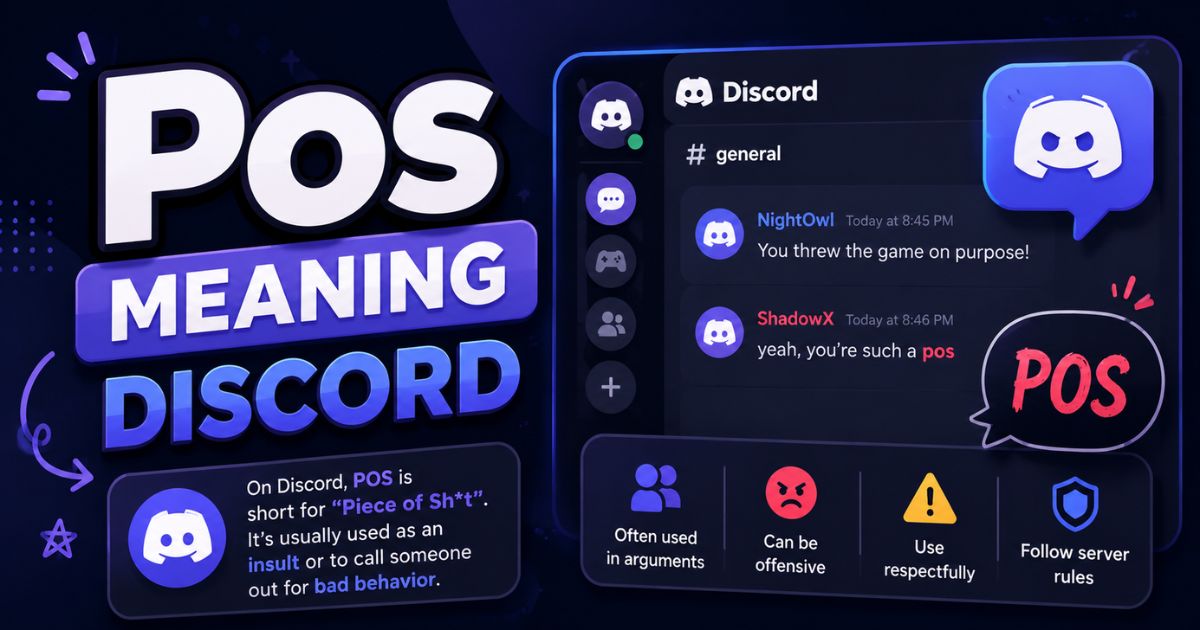
On Discord specifically, POS shifts meaning depending on the type of server:
- Gaming servers: POS almost always means “Piece of S***,” usually directed at a teammate, an opponent, or a frustrating game mechanic.
- Crypto and trading servers: POS (or PoS) typically stands for “Proof of Stake,” a blockchain consensus mechanism used to validate transactions without heavy computing power.
- General or marketplace channels: POS can refer to “Point of Sale” when members discuss online stores, digital goods, or payment systems.
- As a tone tag: Typing /pos at the end of a message signals that the comment was meant kindly, even if it could otherwise be read as sarcastic.
Because Discord communities range from casual friend groups to professional and technical spaces, reading the surrounding conversation is the fastest way to figure out which POS you’re dealing with.
How “POS” Is Used on Different Platforms
Slang doesn’t behave the same way everywhere. The platform often shapes which version of POS shows up.
What Does POS Mean on Social Media
On platforms like Twitter/X, TikTok, and Instagram, POS usually appears in one of two forms:
- POS (no slash): Almost always the negative slang calling out a person, brand, or situation as terrible.
- /pos (with a slash): A tone indicator meaning the message is genuine and positive, not sarcastic. This is common in caption replies and comment threads where tone is easy to misread.
TikTok comment sections and Twitter replies are where /pos as a tone marker shows up most often, especially among younger users who use tone tags to avoid being misunderstood.
POS in Gaming Chat and Voice Comms
Gaming communities are where the insult version of POS probably gets the most daily use. Titles like League of Legends, Call of Duty, and Fortnite all have fast-paced text and voice chat, and tempers can flare quickly after a missed objective or a lucky opponent.
Typing “POS” is a quick way to vent without slowing down gameplay, and it’s often aimed at teammates who aren’t pulling their weight, opponents who are playing dirty, or a boss fight that just won’t go down after several wipes.
Livestream chats add another layer. On Twitch, viewers frequently spam POS in the chat window when a streamer runs into a hacker, a cheater, or a particularly frustrating in-game moment. It functions almost like a shared reaction remote, letting an entire chat room express collective annoyance in real time. Voice chat during raids or ranked matches carries the same energy, just spoken instead of typed.
POS in Texting vs. Real Life
In text messages, POS is typed quickly and casually three letters instead of spelling out a swear word. It softens the delivery slightly, but the meaning behind it is just as sharp.
Spoken out loud, people rarely say “P-O-S” letter by letter. Instead, they say the full phrase, “piece of s***,” because spelling out the acronym sounds unnatural in conversation. The abbreviated, written form is really a texting-specific habit rather than something people say aloud.
POS Meaning Relationship
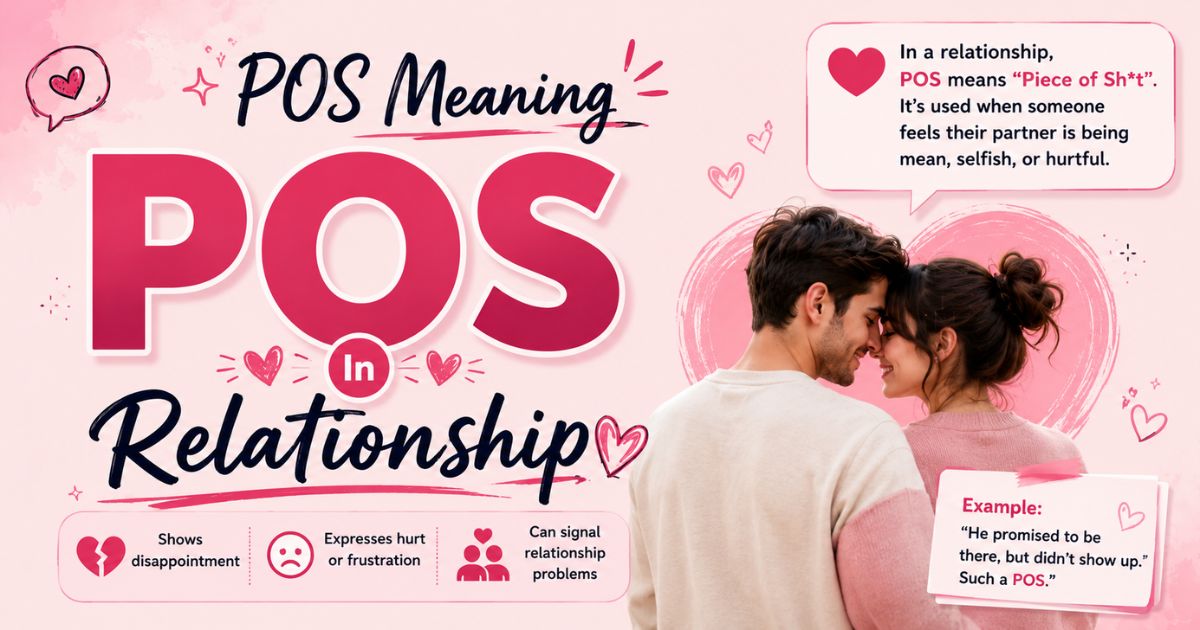
When POS shows up in a relationship context, texts between partners, subtweets, or venting to friends it usually signals real frustration or dissatisfaction with someone’s behavior. It might appear:
- Jokingly, between partners who use blunt humor with each other
- Seriously, after an argument or betrayal
- In a complaint to a friend about how someone is being treated
If POS is being used seriously and repeatedly in a relationship, it’s often a sign of real tension or resentment worth addressing directly rather than brushing off as “just slang.”
Examples of “POS” in Sentences
Seeing POS used in context makes the meaning much easier to pick up:
- “He canceled on me again, what a POS.” (Insult)
- “POS, gtg, talk later.” (Parent Over Shoulder)
- “The store just upgraded their POS system.” (Point of Sale)
- “That validator runs on POS instead of mining.” (Proof of Stake)
- “You did amazing today /pos” (Positive tone indicator)
Variations and Related Slang
POS often appears alongside or gets confused with similar-looking abbreviations:
- POS vs. SOS: Both can function as warning codes in teen texting, though SOS (“Someone Over Shoulder” or the classic distress signal) is more universally recognized.
- P.O.S. Written with periods, still means the same thing, just styled differently.
- PoS Capitalized this way, almost always refers to “Proof of Stake” in crypto discussions.
- Related insults with similar weight include “POS” cousins like “clown,” “loser,” or “trash,” though none are direct synonyms; they’re just used in similar frustrated contexts.
Because internet slang travels fast, POS isn’t limited to American English speakers anymore. Gamers and chat users in the UK, Canada, and Australia use the term the same way it’s used in the United States, and non-native English speakers on platforms like Reddit and Discord have picked it up as part of everyday online vocabulary.
That said, how offensive POS feels can vary by culture. Some communities treat it as a low-stakes complaint, similar to saying “ugh,” while others consider it genuinely harsh profanity that shouldn’t be used lightly, even online. When chatting with people from different backgrounds, it’s worth reading the room before assuming everyone will take the term as casually as you might intend it.
Also Read This Blog : What Does WFH Mean in Slang?
Pos Meaning Discord (Quick Recap)
To recap the platform-specific breakdown: on Discord, expect POS to mean the insult in gaming chats, “Proof of Stake” in crypto and trading servers, and “Point of Sale” in business or marketplace discussions. The server’s theme is usually your best clue.
Is “POS” Safe for Kids?
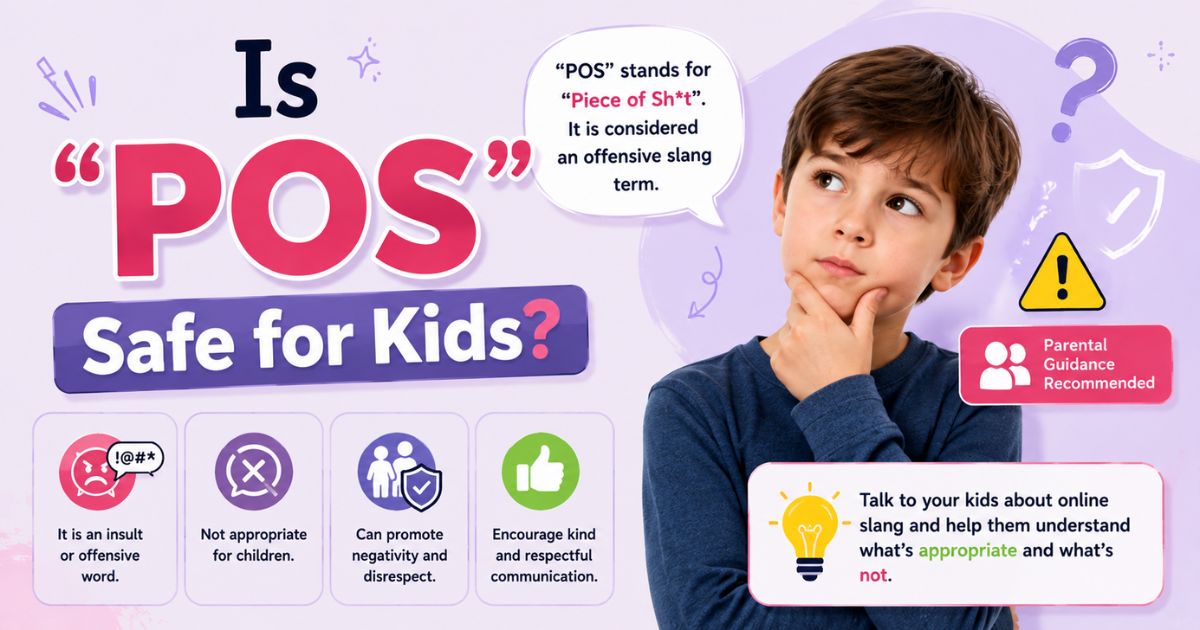
Not entirely. Because the most common slang meaning is a censored swear word, POS isn’t considered appropriate for young children to use, even though it looks harmless written out. A few things worth knowing:
- Kids and teens often use POS as a coded way to insult someone without an adult immediately recognizing the language.
- “Parent Over Shoulder” is the more innocent use, functioning as a warning rather than an insult.
- Parents monitoring a teen’s messages should treat POS as context-dependent; it could be a harmless shorthand or a red flag for cyberbullying, depending on how it’s used.
If a child or teen is using POS to insult someone repeatedly, it’s worth having a conversation about respectful communication, even if the term itself feels mild compared to spelling out the full phrase.
When to Use (and Avoid) “POS”
Use POS when:
- You’re joking casually with close friends who understand your tone
- You’re using it as a tone indicator (/pos) to clarify a sincere, positive message
- You’re referring to a Point of Sale system in a business or retail conversation
- You’re discussing Proof of Stake in a crypto or blockchain context
Avoid POS when:
- You’re talking to someone you don’t know well, since it can come across as genuinely hostile
- You’re in a professional setting where the insult meaning could be misread
- You’re upset and might say something you’ll regret typing it doesn’t make it less harsh
- You’re talking to or around children who might not understand the context
Conclusion
POS is one of those slang terms that changes personality depending on where you find it. On a store receipt, it’s just a payment system.
In a gaming chat, it’s an insult flying at a frustrating teammate. In a group chat with a parent walking by, it’s a heads-up. And with a slash in front of it, /pos becomes a friendly signal that a message is meant sincerely.
The safest approach is simple: read the room before you read into the acronym. Once you know the platform and the tone of the conversation, POS becomes easy to decode every time.