
You get a buzz, glance at your screen, and see “1 new SMS.” Most of us know it’s a text message, but few people stop to ask what those three letters really stand for.
SMS stands for Short Message Service. It is the standard text message sent between mobile phones over a cellular network, with no internet or app required. In this guide, you’ll learn what SMS means in chat and slang, how it works, where it came from, and why it still matters today.
What Does SMS Mean?
SMS is short for Short Message Service. It is the basic text-messaging system built into nearly every mobile phone. When you type a message in your default messaging app and send it to a phone number, you are usually sending an SMS.
The name says it all. The messages are short (originally 160 characters), and they travel as a service run by your mobile carrier.
SMS Meaning in Chat
In a chat, SMS almost always means a regular text message. If someone says, “I’ll SMS you the address,” they simply mean they’ll text it to you. In some regions, such as India, Pakistan, and parts of Europe and Africa, “SMS” is used as a verb and a noun for any text message.
SMS Meaning in Text From a Girl
If a girl texts “SMS” on its own, context matters. Most of the time she means “text me” or “send me a message.” It can also be a playful shorthand for “Send Me Something,” depending on the conversation. When in doubt, read the tone around it, or just ask.
SMS Meaning Slang on Instagram
On Instagram and other social platforms, SMS sometimes appears as slang. The most common version is “Send Me Something,” often used jokingly to ask friends for a snack, a gift, or a favor. Other, less friendly meanings circulate online, so always check the context before replying.
SMS Meaning Messages
On your phone, a “message” labeled SMS is a plain-text message sent through the carrier network. It is different from messages sent through apps such as WhatsApp, Telegram, or iMessage.
How Does SMS Work?
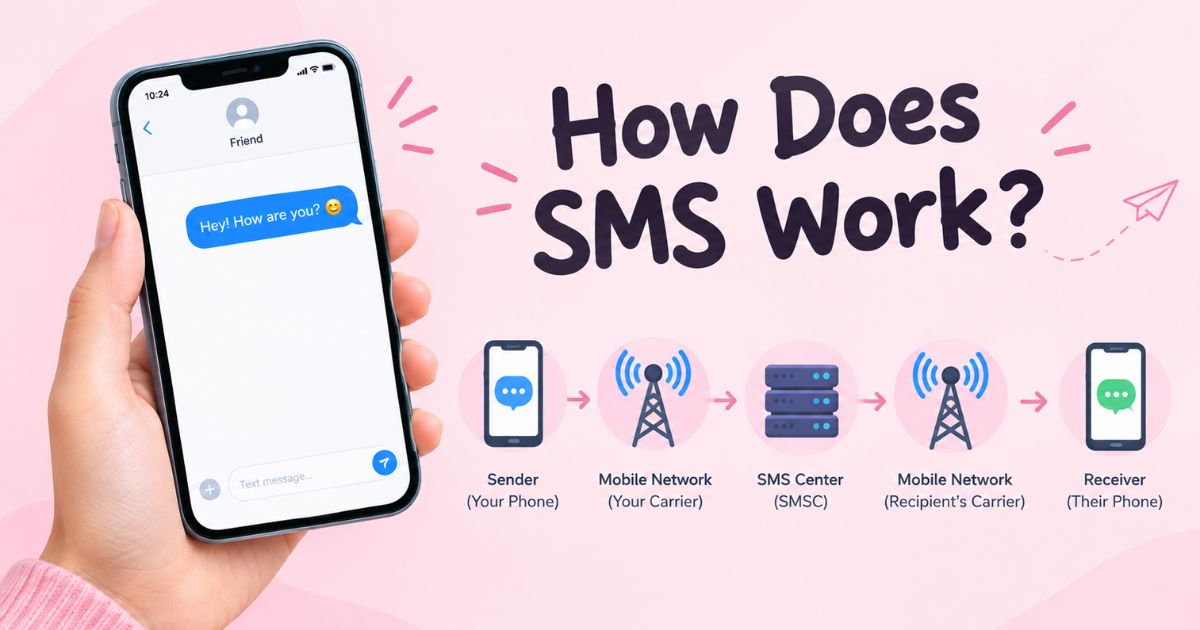
SMS uses the signaling channel of your mobile network, the same channel that handles call setup. That is why texts can go through even when your data connection is weak.
Here is the basic path of a text message:
- You type a message and press send.
- Your phone passes it to the nearest cell tower.
- The tower forwards it to your carrier’s SMS center (SMSC).
- The SMSC stores the message and looks up the recipient’s location.
- The message is delivered to the recipient’s phone, or held until the phone is back online.
Key technical facts:
- Length: A single SMS holds 160 characters in standard GSM-7 encoding. Using emojis or non-Latin scripts drops this to 70 characters.
- Long messages: Longer texts are split into parts and stitched together on arrival.
- Content: Plain text only. Photos, video, and audio need MMS or other services.
When Was SMS Invented?
The idea took shape in the mid-1980s as part of the GSM standard in Europe. Engineers, including Friedhelm Hillebrand, helped define the 160-character limit.
The first SMS was sent on December 3, 1992, when engineer Neil Papworth sent “Merry Christmas” to a Vodafone colleague. It was sent from a computer, since phones then could not yet type texts easily.
| Year | Milestone |
| 1984–85 | SMS concept proposed within GSM standards work |
| 1992 | First SMS sent in the UK |
| 1993 | First phones with SMS support appear |
| Late 1990s | Texting spreads as networks interconnect |
| 2000s | Texting explodes among teens and adults |
| 2010s | Apps like WhatsApp and iMessage compete with SMS |
| 2020s | RCS and business messaging reshape SMS |
Why Did SMS Become So Popular in America?
SMS took off more slowly in the U.S. than in Europe, but it eventually became a daily habit. Several reasons explain the rise:
- Unlimited texting plans made messaging free of per-message worry.
- Cheap and fast: A text felt less intrusive than a call.
- Universal compatibility: It worked on every phone, from flip phones to smartphones.
- Cultural fit: People liked quick, low-pressure communication.
- Business adoption: Banks, stores, and clinics found texts had very high open rates.
Today, most Americans read texts within minutes, which is why companies rely on them so heavily.
What Is the Difference Between SMS and Texting?
“Texting” is the everyday act of sending messages. “SMS” is one specific technology used to do it.
| Feature | SMS | iMessage / WhatsApp (app-based) |
| Needs internet | No, uses cellular network | Yes (data or Wi-Fi) |
| Works on any phone | Yes | Only with the app |
| Message limit | 160 characters per part | Much longer |
| Media sharing | Not natively (needs MMS) | Photos, video, files |
| Encryption | Not end-to-end | Usually end-to-end |
| Cost | Based on carrier plan | Free over internet |
In short, all SMS is texting, but not all texting is SMS.
SMS vs. MMS
MMS (Multimedia Messaging Service) extends SMS to carry images, audio, video, and longer text. If your group chat shows a photo over a green bubble, that is MMS.
What Does SMS Symbolize in Modern Communication?
SMS symbolizes simplicity and reach. It is the one messaging channel that nearly everyone with a phone number can use. No downloads, no accounts, no updates.
That makes it a kind of “common language” for mobile communication, especially when other apps fail or people use different platforms.
What Are the Emotional Associations of SMS?
Texting carries feelings, even in short form. People often link SMS with:
- Connection: A quick “thinking of you” message.
- Anticipation: Waiting for a reply from someone special.
- Anxiety: The stress of unread messages or “left on read.”
- Nostalgia: Remembering old flip phones and T9 typing.
- Urgency: Alerts, delivery updates, and emergency notices.
Because SMS is short, tone is easy to misread. A single period or a delayed response can change how a message feels.
How Is SMS Used Today?
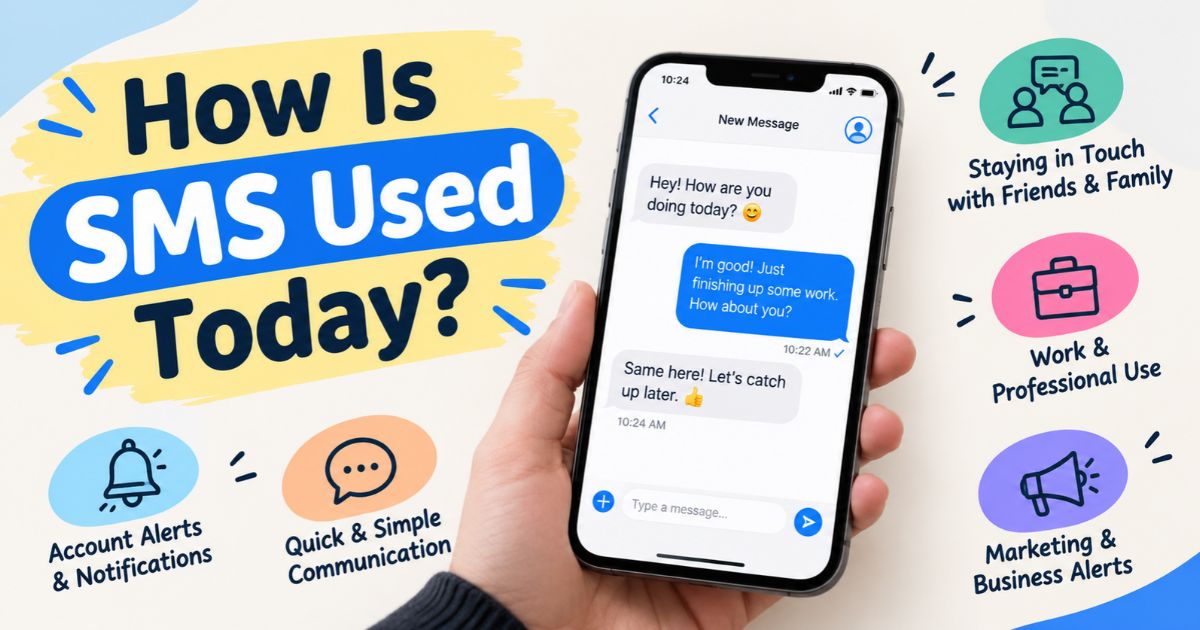
SMS remains active in both personal and professional life:
- Chatting with friends and family
- One-time passcodes (OTPs) and login codes
- Appointment reminders from doctors, salons, and gyms
- Delivery tracking and shipping alerts
- Bank and fraud notifications
- Marketing offers and flash sales
- Emergency and government alerts
Is SMS Still Important on Smartphones?
Yes. Even with WhatsApp, Telegram, and iMessage, SMS stays important because it works without internet, without an app, and across all carriers.
It is the fallback that keeps you reachable when you travel, switch phones, or message someone on a different platform.
What Does SMS Mean on iPhone and Android?
On iPhone
In the Messages app, blue bubbles are iMessages (sent over the internet to other Apple devices). Green bubbles are SMS or MMS texts sent through your carrier. If iMessage is off or the other person doesn’t use an iPhone, your text goes out as SMS.
On Android
Android phones use Google Messages. Standard texts are SMS or MMS, while newer chats may use RCS (Rich Communication Services), which adds typing indicators, read receipts, and better media quality. Apple has also added RCS support in recent iOS versions, which improves iPhone-to-Android chats.
Is SMS Used for Business and Security?
For Business
Companies use SMS for customer alerts, reminders, promotions, and support. Texts are quick to read and need no app, which is why many brands call SMS a high-engagement channel. Businesses must follow rules such as getting customer consent and offering opt-out options.
For Security
Many services send SMS verification codes for two-factor authentication (2FA). It is convenient, but not the safest option. Attacks like SIM swapping and phishing (“smishing”) can target SMS codes. Where possible, use an authenticator app or a passkey instead.
Safety tips:
- Never share a one-time code with anyone.
- Be careful with links in unexpected texts.
- Block and report suspicious numbers.
What Are Common Misunderstandings About SMS?
- “SMS and iMessage are the same.” They are not. iMessage uses the internet; SMS uses the carrier network.
- “SMS is free.” It depends on your plan, and international texts may cost extra.
- “SMS is private and secure.” Standard SMS is not end-to-end encrypted.
- “SMS can’t send pictures.” Pure SMS can’t, but MMS can.
- “SMS means the same thing everywhere.” In slang, meanings can differ by community and context.
How Has SMS Meaning Changed Over Time?
In the 1990s, SMS meant a short, expensive, character-limited note. In the 2000s, it became the heart of youth culture and gave us text-speak like “LOL” and “BRB.” In the 2010s, messaging apps took much of the everyday chat.
Now, SMS is increasingly a utility channel: codes, alerts, reminders, and business updates, with RCS slowly taking over the richer conversations.
Does SMS Have a Spiritual or Cultural Meaning?
SMS has no spiritual meaning in a religious sense. Culturally, though, it has shaped how people talk. It created new abbreviations, changed dating and friendship habits, and even influenced language itself.
Some people see a “perfectly timed text” as a sign or coincidence, but that is personal belief, not a formal meaning of the term.
Also Read This : Touché Meaning
How Does SMS Appear in Modern Culture?
SMS shows up everywhere in pop culture:
- Music and film: Texting scenes and text bubbles on screen are now standard.
- Language: Short forms like “u,” “gr8,” and “idk” came from the texting era.
- Politics and media: Text alerts and campaign messages reach voters directly.
- Memes: “Left on read” and awkward texts are common internet jokes.
Conclusion
SMS, or Short Message Service, is the simple, reliable text-messaging system that changed how the world communicates. It began as a 160-character experiment in 1992 and is now a universal tool for friends, banks, businesses, and emergency services.
Slang meanings like “Send Me Something” may come and go, but the core idea stays the same: a quick message that reaches any phone, anywhere. Whether you use an iPhone or Android, understanding SMS helps you text smarter, stay safer, and know exactly what those three letters mean.


1 thought on “SMS Meaning: What Does SMS Mean in Texting? (Updated 2026) ”