
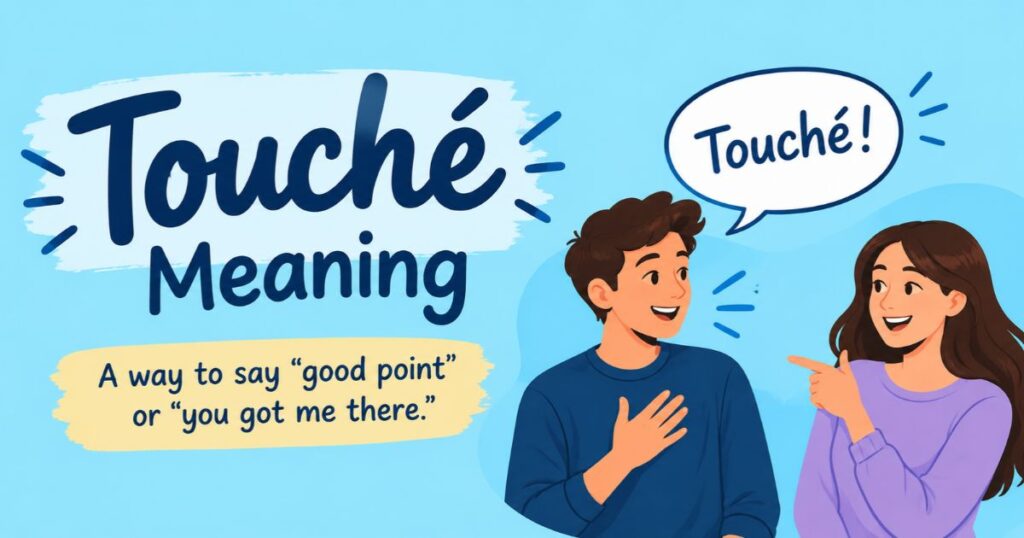
You’re arguing with a friend about pizza toppings. They fire back with one perfect line, and you’ve got nothing. So you smile and say, “Touché.”
That one word says a lot. It admits defeat, gives credit, and keeps things friendly, all in two syllables. But where did it come from, and is it always polite? This guide covers the touché meaning, its fencing roots, how Americans use it today, and the mistakes to avoid.
Quick answer: Touché (pronounced too-SHAY) is what you say when someone makes a sharp, valid point or comeback that you can’t argue with. It means “good one” or “you got me.”
What Is the Meaning of Touché?
Touché is an exclamation used to acknowledge that someone has made a clever, fair, or hard-to-counter point. It is a polite way of saying, “You win that one.”
In everyday American English, it usually works as a short reply, not a full sentence. You say it, and the conversation moves on.
Touché Meaning in English (Simple Definition)
In plain English, touché means:
- “Good point.”
- “You got me there.”
- “Fair enough.”
- “Nice comeback.”
Dictionaries describe it as an acknowledgment of a successful point in an argument, borrowed from fencing.
Touché Meaning in Slang
As slang, touché is looser and more playful. Friends toss it around to tease each other, to admit a joke landed, or to concede a small argument without making it a big deal.
Think of it as a verbal fist bump. It’s less formal than “I stand corrected” and more stylish than “okay, you’re right.”
Where Did Touché Come From?
Touché is a French word, but it came into English through sport.
The Fencing Connection
In French, touché is the past participle of toucher, meaning “to touch” or “to hit.” In fencing, a fencer calls it out to admit that the opponent’s blade has landed a valid hit. It’s an honor-code moment: you admit the point yourself.
The Timeline
| Stage | What Happened |
| Old French | touchier, “to touch, strike” |
| Modern French | toucher becomes touché (“touched”) |
| Early 1900s | English borrows touché as a fencing exclamation (around 1902, per etymology sources) |
| Shortly after | Use spreads outside fencing to admit a fair point (recorded around 1907) |
| Today | Everyday word for conceding a clever remark |
So the jump from sword to conversation happened early. The idea never really changed. A “hit” simply moved from the body to the argument.
How Is Touché Used in America?
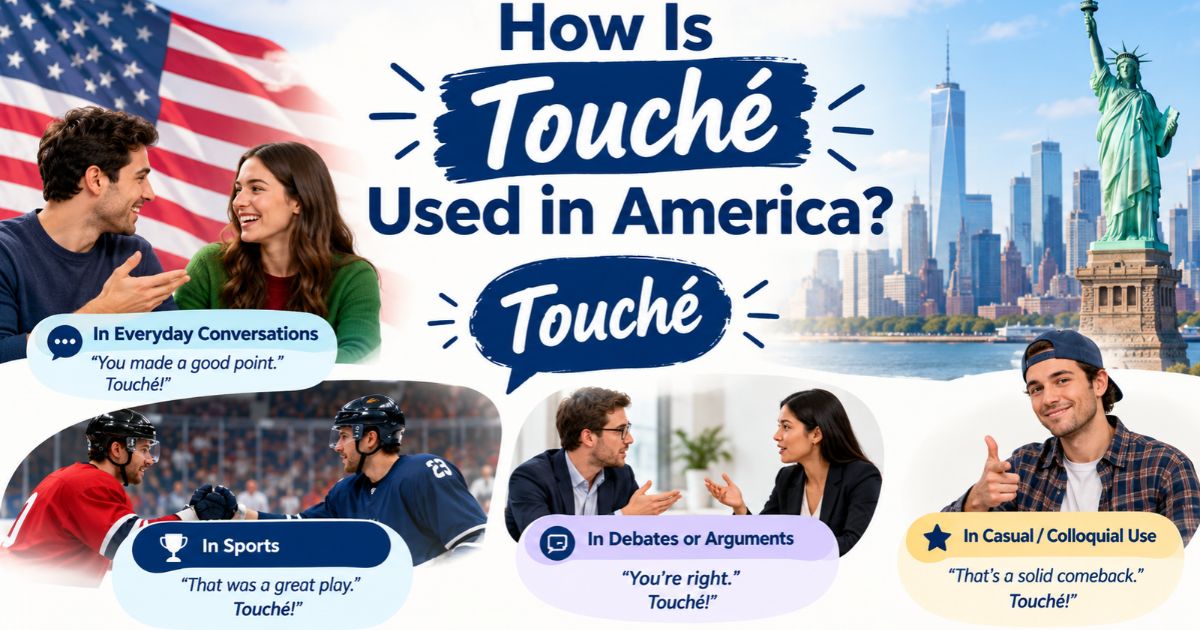
Americans use touché in casual talk, at work, in classrooms, and online. It’s usually lighthearted.
Common Situations
- Friendly debates: “You said you’d diet, and you’re ordering fries.” “Touché.”
- Workplace feedback: A coworker spots a flaw in your plan. You reply, “Touché, I’ll fix that.”
- Family banter: A sibling roasts you with a true fact. “Touché.”
- Dry humor: Used after a witty remark that needs no further response.
Example Sentences
- “I told him to be on time, and he pointed out I’m always late. Touché.”
- “Touché. I didn’t think about the budget.”
- “Okay, touché. That was a good one.”
Pronunciation and Spelling
Say it too-SHAY. The accent mark (é) is correct, but most Americans type “touche” in texts and searches. Both are widely understood.
What Does Touché Mean in a Conversation?
In conversation, touché does three jobs at once:
- Concedes the point without a long speech.
- Compliments the speaker’s wit.
- Defuses tension by turning a disagreement into a light moment.
It works best when the other person’s point is short, clever, and hard to dispute. If someone gives you a long, complicated argument, “touché” can feel too small.
Pro tip: Say it with a smile or a nod. Tone decides whether it sounds gracious or grudging.
What Does Touché Mean Emotionally?
Emotionally, touché sits somewhere between surprise and respect.
- Surprise: “I didn’t see that coming.”
- Respect: “That was smart.”
- Humility: “I can’t argue with that.”
- Playfulness: “Nice hit, but this isn’t over.”
It can also carry a hint of mild embarrassment, especially when the point you’re conceding exposes your own mistake. That’s why it feels so human. You’re being corrected, and you’re handling it with style.
Also Read This : NTM Mean in Text
What Does Touché Mean in Texting and Social Media?
Online, touché is short, fast, and flexible.
Typical Uses
- A one-word reply to a witty comment.
- A reaction to a meme or joke that made a fair point.
- A way to end a back-and-forth without escalating it.
Examples
| Message | Reply | Tone |
| “You said you’d sleep early 😏” | “touché” | Playful |
| “That’s not what the data shows.” | “Touché. Let me recheck.” | Sincere |
| “Cool story.” | “Touché.” | Sarcastic or dry |
In texting, lowercase “touche” without the accent is normal. Adding “lol” or an emoji keeps it friendly.
Why Do People Say Touché After a Comeback?
People say touché after a comeback for a few reasons:
- It’s gracious. Admitting a good point makes you look confident, not weak.
- It keeps the peace. The exchange ends on a light note.
- It signals fairness. Like in fencing, you’re acknowledging a clean hit.
- It’s stylish. Compared with “you got me,” it sounds a bit more polished.
There is also a social reward. People who concede well often come across as more likable and secure than people who dig in.
What Does Touché Mean in French?
In French, touché literally means “touched” or “hit.” It’s the past participle of toucher.
Outside fencing, French speakers can use it for being physically touched, and it also appears in a few other contexts, such as the “touché” of a keyboard key (touche, no accent, means a key or button). That’s a different word form in everyday French, so don’t mix the two up.
The “good point” sense is far more common in English than in French, where people usually pick other expressions to concede an argument.
| Language | Meaning |
| French (fencing) | A valid hit has been scored |
| French (general) | “Touched” (past participle) |
| American English | “Good point” or “you got me” |
Touché Meaning on Reddit
On Reddit, touché shows up in comment threads where one user lands a sharp reply or a fair correction. A common pattern: someone posts a counterpoint, and the original poster replies “Touché” to show the debate went their opponent’s way.
You’ll also see it used sarcastically, especially in heated threads, where it can imply “okay, technically correct, but I’m not impressed.” Context and surrounding tone matter. If the thread is friendly, it’s a compliment. If it’s tense, read it carefully.
Is Touché a Compliment or an Insult?
Mostly a compliment. It credits the other person for a clever or accurate point.
But tone can flip it. Said with an eye-roll or a flat voice, it can sound dismissive.
| Situation | Likely Meaning |
| Said warmly, with a smile | Genuine praise |
| Said quickly in a friendly debate | Light concession |
| Said flatly after criticism | Reluctant or sarcastic |
| Said to end an argument abruptly | “I’m done with this” |
If you want to be sure you sound sincere, add a short follow-up: “Touché, that’s a fair point.”
Touché in Popular Culture and Modern Identity
Touché has a long run in books, films, TV comedies, and late-night banter. Writers love it because it signals a witty exchange in just one word.
It also says something about personal style. People who use it tend to be seen as:
- Quick-witted
- Good-humored
- Comfortable admitting they’re wrong
- A little theatrical, in a fun way
In the age of memes and group chats, touché has become a shorthand for “nice try, and you got me.” It travels well because it’s short and has a built-in sense of drama.
Common Misunderstandings About Touché
Even a simple word gets misused. Watch out for these:
- Using it for any agreement. Touché isn’t just “yes.” It fits when someone has scored a clever or surprising point.
- Saying it after a long lecture. It works best after a short, sharp remark.
- Treating it as always sarcastic. Most of the time it is sincere.
- Misspelling it as “tushay” or “to shay.” The correct spelling is touché (or touche in casual typing).
- Using it in serious or sensitive moments. A grave criticism or an emotional conversation usually calls for something more direct, like “You’re right, I’m sorry.”
How Has the Meaning of Touché Changed Over Time?
The core idea has stayed the same: acknowledging a hit. What changed is the target.
- Early 1900s: A physical hit in fencing.
- Soon after: A well-aimed verbal point.
- Late 20th century: A casual, witty reply in everyday speech and TV dialogue.
- Today: A text, tweet, or comment reply, sometimes sincere and sometimes ironic.
The word has also become more flexible in tone. It used to be mostly polite. Now it can be affectionate, teasing, or dry. That range is why it has lasted.
Related Words and Alternatives
If you want a different way to say it:
| Instead of Touché | Tone |
| “Fair point.” | Neutral |
| “You got me.” | Casual |
| “Good one.” | Friendly |
| “Point taken.” | Formal |
| “I’ll give you that.” | Slightly reluctant |
| “Well played.” | Playful |
Conclusion
The touché meaning is simple, but its charm is in how it’s used. It started on the fencing strip as an honest admission of a hit, and it’s now an everyday American way to say, “Good one, you got me.”
Use it when someone lands a smart, fair point. Say it with a friendly tone, keep it short, and skip it in serious moments. Do that, and a single French word can make you sound sharp, humble, and good company all at once.
Next time someone gets the better of you in a debate, try it. You might be surprised how much goodwill one word can earn.


1 thought on “Touché Meaning: What Does It Mean in America? Updated 2026”